
Abstract:
NVIDIA has adjusted some hardware specifications of the next-generation Vera Rubin artificial intelligence computing platform, including HBM4 high-bandwidth memory bandwidth and NVLink high-speed interconnect bandwidth. Compared with previously announced or circulated indicators, the new specifications have declined, but the horizontal expansion network bandwidth has increased. This change may mean that Nvidia is rebalancing chip performance, supply capabilities and system costs based on actual mass production.
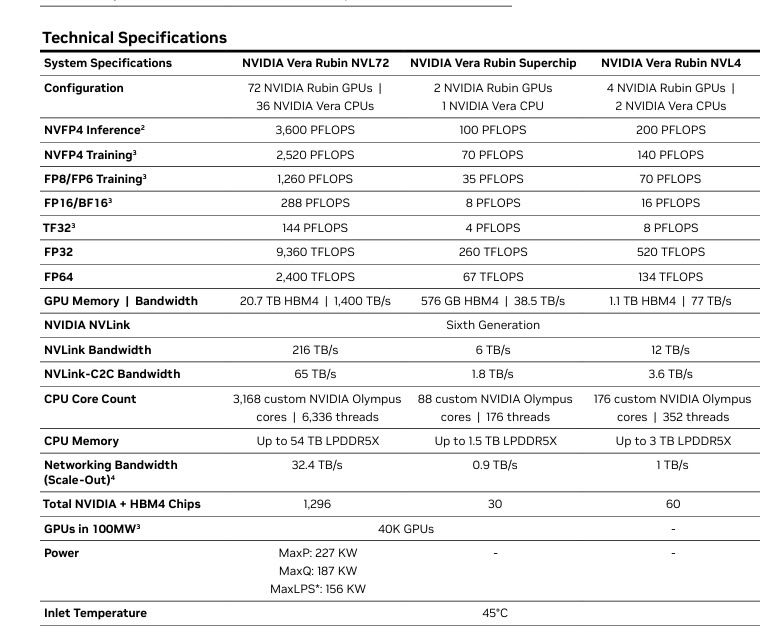
According to the Vera Rubin platform specifications currently announced by NVIDIA, the Rubin GPU is equipped with 288GB HBM4 memory and a memory bandwidth of 19.2TB/s. Previously, NVIDIA's technical data had given a maximum memory bandwidth indicator of 22TB/s. Compared with the two, the currently announced value is about 12.7% lower. It’s important to note that Nvidia previously used a “maximum attainable” metric, so this reflects changes in spec numbers and does not necessarily mean that all products have experienced an equal drop in actual performance.
HBM4 is a new generation of high-bandwidth memory technology that uses a wider memory interface to provide higher data throughput capabilities for artificial intelligence model training and inference. As the size of the model continues to expand, the GPU not only requires stronger computing power, but also must continuously obtain a large amount of model parameters and intermediate data. If the memory bandwidth is insufficient, even if the computing unit has a high theoretical computing power, it may not be able to fully exert its performance due to waiting for data.
The high memory bandwidth previously pursued by the Rubin platform has also brought higher technical requirements to the HBM4 supply chain. Video memory manufacturers need to meet power consumption, thermal dissipation, signal integrity and long-term reliability requirements at higher data transfer rates. The higher the bandwidth specification, the greater the challenges typically faced by the design verification and volume production processes.
If NVIDIA lowers its memory bandwidth requirements, the range of HBM4 chips that meet product standards may expand, and suppliers will also have the opportunity to increase the output proportion of qualified products. This does not mean that video memory manufacturers must redesign the entire set of products, but it may allow some products that cannot reach the previous highest performance targets but still meet new requirements to enter the supply system, thus improving overall supply capabilities.
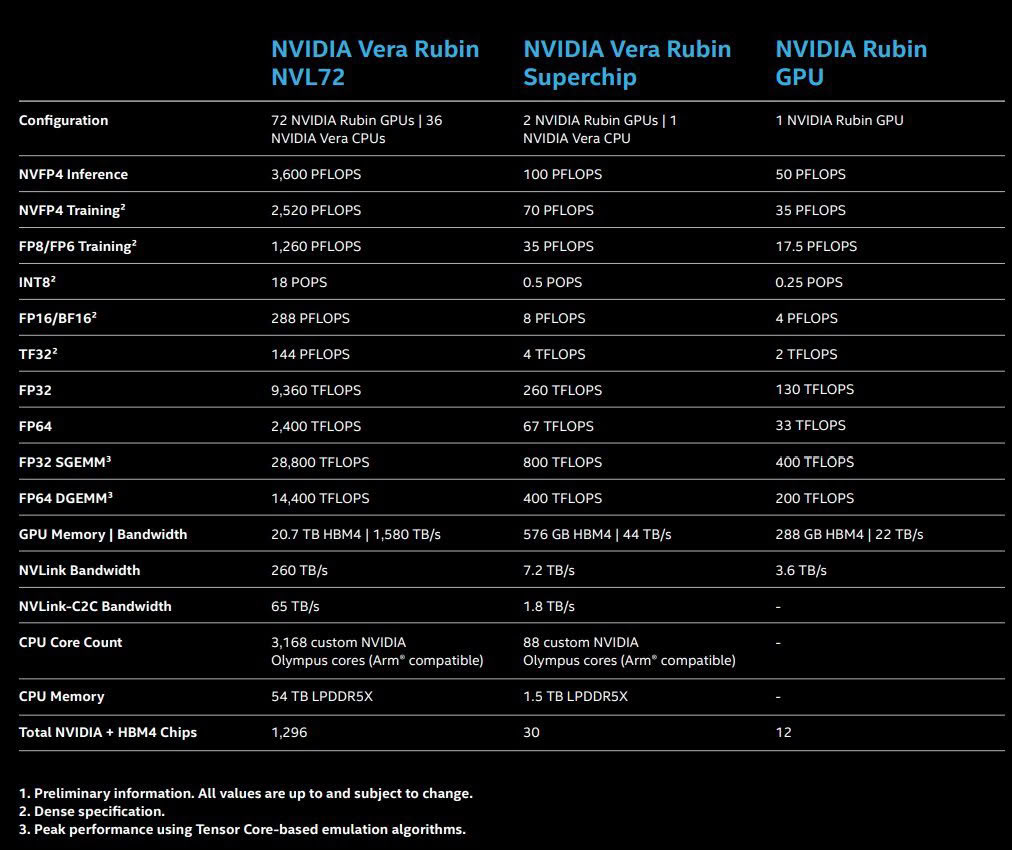
In addition to memory bandwidth, Nvidia has also adjusted the NVLink interconnect specification of the Vera Rubin super chip. According to current product information, the NVLink bandwidth of the Vera Rubin super chip has been adjusted from the previous 7.2TB/s to 6TB/s, a decrease of approximately 16.7%. NVLink is NVIDIA's interconnect technology for high-speed communication between GPUs. It plays an important role in data exchange, model parallel training and complex artificial intelligence inference tasks in multi-GPU systems.
In large artificial intelligence clusters, gradients, activation values, and other intermediate data need to be frequently exchanged between GPUs. Communication between different computing units is especially important for large models with expert hybrid architectures. Therefore, reducing the NVLink bandwidth indicator may affect the performance of some communication-intensive tasks, but the final impact still depends on the model architecture, software scheduling method, and actual load. The overall computing power loss cannot be simply calculated based on the bandwidth reduction ratio.
At the same time, Nvidia has increased bandwidth metrics for some scale-out networks. Existing data shows that the horizontal expansion network bandwidth of the Vera Rubin super chip has increased from the previous 0.8TB/s to 0.9TB/s. This type of network is mainly used to connect different computing nodes, allowing data centers to organize a large number of GPUs into a unified computing cluster. Increasing network bandwidth can help improve data transfer capabilities between nodes, especially when computing tasks need to be completed collaboratively across servers.
This adjustment of one down and one up reflects the trade-off relationship in the design of artificial intelligence computing platforms: communication capabilities within the GPU and within the cabinet are important, but as the cluster scale expands, cross-node communication may also become a factor limiting overall performance. Nvidia may be reallocating the performance budget in system designs based on actual application needs.
However, the specification change itself does not prove that Nvidia has confirmed that there is a shortage of video memory, nor can it alone prove that lowering the indicator is to increase production. Relevant explanations still need to be judged based on the supplier's mass production progress, product certification status, and subsequent information disclosed by Nvidia.
For the HBM4 supply chain, specification adjustments may change the focus of competition among suppliers. Previously, manufacturers needed to strive for higher data transmission speeds; if Nvidia reduces the bandwidth requirements for mass production products, competition may become more focused on yield, supply scale, power consumption, stability and cost. Suppliers that can deliver qualified products at scale may gain more opportunities as a result.
From the perspective of the entire platform, Vera Rubin does not solely rely on memory bandwidth to determine performance. GPU computing power, video memory capacity, chip-to-chip interconnection, network architecture, and software optimization jointly determine system performance. Nvidia’s officially announced Vera Rubin NVL72 cabinet configuration contains 72 Rubin GPUs and connects multiple GPUs through sixth-generation NVLink to support large-scale artificial intelligence training and inference tasks.
Therefore, even if some hardware indicators are lower than early targets, Vera Rubin may still achieve higher performance through computing architecture, video memory capacity and system-level optimization. What really deserves attention is whether Nvidia can expand shipments as planned after adjusting specifications, and whether the actual model training and inference performance meets customer expectations.
Comments