
Abstract:
On October 9, the latest high-end IT display panel shipments and technology report released by Counterpoint Research shows that the shipments of the high-end notebook computer display market (covering OLED and MiniLED) are expected to increase by 11% year-on-year in 2026, while the overall notebook computer display market is expected to decrease by 3% year-on-year due to rising storage costs and rising machine bill of materials costs.
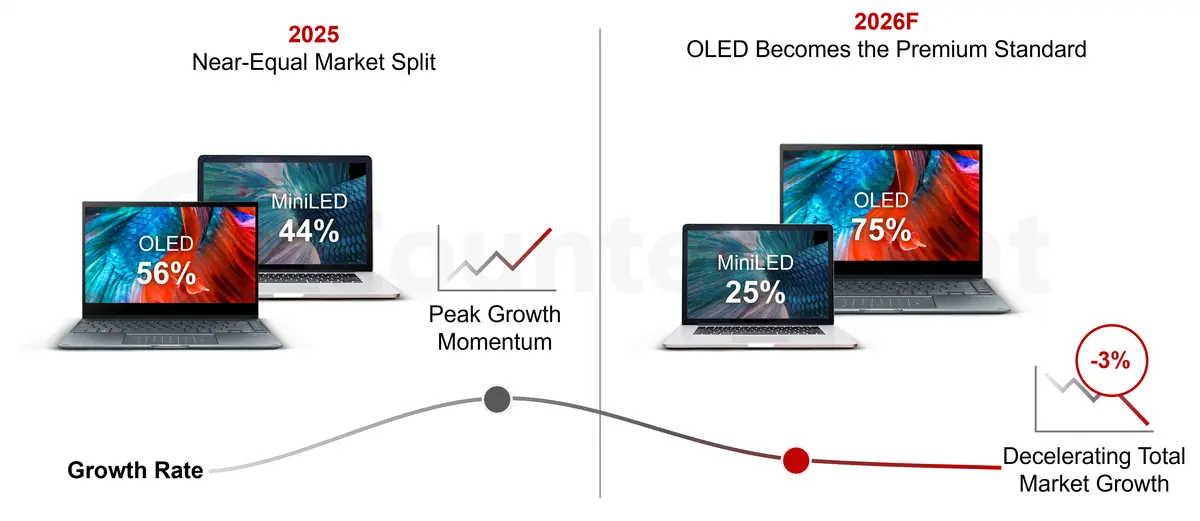
The report predicts that OLED laptop display panel shipments will increase by 50% year-on-year in 2026, and further increase by 24% in 2027, mainly driven by Apple's next generation MacBook Pro is expected to adopt OLED panels and the growth in demand for high-end AI PCs. At the same time, MiniLED laptop display panel shipments are expected to decline by 38% year-on-year in 2026 and 60% in 2027, and manufacturers are gradually leaning towards OLED technology.
At the technical level, the Tandem OLED architecture can improve brightness, energy efficiency and panel life; Visionox Intelligent Pixelation Technology (ViP) and LG Display's FLiPP technology are expected to improve material utilization and production yields; the commercial application of phosphorescent blue OLED light-emitting materials can reduce power consumption; the expansion of the 8.7th generation oxide backplane production scale will help reduce manufacturing costs.
Counterpoint Research predicts that from 2024 to 2030, the compound annual growth rate of OLED laptop panel shipments and revenue will reach 26% and 35% respectively. The revenue growth rate is higher than the shipment growth rate, indicating that the average value of a single panel is expected to increase. David Naranjo, deputy director of the agency, said that the growth of the OLED laptop market will increasingly rely on panel performance and manufacturing process advancements to transform products into products that are both attractive and price-competitive. Apple expects the demand for OLED and high-end AI PCs to accelerate the recent transformation, while improvements in energy efficiency, panel life and production scale will provide support for widespread adoption before 2030.
Comments