
Abstract:
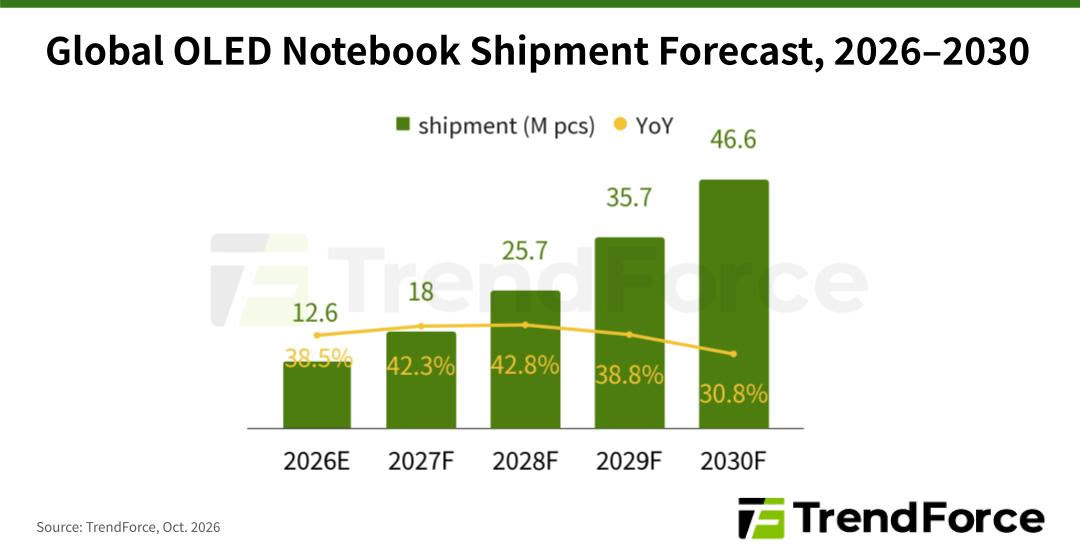
According to the latest forecast from market research firm TrendForce, despite the overall growth pressure on the global laptop market, the OLED laptop market will still maintain strong growth momentum. It is expected that global OLED laptop shipments will increase by nearly 40% year-on-year in 2026, and further increase by more than 40% in 2027. Apple's launch of MacBook Pro using new OLED display technology is considered to be an important factor in promoting the development of the industry, and it will also prompt display panel manufacturers to accelerate related technology research and development and production capacity layout.
Apple's new MacBook Pro is equipped with a display called PROLED XDR, becoming the first model in the MacBook product line to use a tandem OLED touch screen. This change marks an important turning point in Apple's laptop display technology and is also expected to accelerate the high-end laptop market's transition to OLED technology. TrendForce predicts that shipments of this new phone will reach 1.2 million to 1.5 million units in 2027.
However, there is still some uncertainty about the market performance of the new MacBook Pro. The starting price of the 14-inch model is as high as US$2,899. In addition, the new product will initially be sold in parallel with the existing Mini-LED version, which may limit consumers' demand for replacement in the short term. Nonetheless, this product update further strengthens Apple's positioning in the high-end market and reflects its strategy of trying to expand market coverage through product layout in different price ranges.
Before Apple entered this market, the global OLED laptop market was mainly driven by brands using Windows systems such as Lenovo, HP and Asus. In recent years, these manufacturers have gradually introduced OLED displays into product series at different price points, so that the technology is no longer limited to a few high-end models. Apple's participation is expected to further increase the market's attention to OLED laptops, prompt more brands to prioritize OLED solutions in future product planning, and enhance consumer acceptance of this display technology.
OLED technology has certain advantages in picture performance, body design and display performance. Compared with traditional LCD displays, OLED can achieve higher contrast, deeper black performance, and faster pixel response speed, while helping to create thinner and lighter laptops. However, panel manufacturing costs, production yields, and the brightness and service life requirements of different products are still important factors affecting its further popularity.
TrendForce pointed out that although the global laptop market as a whole is expected to shrink for two consecutive years, OLED laptop shipments are expected to buck the trend and grow. Apple's product transformation will not only increase the demand for OLED panels, but also promote the entire industry chain to accelerate technological upgrading, especially R&D investment in high resolution, low power consumption and high brightness.
In terms of supply chain, Samsung Display is currently the exclusive OLED panel supplier for this new MacBook Pro. The company has designated the first phase of the A6 project, a sixth-generation and above large-size OLED production line located in Asan Park, South Korea, as a dedicated production facility for Apple.
This MacBook Pro is of great strategic significance to Samsung Display because it is the first product on the company's G8.6 generation fine metal mask (FMM) OLED production line to enter the mass production stage. Apple's choice of Samsung Display to supply panels for its first high-end OLED laptop not only reflects Samsung's strength in advanced display technology, but also further consolidates its competitive position in the high-end OLED panel market.
The new MacBook Pro uses a tandem OLED structure with a pixel density of 254 pixels per inch, which places very high requirements on panel manufacturing. By stacking multiple light-emitting layers, tandem OLED is expected to achieve a better balance between brightness, energy efficiency and panel life. However, the manufacturing process is also more complex, which puts forward higher requirements for material cost, production yield and process control.
At present, other panel manufacturers are also carrying out qualification certification work for related products, but Apple's strict technical specifications, coupled with Samsung Display's established supply advantages, make competitors face high barriers to entry into this supply chain. Therefore, manufacturers such as LG Display, BOE and TCL CSOT are focusing more on securing panel orders for future OLED versions of MacBook Air. The product is expected to be launched in 2029.
As Apple gradually expands the application of OLED in its notebook product line, competition among display panel suppliers is expected to further intensify. In the future, manufacturers that can strike a balance between production costs, manufacturing yields, display performance and large-scale supply capabilities will have a better chance of obtaining orders from major laptop brands. Although it is still difficult for OLED to completely replace LCD screens in the short term, as production capacity expands and technology continues to mature, its penetration rate in the notebook computer market is expected to further increase.
Comments