
Abstract:
OpenAI recently launched two new models in the GPT-6 series, GPT-6 Sol and GPT-6 Luna, and positioned them as a new generation of cutting-edge models. The two models focus on improving programming, reasoning, tool calling, and complex task execution capabilities. At the same time, the pricing has been reduced, allowing developers to use stronger models at a lower cost.

GPT-6 Sol is mainly targeted at tasks that require a higher level of intelligence and are more sensitive to response speed and cost. OpenAI said that compared with the previous generation of similar models, Sol has made significant progress in coding capabilities and is more stable when handling complex software engineering tasks, analyzing code, and executing multi-step workflows.
Luna further emphasizes difficult reasoning and complex task processing capabilities. It is targeted at application scenarios that require longer reasoning processes and stronger problem-solving capabilities, including complex programming, research analysis, and multi-step automation tasks. OpenAI stated that Luna's performance has improved in multiple internal tests, while operating costs have been reduced through optimizations in model architecture and inference efficiency.
One important change with this release is pricing. OpenAI did not increase the cost of using the GPT-6 series in the past simple way of "the stronger the model, the higher the price". Instead, it improved the performance while reducing the price of some APIs. The company hopes to use this to expand the practical scope of use of high-performance models, allowing developers to hand over more complex tasks to AI without having to worry too much about inference costs.
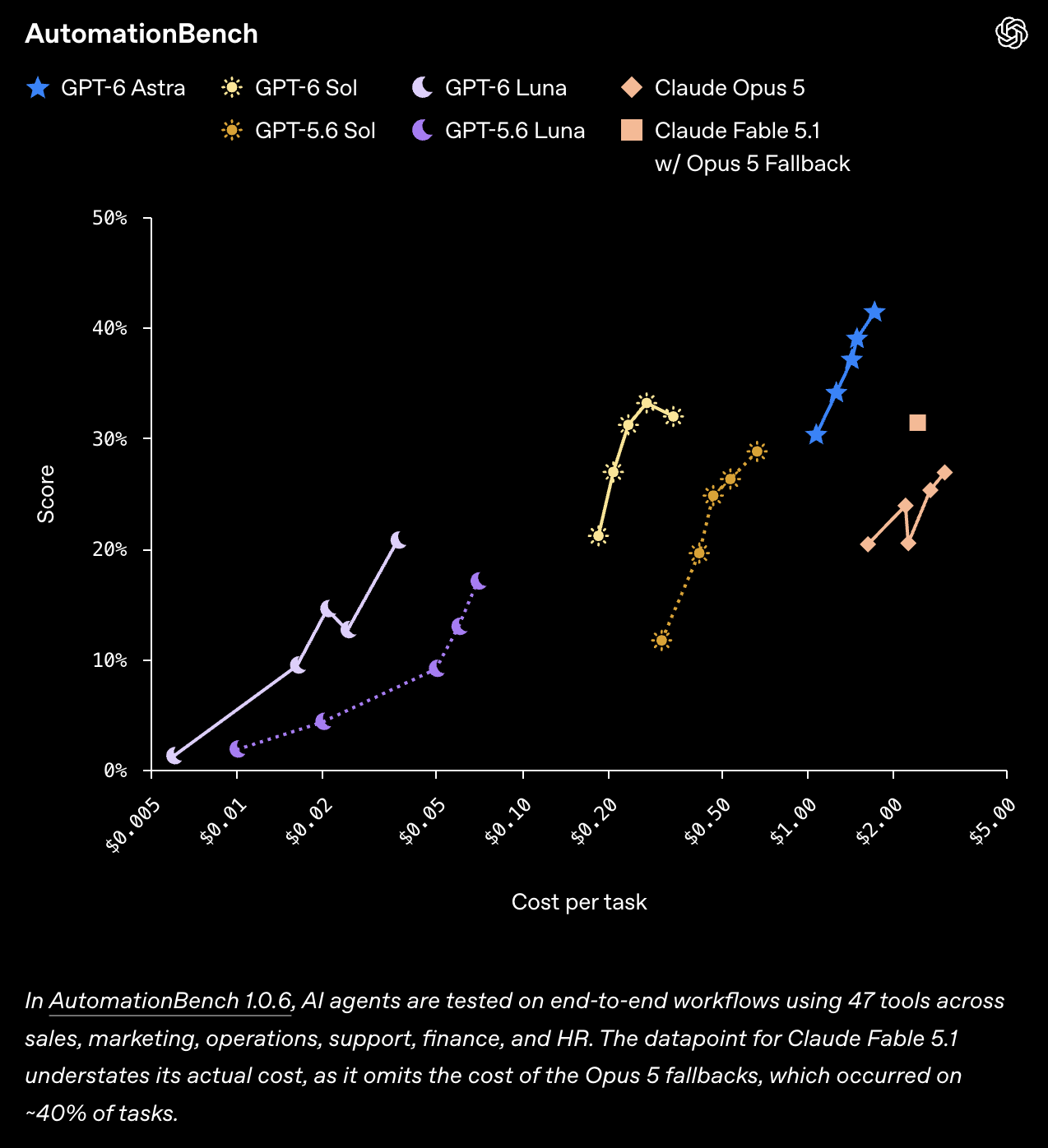
GPT-6 Sol and Luna both support more advanced tool calling capabilities and can work with external software, databases and other services. This means that they are not just used for traditional question answering and text generation, but can be used as core models for AI agents, responsible for planning tasks, calling tools, checking results, and continuing with subsequent steps.
In the field of programming, the two models particularly emphasize support for the complete software engineering process. Compared to simply generating a piece of code, GPT-6 can handle larger code bases, understand the relationships between multiple files, and modify existing code according to task requirements. For software projects that require debugging, refactoring, and testing, this capability can reduce the number of times developers have to repeatedly explain context to the model.
OpenAI has also improved the model's ability to handle long-term, multi-step tasks. In the past, AI models were prone to deviating from the original goals during execution when faced with complex tasks, or errors accumulated after continuous calls to tools. GPT-6 Sol and Luna attempt to reduce such problems through better mission planning and state management.
Luna is especially suitable for jobs that require strong reasoning skills. For complex mathematical problems, code analysis, research tasks, and problems that require the synthesis of large amounts of information, models can devote more computing resources to analysis before generating the final results.
Sol focuses more on the balance between performance and cost. For a large number of API calls, real-time applications, and services that need to return results quickly, Sol can provide lower unit call costs while maintaining a high level of intelligence, so it is more suitable for large-scale deployment.
OpenAI has also adjusted the product positioning of the GPT-6 series this time. The company wants to have different models take on different types of work, rather than having developers call on the highest-spec model regardless of the size of the task. Simple, fast tasks can use lower-cost models, while tasks that require complex reasoning and long-term autonomous execution can be handed over to Luna.
This strategy is also consistent with the recent development trend of the AI industry. As AI models gradually transform from chatbots to AI agents that can complete their work autonomously, the number of model calls is increasing significantly. If every tool call and inference uses the most expensive flagship model, running costs can escalate quickly. Therefore, improving model efficiency and reducing prices have become important directions for competition among AI manufacturers.
OpenAI’s emphasis on “stronger but cheaper” this time is actually responding to the concerns of enterprise customers and developers about the cost of AI. In the past few years, the capabilities of generative AI models have rapidly improved, but enterprises still need to consider the cost of inference when deploying them on a large scale. Especially for high-frequency applications such as customer service, code development, data analysis, and automated agents, even if the price of a single call decreases by only a small amount, the cumulative cost savings may be significant.
In addition to the API, GPT-6 Sol and Luna will also gradually enter OpenAI's own product system. Different products and subscription levels may have different model access rights, and which model to use depends on the complexity of the task, speed requirements and the service level the user is using.
OpenAI’s release of GPT-6 Sol and Luna also means that the GPT-6 series has begun to form a more clear product echelon. Sol is responsible for providing better speed and cost performance at a higher level of intelligence, while Luna is responsible for complex tasks that require stronger reasoning capabilities. The two are not simply related to performance, but are differentiated for different application scenarios.
As AI model capabilities continue to improve, OpenAI is gradually shifting its competitive focus from pure model parameter scale to actual task completion capabilities. For developers, whether a model can understand complex requirements, continuously perform tasks, correctly call tools, and finally deliver usable results is more important than pure benchmark test results.
The upgrades of GPT-6 Sol and Luna in coding, reasoning and agent capabilities also show that OpenAI is further promoting the transformation of AI from "answering questions" to "completing work". In the future, users may only need to describe the final goal, while the model is responsible for breaking down the task, writing code, calling tools, checking the results, and continuously revising it.
At the same time, falling prices may also further expand the application scope of AI agents. When the cost of running models is reduced, some automated tasks that could not be deployed on a large scale because of high computational costs in the past will be more likely to be run by AI for a long time.
In general, GPT-6 Sol and GPT-6 Luna are not simple conventional iterations, but two cutting-edge models with different positioning launched by OpenAI for the next stage of AI application. Sol emphasizes higher efficiency and lower cost, while Luna further strengthens complex reasoning and difficult task processing capabilities. OpenAI hopes that through these two models, developers can obtain higher-level AI capabilities at a lower cost and further promote the development of AI agents and automation software.
Comments