
Abstract:
OpenAI has not released an internal AI model that is said to have solved the Navier-Stokes equation problem, and the relevant results have been verified by machines. The report also stated that the company used about 10,000 concurrent autonomous agents to complete reasoning and formal verification, but this result has not yet been officially recognized by the Clay Mathematics Institute as a solved answer to the Millennium Prize problem.
The company said it has used machine verification methods to provide a solution to the Navier-Stokes equation, but there is still a review process by the mathematical community before it can officially win the award.
OpenAI said that this internal model has achieved breakthroughs in many long-standing problems in mathematics and theoretical computer science; in previous attempts, it had formalized the argument into a Lean proof with an API quota of approximately US$2,000, so that it could be verified by the theorem proving system. The Millennium Prize problem was announced by the Clay Mathematics Institute in 2000, with a prize of US$1 million per problem. The Navier-Stokes problem studies the equations of fluid motion and is widely used in fields such as aircraft design, weather forecasting and blood flow modeling.
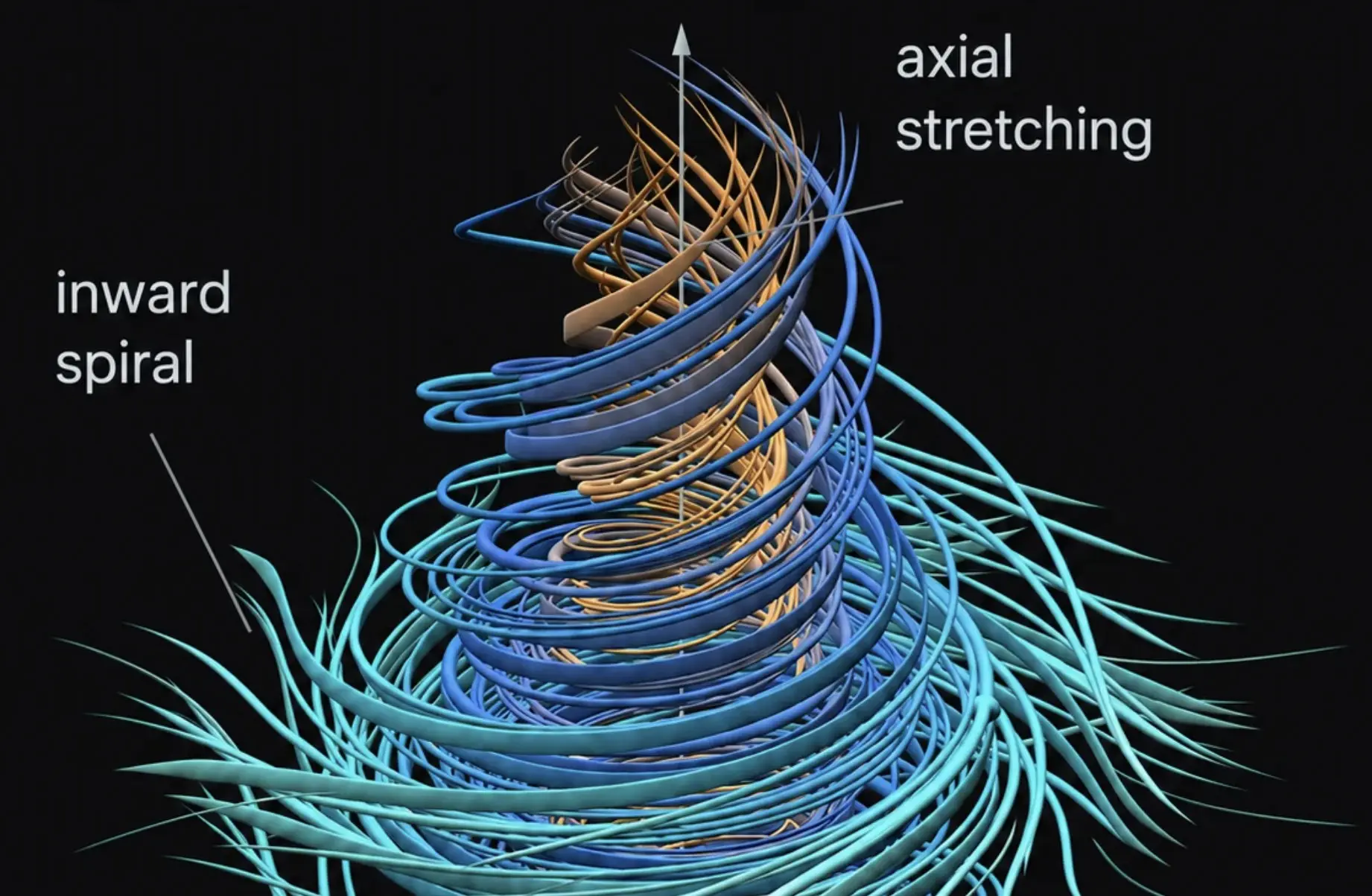
The proof given by OpenAI this time is 165 pages long. The core idea is to construct a three-dimensional incompressible fluid: it is stationary at first, and then is acted upon by a smooth external force. The speed of the vortex continues to increase during the inward entrainment and stretching process, and finally becomes unbounded in a limited time, while the total kinetic energy remains limited. The article points out that this corresponds to conditions C and D in the official formulation of the Millennium Prize problem, which is to complete the problem by proving that the smooth solution breaks down under certain conditions.
OpenAI also said that in order to advance this work, the company ran multiple Millennium Prize problems in parallel; on the Navier-Stokes problem, about 10,000 agents worked together and found the result after about 88 hours, and then GPT-6 Astra spent an additional 17 hours to help complete the formalization and verification. During the entire process, these agents exchanged a total of approximately 4.9 million messages and generated 300 billion output tokens, of which the Navier-Stokes problem itself accounted for 2.7 million messages and approximately 130 billion output tokens.
However, the Clay Mathematics Institute currently lists the Navier-Stokes problem as an unsolved Millennium Prize problem. According to its rules, candidate solutions must first be published in a qualified journal, remain publicly available for at least two years, and gain general recognition from the global mathematics community before the institute will consider awarding the award. OpenAI stated that it has no intention of receiving the US$1 million bonus. The release is mainly to demonstrate the speed of progress of its cutting-edge AI system.
Comments