
Abstract:
Researchers at New York University’s Tandon School of Engineering recently launched a bionic robotic fish called ScaFi. Not only is its shape and movement similar to that of real fish, it can also be enlarged or reduced as needed to adapt to water environments of different depths and scales.
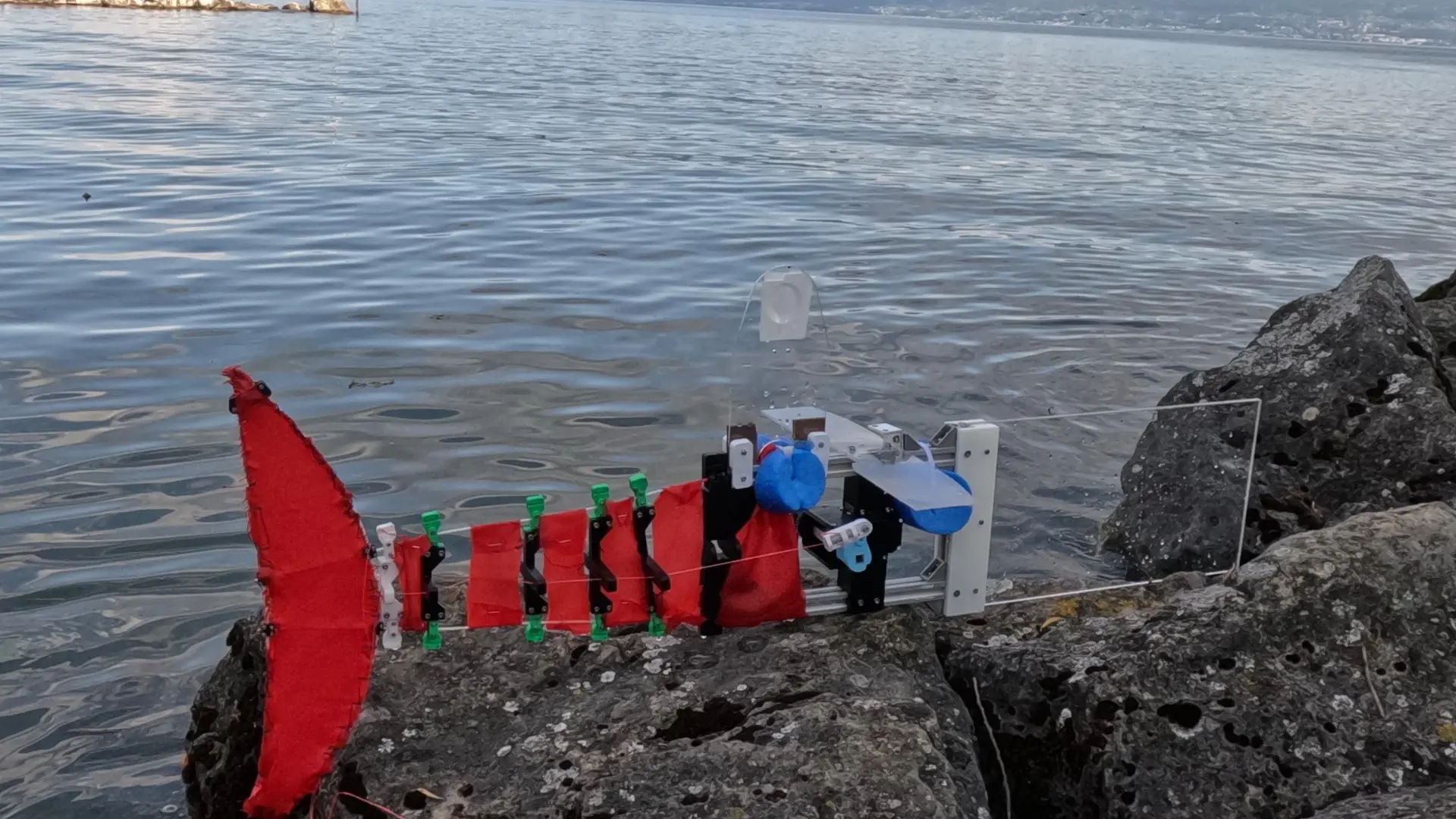
The core idea of this design is to avoid the propeller propulsion method commonly used by traditional underwater robots and instead use "body bending" to move forward. The research team believes that although propellers are common in underwater missions, they can easily get entangled in water plants, stir up sediment, and scare away research subjects, which is not conducive to observing coral reefs, water quality, and aquatic animals.
ScaFi's structure is divided into two parts: the front part is where the motors and electronic components are concentrated, and the rear part is a flexible tail made of fiberglass rods and fabric. There is only one motor inside the robot. By pulling two cables that cross near the end of the tail, the tail is bent into an S shape, which then swings left and right, pushing the whole machine forward quietly.
More importantly, this propulsion mechanism has good scalability. The researchers said that no matter whether the robot is made larger or smaller, the motor and cross-cable mechanism at the front end can remain the same. The only thing that really needs to be adjusted is the diameter of the tail rod, so there is no need to redo the entire machine from scratch every time.
To test this idea, the team built ScaFi in three different sizes, with lengths of 0.6 meters, 1.1 meters and 2.9 meters. They were then taken to real waters for testing: the smallest version swam in a creek at a depth of 15 to 30 centimeters, the medium version was tested in a stream in Switzerland, and the largest version entered Lake Geneva for exploration.
Test results show that all three robots can swim smoothly, but size changes will also affect their performance. Among them, the small version is more flexible and its swimming posture is closer to that of real fish; the large version has reduced maneuverability and lower energy efficiency, but while requiring stronger power, it also shows better stability in the water flow.
The researchers pointed out that overall, this swimming method can still maintain a very good performance after amplification, and the three robots can continue to swim even after the GPS signal is interrupted. The team believes that this scalable idea can not only be used for underwater detection robots in the future, but may also be extended to other types of robot systems. The next step is to focus on maintaining the same energy efficiency in versions of different sizes.
Comments