
Abstract:
Informed sources revealed that the Pentagon is in preliminary negotiations with General Motors and other manufacturing companies, hoping to use them to achieve mass production of military drones. The Pentagon is negotiating with General Motors and other manufacturing companies to mass-produce drones. This is the latest move by the US military: mobilizing the huge assembly lines in the automobile industry to increase the production of key ammunition and military equipment.
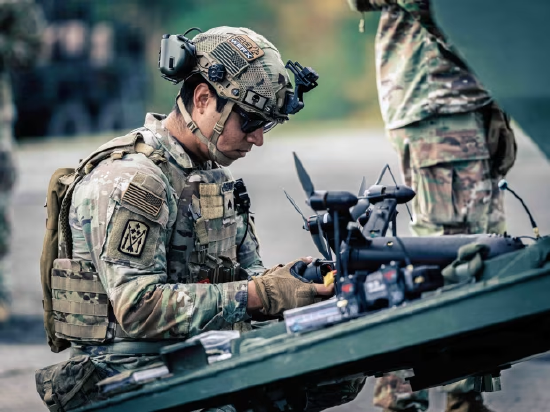
Earlier this month, a U.S. Army soldier operated anti-drone interception equipment in Poland.
In the past few months, senior officials of the U.S. Department of Defense have been wooing automakers to use their mature supply chains to expand production capacity of equipment ranging from missiles to tactical trucks. Now, the military is looking to car companies to help alleviate the shortage of unmanned systems, including reconnaissance drones and attack drones, which have played a key role in global conflicts.
Informed sources said that if cooperation is reached, automobile companies will supply parts to drone manufacturers. One option: General Motors is evaluating whether to produce a drone engine that would be closer in size to a riding lawn mower than a car engine. Defense Department officials have met with Ford Motor Co. and Magna International, a large Canadian parts company, and have also contacted some manufacturing companies outside the automotive industry.
No agreement has been finalized yet, and those involved said negotiations are still in the preliminary stages. Trump administration officials have so far received mixed feedback from auto executives, sources involved in the negotiations said.
The Pentagon expects that the demand for drones will grow significantly in the next few years, but senior officials of the Department of Defense realize that many domestic drone companies in the United States are small in scale, lack manufacturing experience and production capacity, and cannot meet large-scale production requirements.
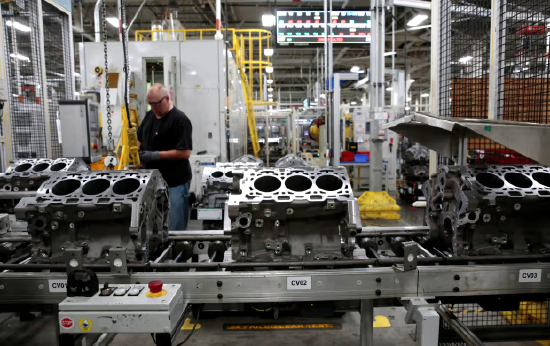
An assembly line at a General Motors plant in Romulus, Michigan, 2019.
The United States has just begun to promote the return of some drone production capacity to its home country. To meet military specifications, the production process of U.S. drone manufacturers is not only slow, but also costly. For more than a decade, China has dominated the global drone industry, with the main or even sole source of supply of many parts coming from China.
But for leading American car companies and their suppliers, joining the US military supply chain is full of risks. Represented by the large number of small expendable drones used on the battlefield in Ukraine, drones are a low-margin business, and car companies are likely to suffer losses.
Car companies are worried that the military business does not match their core business; they are also concerned about the brand reputation risks caused by being tied to weapons production. The demand for orders from the Ministry of National Defense fluctuates greatly, and there is uncertainty in the approval of congressional appropriations every year.
Ford, in particular, has deliberately avoided the weapons manufacturing business and only supplies the Pentagon with vehicles and equipment that are highly related to its own civilian product line.
After the midterm elections, the political risks of signing such agreements with the government have increased, and the Democratic Party has stepped up scrutiny of contracts signed by the Pentagon, as well as the military and private companies.
In order to resolve the concerns of enterprises, the Ministry of National Defense has handed over the coordination of this drone production project to a special command newly established by Defense Minister Hegseth this fall. The command aims to unify the research, development and production of drones across the services. The official thinking is: only larger contracts will have the opportunity to achieve profitability based on volume.
Car companies will be mainly responsible for supplying actuators, engines, sensors, lidar and other components.
Max Strahizer, a senior petty officer of the U.S. Navy SEALs who was assigned to lead the drone project, said: "We must integrate procurement forces and release clear demand signals so that partner companies are willing to follow up. To attract companies to participate, the contract amount must be high enough to allow the factory to complete the conversion of the production line."
The Pentagon estimates that the military drone market could reach $20-30 billion annually. People familiar with the matter said that the Ministry of National Defense is preparing to provide large amounts of funds to auto companies.
Strathizer said frankly that the research and development process of military drones is cumbersome, complex and costly, which has discouraged many companies. For example, the Ministry of Defense once launched six different projects at the same time to develop the same suicide attack drone. The goal of each project is exactly the same: to create a device that can hover in the sky, search for and wait for targets.
Although the goals are basically the same, the technical specifications proposed by each project team are different, which greatly increases the difficulty of research and development.
According to people familiar with the matter, General Motors is the most interested in participating in military projects at the invitation of senior officials of the Ministry of National Defense. General Motors said in a statement that the company has been committed to helping strengthen the U.S. defense industrial base.
The Detroit automaker signed an agreement earlier this year to produce casing components for Lockheed Martin's Patriot air defense missiles, and is also negotiating similar cooperation with Raytheon Technologies and L3 Harris.
Some small and medium-sized auto parts companies also see opportunities in the military industry. Lacks Enterprises, a family-owned parts company in Michigan, entered the drone track in April this year by taking a stake in a military contractor. Company representatives said the company has communicated with about 30 drone manufacturers and has begun producing related parts.
A former senior Defense Department official revealed that Washington is considering allowing car companies to participate in the manufacturing of the Lucas drone; the model is for the Pentagon to master the design and outsource production to companies with mature assembly lines.
Comments