
Abstract:
South Korean memory chip giant SK Hynix announced its third quarter financial report for 2026. Driven by the continued explosion in demand for artificial intelligence, the company achieved its best quarterly performance in history. The financial report shows that SK Hynix’s third-quarter revenue reached 104.6 trillion won, breaking the 100 trillion won mark in a single quarter for the first time.
In terms of profitability, the company's operating profit reached 83.3 trillion won and net profit was 39.8 trillion won, corresponding to an operating profit margin of approximately 80% and a net profit margin of approximately 38%, showing a very high level of profitability.

As of the end of the third quarter, SK Hynix held 114.5 trillion won in cash and cash equivalents, an increase of 26.5 trillion won from the previous quarter. At the same time, the company's borrowings fell to 15.8 trillion won, a decrease of 2.8 trillion won from the previous quarter, and the net cash scale increased to 98.7 trillion won, further improving its financial situation.
In terms of product business, sales of high-bandwidth memory HBM4 for artificial intelligence servers continue to expand. SK hynix predicts that HBM4 will surpass HBM3E in terms of shipments and revenue contribution in the next quarter and become the company's main product.
In addition to HBM products, server DDR5 memory sales have also achieved significant growth. At the same time, the demand for LPDDR5 SOCAMM memory for AI servers continues to rise. The company's new M15X wafer fab is expected to reach full capacity by the end of this year, with a monthly production capacity of approximately 55,000 to 60,000 1b process DRAM wafers. In addition, the proportion of next-generation 1c DRAM technology used in LPDDR6 products is also steadily increasing.
In terms of NAND flash memory business, SK Hynix said that sales of 321-layer TLC flash memory chips in the embedded SSD market are growing rapidly. The company expects that by the end of this year, 321-layer products will account for more than half of its local NAND production capacity in South Korea.
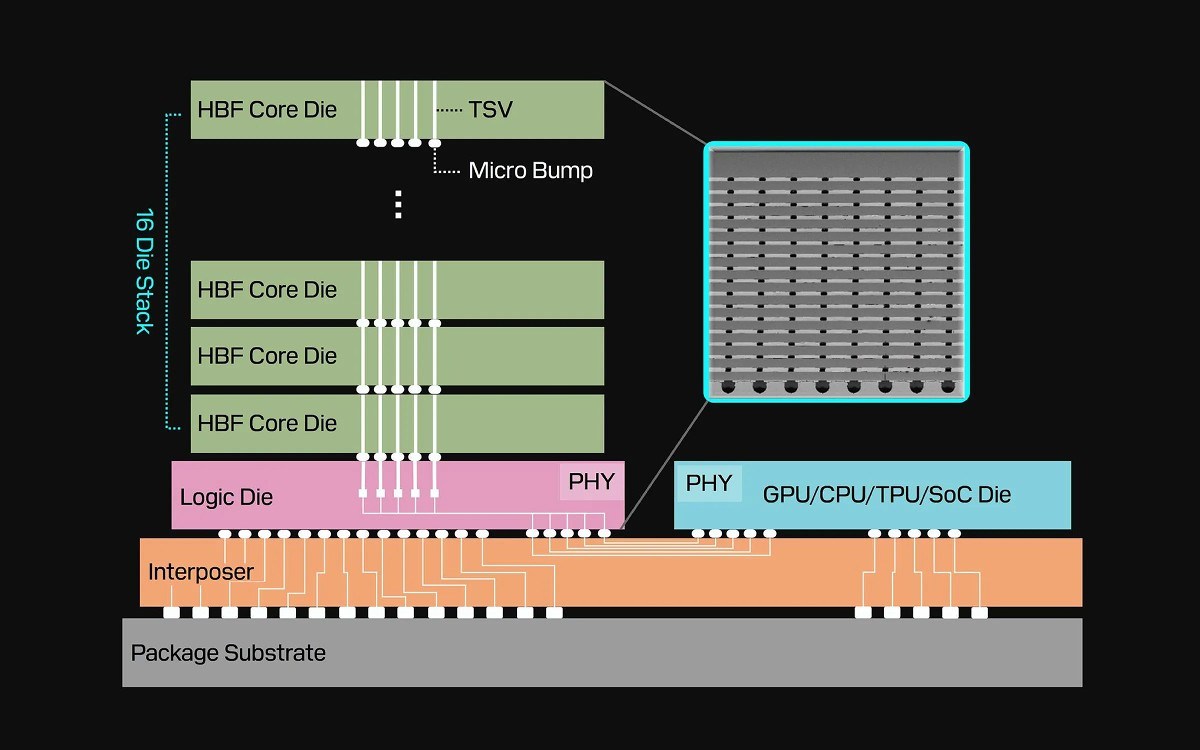
At the same time, the company is also developing a new storage solution HBF (High Bandwidth Flash) specifically for AI servers. This technology is similar in concept to HBM, but it is mainly responsible for long-term data storage tasks rather than traditional memory functions. It can help artificial intelligence models quickly call large-scale data sets that cannot be fully loaded into RAM, thereby alleviating memory capacity constraints.
It is worth noting that SK Hynix warned in its financial report that the global memory supply shortage is expected to continue until 2030. Although the company plans to accelerate the expansion of production capacity, the investment in new manufacturing capacity will take time, and it will still be difficult to fully meet market demand in the short term.
The company believes that the main driving force for demand growth in the next few years will come from enterprise-level AI and personal AI applications. As technology further matures, artificial intelligence applications in autonomous driving and robotics will also become an important source of demand in the medium to long term, continuing to drive up demand for advanced storage products.
According to a report released by Counterpoint Research in September this year, SK Hynix is currently the world's second largest DRAM manufacturer in terms of revenue, accounting for approximately 25% of the market share. Samsung Electronics ranked first with a 38% share, and Micron Technology ranked third with a 24% share. These three companies all supply LPDDR and NAND storage products to Apple and many smartphone manufacturers.
In addition, SK Hynix CEO Kwak Noh-Jung also responded to the decision of its subsidiary Solidigm to withdraw its initial public offering (IPO) plan. He said that the original purpose of promoting the IPO was to raise external funds to expand the scale of Solidigm's production facilities, thereby reducing the group's own investment burden and improving shareholder returns. However, after a comprehensive assessment of the recent financial market environment and other factors, the company believes that it is difficult to achieve the expected goals by promoting listing at this stage, so it decided to terminate the relevant review procedures.
Comments