
Abstract:
Although HomeView, the smart home hub just launched by Apple, is equipped with the A18 chip and supports the new generation of Siri based on Apple Intelligence, it cannot run all artificial intelligence functions completely independently. According to the product description published by Apple, if users want to query personal information, retrieve text messages and calendar content through HomeView, or perform cross-application operations based on personal information, they still need to be equipped with an iPhone or iPad that supports Apple Intelligence and has a new generation of Siri enabled.
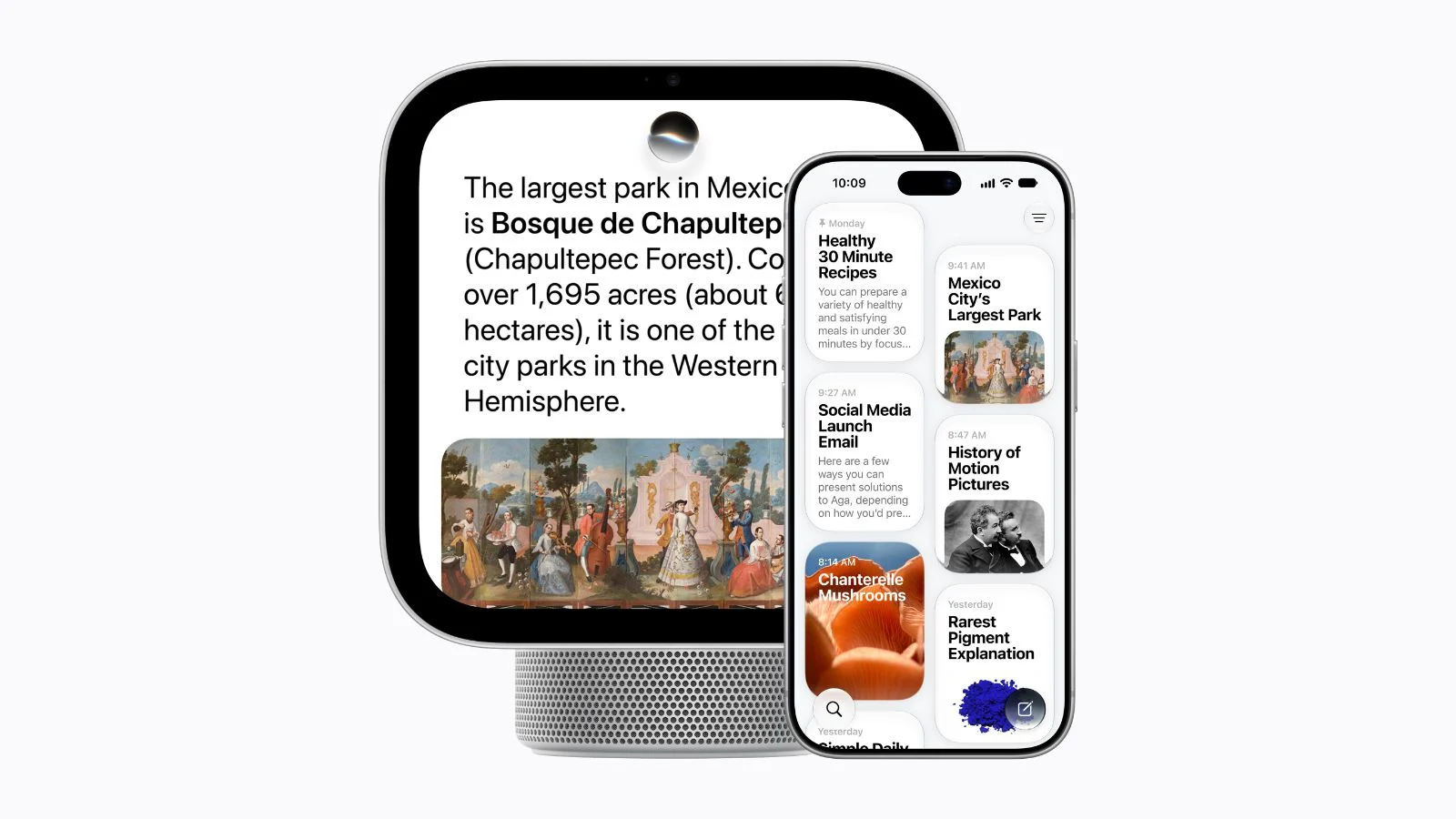
This design means that although HomeView has an independent screen, processor and voice interaction capabilities, Apple has not fully integrated all personal information processing functions into this smart home device. For users who are already deeply involved in the Apple ecosystem, this arrangement may not pose a big obstacle; but for users without a compatible iPhone or iPad, some of HomeView’s core features will be unavailable.
Apple has been trying to improve Siri’s interactive experience through artificial intelligence. The new generation of Siri not only hopes to answer general questions, but also plans to understand the user's personal background and perform more complex tasks based on information from different applications. HomeView is an important part of this strategy. Apple hopes to allow users to obtain information or control smart home devices through natural language without picking up their mobile phones in home scenes such as the kitchen and living room.
For example, users can ask a friend which song was recommended in a text message, ask Siri to find a schedule in the calendar, or complete follow-up actions based on messages and schedule information. Compared with traditional voice assistants that can only execute simple commands, this type of function requires the system to understand personal information and establish connections between different applications.
However, HomeView's personal information functionality is not completely independent. Apple clarifies that Siri requests involving personal context require pairing an iPhone or iPad that supports Apple Intelligence, and the device must be running the latest software version, enable the next generation of Siri, and use a supported language.
This means that even if a user purchases HomeView, they cannot obtain complete personal information retrieval capabilities with this device alone. It still needs to rely on the user's existing Apple mobile device to access the corresponding personal contextual information.
According to instructions published by Apple, these restrictions mainly involve extracting relevant content from applications such as Messages and Calendar, and using personal information to perform operations across applications. Ordinary smart home control, display information and other basic functions should not be confused with these AI capabilities that require personal context.
In this way, Apple hopes to make the boundary between family shared devices and personal information clearer. HomeView can be placed in a space shared by family members, but text messages, calendars, and other private content shouldn't automatically be available to everyone. By tying access to personal information to a specific user's identity and device, Apple attempts to strike a balance between convenience and privacy protection.
Facial recognition is an important part of this mechanism. HomeView can recognize different family members and display corresponding personalized interfaces based on the recognition results. But simply identifying a person does not mean that the device has unconditional access to all of their personal information. Apple also requires that the paired iPhone or iPad be in a corresponding usable state to further confirm user identity and access eligibility.
Specifically, HomeView will display the corresponding personal content only when the system recognizes the registered user and the paired device meets the connection and unlocking conditions specified by Apple. This design reduces the risk of family members accidentally seeing each other's private information.
However, this also increases limitations during use. Users who might otherwise want to leave their home without their phone at all and do everything from a HomeView on the wall or a desktop device still need to rely on another device when the request involves private messages or calendar information.
From the perspective of product positioning, HomeView is not only a home sharing device, but also attempts to provide an experience similar to a personal smart assistant. The former emphasizes that all family members can use the same screen to control devices, check the weather, or play music; the latter requires access to a specific user's personal information and provides more targeted answers based on their context. Apple currently chooses to assist in the latter through an iPhone or iPad, rather than letting HomeView take on the entire task independently.
This design is also related to Apple’s long-term emphasis on privacy policy. Personal information often involves communication records, schedules and other sensitive content, and Apple needs to ensure that this information is not inappropriately displayed or used because smart home devices are placed in public spaces.
But from a consumer perspective, relying on paired devices also exposes a limitation of HomeView: What users buy is not a completely independent AI home terminal, but a device that is tightly bound to Apple's existing ecosystem. Part of its capabilities depends on whether the user has the right iPhone or iPad, and whether those devices meet software and language requirements.
This also makes the competition between HomeView and smart display devices such as Amazon Echo Show and Google Nest Hub more complicated. Apple hopes to form a differentiated advantage through personal information integration and privacy protection, but at the same time, users must also accept more stringent device compatibility requirements.
In addition, Apple does not promise that all Siri artificial intelligence functions will be available on HomeView without restrictions. Some features are still in beta, and availability depends on software version, supported language, and region. Server-side functions may also have daily usage limits. Whether paid extended access will be provided in the future still needs to be subject to subsequent information released by Apple.
It’s worth noting that HomeView’s regional availability is also limited. Apple stated at the time of release that HomeView will not be sold in the EU market for the time being because the new generation of Siri is not currently available on iOS and iPadOS in the EU. Apple said it is communicating with the EU and hopes to find a solution, but it has not announced a clear timetable for the launch.
This restriction is particularly important for European consumers. Even if the user has an iPhone or iPad that meets the hardware requirements, it does not mean that all the artificial intelligence functions of HomeView can be used locally. Apple needs to first solve the regional availability problem of related software functions before it can further expand product sales.
Overall, HomeView shows the direction in which Apple hopes to introduce artificial intelligence into home scenarios: integrating home devices with personal information through touch screens, voice interaction, facial recognition and smart home control. But it also shows that Apple is still exploring how to safely provide personalized AI services on shared devices.
For consumers, the appeal of HomeView not only depends on the screen, processor and smart home control functions, but also on whether it can truly exert the value of a personal information assistant without adding too many operating steps. At least for now, users still need an iPhone or iPad that meets the requirements to take full advantage of its personal contextual AI capabilities. This dependence may become an important test for whether Apple's Intelligence home strategy can attract a wider range of users.
Comments