
Abstract:
The SpaceX giant Starship rocket entered orbit for the first time on Monday morning, achieving an important milestone for the project. Previously, one of the rocket's engines failed during its ascent, causing uncertainty as to whether the mission could continue. The Starship lifted off from SpaceX's Starbase launch base in South Texas at 7:49 a.m. local time, beginning a test flight that could last nearly 10 hours. The rocket carried 26 upgraded Starlink satellites and successfully deployed them into orbit to join the existing space Internet satellite network.
SpaceX spokesman Dan Huot said: "From what we know so far, every satellite that has been deployed is in good condition. The whole process is very smooth."
As of 10:22 a.m. New York time, SpaceX's stock price gave up gains and fell slightly.
During the launch of the Starship, one of the six Raptor engines stalled prematurely, and SpaceX engineers temporarily suspended attempts to put the rocket into orbit. However, after reviewing the relevant data, the team decided to continue the mission and ignited one of the Starship's Raptor engines, ultimately launching the vehicle into orbit for the first time.
Monday was the 14th test flight of Starship, which is of great significance to SpaceX. All previous Starship space launch missions deliberately did not enter orbit to ensure maximum safety. Now, U.S. regulators have given SpaceX the go-ahead to take the next step, trusting the company to safely accelerate the starship to orbital speed and return the vehicle to Earth in a controlled manner.
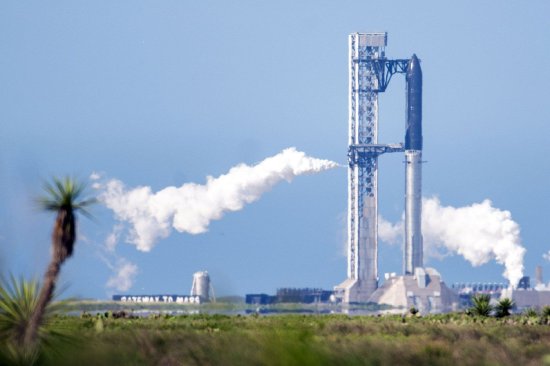
On May 21, SpaceX Starship V3 was parked on the launch pad at the Starbase launch base in Boca Chica Beach, Texas.
If successful, the flight could pave the way for more orbital flights in the future. This launch will also officially add SpaceX’s first batch of upgraded Starlink satellites V3 to its current in-orbit network of more than 11,000 satellites. SpaceX also deployed V3 Starlink satellites in a previous launch, but those satellites eventually burned up in the Earth's atmosphere as planned.
SpaceX Chief Financial Officer Bret Johnsen called the mission a "revenue-generating flight" for the company because these V3 satellites have reached mass production standards and will be formally integrated into the overall network. SpaceX CEO Elon Musk has also emphasized that V3 satellites will significantly increase the overall capacity of Starlink.
“We do expect that V3 satellites will drive rapid growth in Starlink communications revenue,” he said during SpaceX’s first earnings call in August. He said that the capability of the V3 satellite is "more than 10 times that of the V2 satellite, and our number of launches will also reach 10 times."
Comments