
Abstract:
Steam hardware survey data released by Valve in September 2026 shows that the memory configuration of PC players is undergoing a landmark change: 32GB memory accounted for more than 16GB for the first time, officially becoming the most common system memory capacity on the Steam platform. This also means that after years of popularity, 16GB memory has begun to give way to the mainstream configuration of PC games.
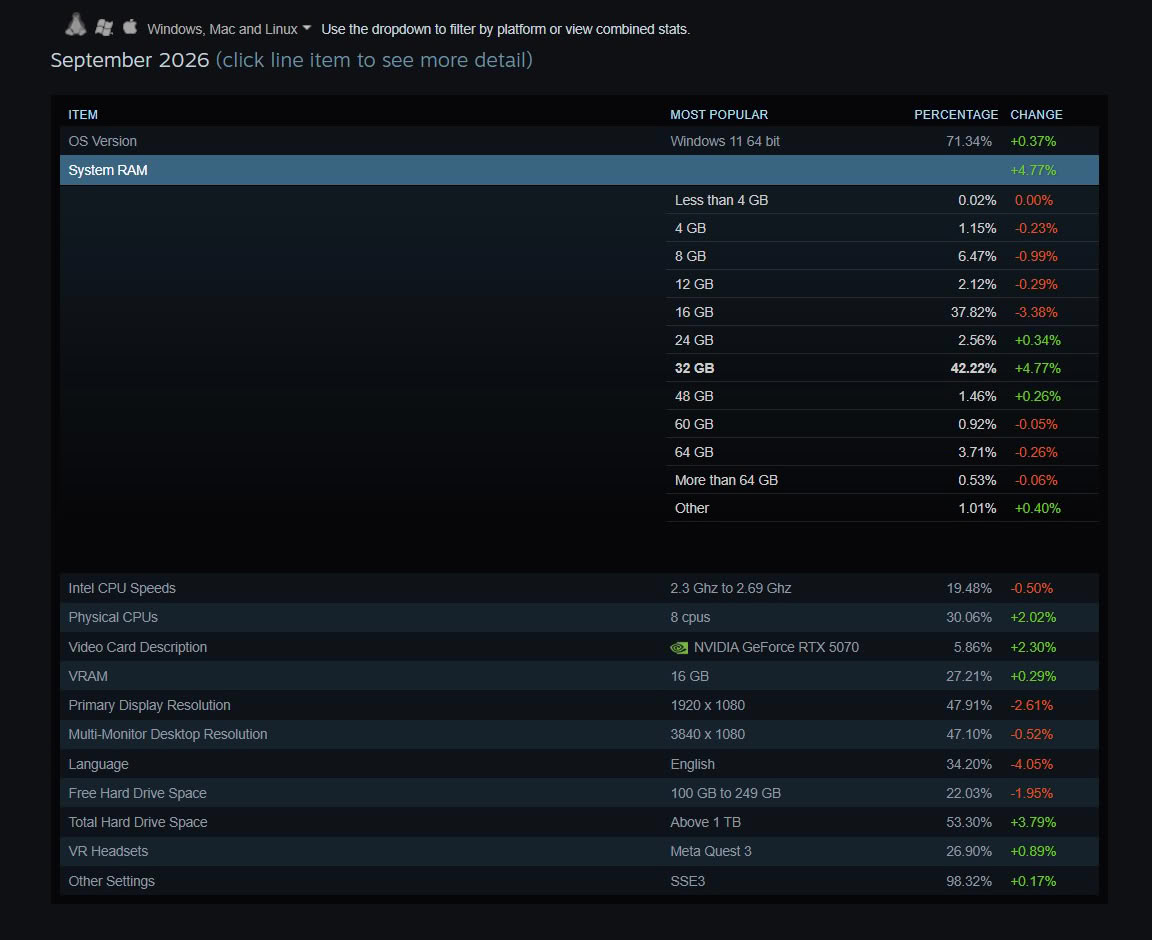
According to September survey data, the proportion of 32GB memory reached 42.22%, an increase of 4.77 percentage points compared with August; the proportion of 16GB memory dropped from 41.20% to 37.82%, a decrease of 3.38 percentage points in one month. The gap between the two quickly changed from 16GB's lead of 3.75 percentage points to 32GB's lead of 4.40 percentage points.
Meanwhile, low-capacity memory continues to shrink. The proportion of 8GB memory dropped to 6.47%, and 4GB only left 1.15%. The 12GB configuration is also further reduced. This means that the memory capacity of Steam players is obviously concentrated above 16GB, and 32GB has become the largest single capacity range.
If all capacities above 32GB are taken into account, the proportion of users on the Steam platform with at least 32GB of memory is actually higher than 42.22%, because higher-capacity systems are also separately counted in the survey. For example, 24GB, 48GB, 64GB and higher capacity configurations are separate statistical items. Therefore, just because 32GB has become the largest single specification does not mean that this capacity is the only one that is growing.
This change is related to the increasing memory requirements of PC games and Windows software in recent years. Modern large-scale games themselves may occupy more than ten GB or more of memory. At the same time, browsers, game platforms, instant messaging software, recording tools, and background services will also occupy system resources for a long time. When players are running games and other applications at the same time, 16GB is increasingly becoming a budget-conscious capacity.
In addition, AI applications are also becoming a new factor driving the increase in PC memory capacity. In recent years, it has become more and more common to run AI models, AI image generation tools, and various development tools locally, and such workloads usually rely more on memory than traditional office software. For users who are engaged in gaming, live streaming, video editing and AI applications at the same time, 32GB has become a capacity that is easier to cope with multi-tasking scenarios.
This data from Steam also reflects an interesting market change: 32GB has gradually transformed from a "high-end configuration" to a mainstream specification for ordinary gaming PCs. A few years ago, 16GB was usually sufficient for the vast majority of PC gaming needs, while 32GB was more commonly found in high-end gaming consoles or workstations. Nowadays, as more and more new installed users adopt 32GB, the proportion of old devices in the Steam user group has declined, and this specification has finally overtaken it in the statistics.
In addition to memory, the September Steam survey also showed that other hardware configurations of players are also being upgraded. In terms of processors, eight-core CPUs accounted for 30.06%, an increase of 2.02 percentage points from the previous month, becoming the most common number of CPU cores; six-core processors ranked second with 27.23%.
In terms of graphics cards, NVIDIA continues to have an absolute advantage, with an overall share of 75.97%, AMD 16.67%, and Intel 7.01%. In terms of specific models, the GeForce RTX 5070 accounted for 5.86%, an increase of 2.30 percentage points from the previous month, ranking first among the specific GPU models surveyed by Steam; the previously leading RTX 3060 dropped to 3.54%.
Monitor resolution also changes significantly. 1920×1080 is still the most used resolution among Steam players, accounting for 47.91%, but it dropped by 2.61 percentage points month-on-month. At the same time, the proportion of 2560×1440, commonly known as 2K resolution, increased significantly by 5.18 percentage points, reaching 27.04%. 4K resolution is 4.79%.
This means that while 1080p is still the largest single resolution among Steam's user base, 2K is rapidly expanding its influence. Combined with the popularity of RTX 50 series graphics cards and 32GB memory, it can be seen that more and more players are migrating from the mainstream 1080p gaming platform in the past to higher-performance gaming PCs.
Storage capacity also shows an upgrade trend. Steam surveys show that the proportion of users with a total available hard drive capacity of more than 1TB has reached 53.30%, an increase of 3.79 percentage points from the previous month. Among them, the proportion of users with capacity above 4TB reached 7.28%, an increase of 4.06 percentage points. As the installation volume of large-scale AAA games has continued to expand in recent years, players' demand for larger-capacity SSDs has become increasingly apparent.
However, the Steam Hardware Survey cannot be directly equated to hardware sales statistics for the entire PC market. It reflects the device configuration of users who participated in the Steam hardware survey. Steam users themselves are more biased towards PC gamers, so their hardware specifications are usually higher than those in the general office PC market. In addition, the data of the Steam Hardware Survey may be affected by changes in the composition of users participating in the survey every month. Therefore, when there are large changes in a single month, it is also necessary to observe them in conjunction with subsequent months.
This is why the sudden increase of 32GB from 37.45% to 42.22% and the simultaneous decrease of 16GB from 41.20% to 37.82% are particularly noteworthy. Such obvious single-month fluctuations may also include factors such as changes in survey samples in addition to real hardware upgrades.
However, even considering this factor, the trend itself is quite clear: 16GB is gradually changing from the default capacity for PC gamers to a "sufficient configuration", while 32GB is getting closer and closer to the new mainstream standard.
This change also has certain reference significance for players who are preparing to buy a new computer. If 16GB used to be the most common "dessert capacity" for gaming PCs for a long time in the past, then after entering 2026, 32GB has begun to assume this role. Especially when modern large-scale games, browser multi-tabs, background programs, game recording, and AI applications are running simultaneously, 32GB can provide significantly more headroom.
What is more noteworthy is that in the Steam survey, 32GB has just surpassed 16GB, while 24GB, 64GB and higher capacities are still relatively niche configurations. This means that the focus of the next stage of PC memory capacity competition is likely to first focus on whether players will further migrate to 48GB, 64GB or even higher capacities after 32GB becomes the absolute mainstream.
If games, AI and content creation software continue to increase the demand for system memory in the next few years, then 32GB is likely to be just the starting point for a new round of memory capacity upgrades, rather than a high-end configuration in the past sense. The greatest significance of this Steam survey is that it marks that the PC game market has officially passed an important point of shifting from 16GB to 32GB.
Comments