
Abstract:
The results of the Steam Hardware and Software Survey for October 2026 released by Valve show that after experiencing a number of abnormal fluctuations in September, a number of key hardware statistics have significantly returned. Memory capacity, graphics card ranking, processor market share and operating system share have all seen new changes, showing the latest pattern of the current hardware ecosystem for PC gamers.
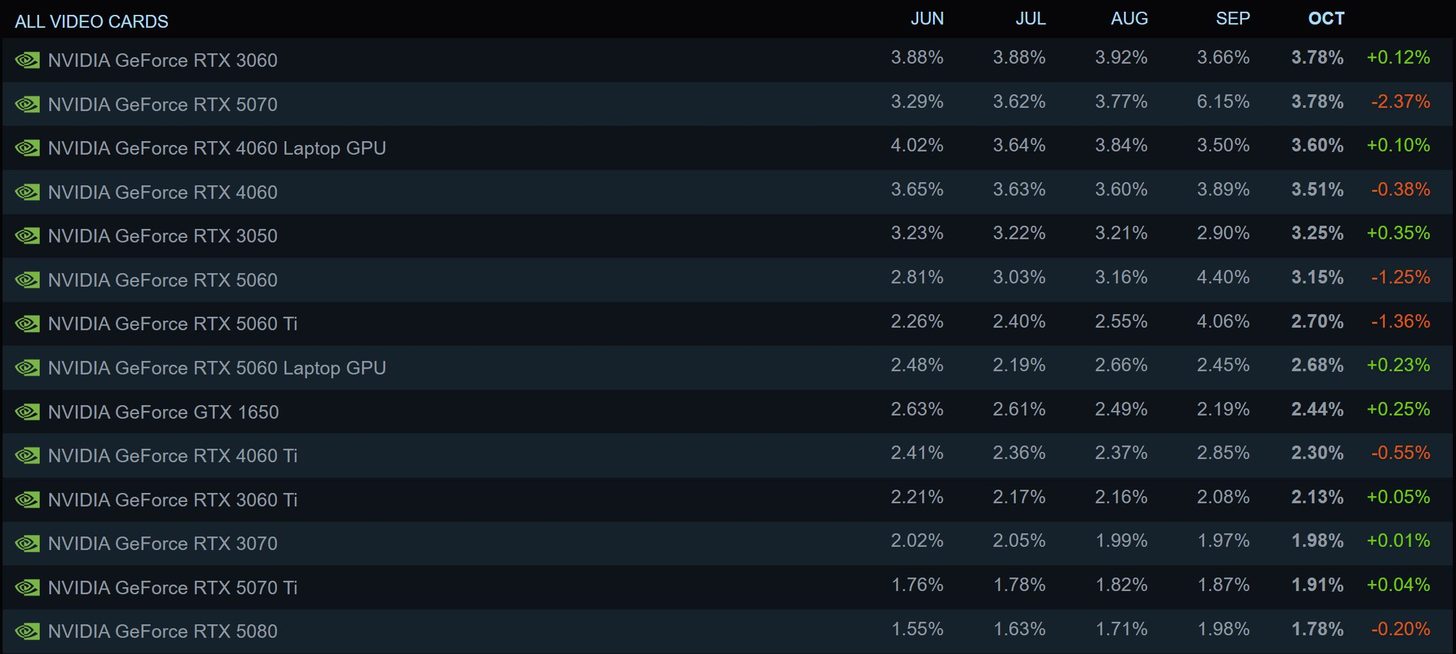
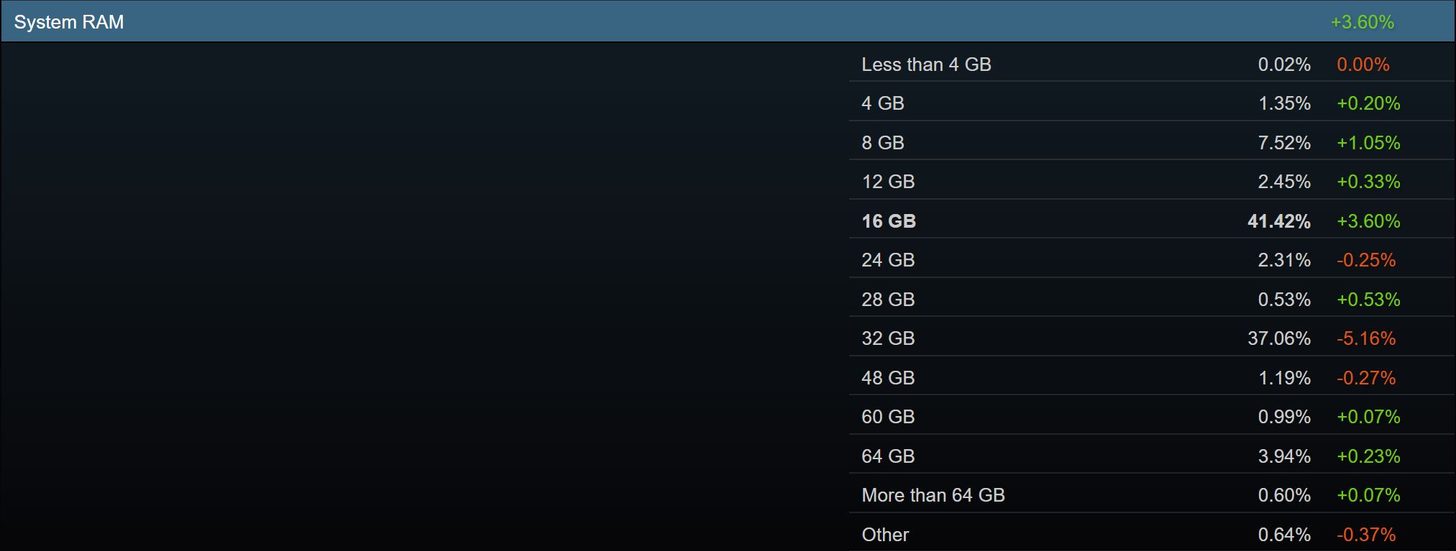
The most concerning change in this survey comes from system memory. Data shows that 16GB memory has once again become the most common configuration on the Steam platform, accounting for 41.42%, an increase of 3.60 percentage points from the previous month. Previously, in September, 32GB memory briefly surpassed 16GB to become the largest capacity configuration, but in October its share dropped by 5.16 percentage points to 37.06%, relegating it to second place again.
Analytics believe that the continued tight supply and rising prices of global DRAM and NAND flash memory are important factors affecting the memory upgrade trend. For players who plan to build or upgrade their computers, the cost of high-capacity memory remains high, allowing the 16GB configuration to remain mainstream.
In the processor market, Intel's share in the Windows gaming platform has rebounded slightly. Data shows that Intel processors accounted for 53.48%, an increase of 0.89 percentage points from the previous month; AMD dropped to 46.51%. However, compared to Intel's overwhelming advantage a few years ago, AMD still maintains strong competitiveness.
From the perspective of core number, 8-core processors continue to occupy the leading position, accounting for 28.68% of all systems; 6-core processors follow closely, accounting for 27.29%. The two combined are close to 56%, showing that 8-core and 6-core are still the mainstream choices for the vast majority of PC players.
The graphics card market also experienced ranking changes. NVIDIA GeForce RTX 3060 regained the position of Steam's most popular graphics card, accounting for 3.78%, almost the same as RTX 5070, but ranked first with a slight advantage. Previously, the RTX 5070 briefly reached the top in September, but was overtaken by the RTX 3060 again in October.
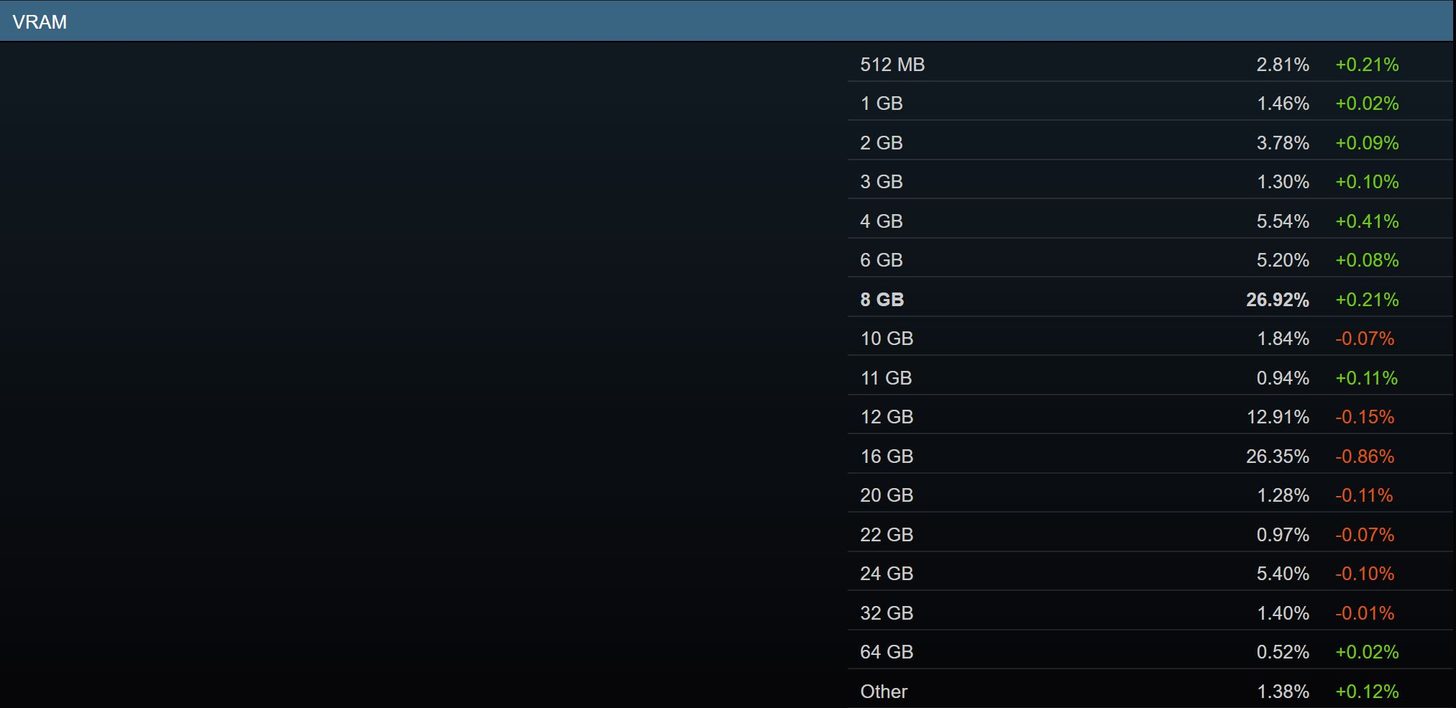
Video memory capacity statistics show that 8GB video memory once again became the most popular configuration, accounting for 26.92%; 16GB video memory followed closely, accounting for 26.35%; 12GB video memory reached 12.91%. As the price of high-end 16GB graphics cards continues to rise, many players still choose 8GB products that are more affordable when installing new machines or upgrading.
In terms of display resolution, 1920×1080 continues to be the absolute mainstream, accounting for 50.23%, and more than half of users are still using 1080P displays. 2560×1440 resolution accounts for 21.82%, while the proportion of 4K resolution users is only 5.05%. It is worth noting that the proportion of 1440P users decreased by 5.22 percentage points from the previous month, while 1080P increased by 2.32 percentage points.
In terms of operating systems, Windows still has an absolute advantage, accounting for 93.7% of all Steam users. Among them, Windows 11 continued to expand its leading position, accounting for 72.51%, an increase of 1.54 percentage points from the previous month; Windows 10 dropped to 21.11%, continuing to show a downward trend.
Meanwhile, the Linux gaming platform continues to grow slowly. The latest data shows that the proportion of Linux users has reached 3.95%, just one step away from the 4% mark, which is higher than previous statistics. macOS accounts for 2.35%. For the community that has been paying attention to the development of the Linux gaming ecosystem for a long time, this means that the Linux platform is gradually gaining recognition from more players.
Among Linux distributions, CachyOS based on Arch Linux has become the most popular distribution, accounting for 0.65% of all Steam users; SteamOS Holo used by Steam Deck ranks second, accounting for 0.55%.
In terms of storage capacity, systems with more than 1TB of total storage space are still the most common, accounting for 48.62%, showing that the growing size of large-scale games is driving players to upgrade to larger-capacity storage devices.
In the field of VR equipment, Meta Quest 3 continues to rank first, accounting for 27.27% of connected VR headsets. Valve’s own Steam Frame also showed significant growth momentum for the first time, accounting for 4.13%, surpassing some traditional VR devices.
Industry insiders pointed out that the results of this survey largely reflect the correction effect after the statistical anomaly in September. Since the Steam Hardware Survey adopts a voluntary participation method, changes in the proportion of user samples in different regions will significantly affect the final statistical results. For example, the proportion of Simplified Chinese users dropped significantly in October, causing many hardware projects to return to long-term trends. Therefore, single-month data fluctuations may not completely represent the real changes in the market. It is more important to observe the long-term trend.
Overall, as of October 2026, 16GB memory, RTX 3060 graphics card, 8-core processor, 1080P monitor and Windows 11 system still constitute the most typical mainstream gaming computer configuration on the Steam platform, and the Linux platform is also continuing to expand its influence with steady growth.
Comments