
Abstract:
arXiv, one of the world's largest open access preprint paper platforms, recently announced that it will adjust the submission frequency limit. Starting from October 1, 2026, all contributors can only submit a maximum of two papers per calendar month, and the number of active submissions at any time must not exceed 3. The new policy applies to all subject categories on arXiv, not just artificial intelligence or computer science.
arXiv stated that this adjustment is a "transitional measure" to more fairly distribute the workload of volunteer reviewers in the rapidly changing academic publishing environment, while buying time for the platform to improve review tools and processes. The platform had previously allowed reviewers to restrict high-frequency contributors based on specific circumstances, but starting from October 1, submission frequency limits were officially standardized.
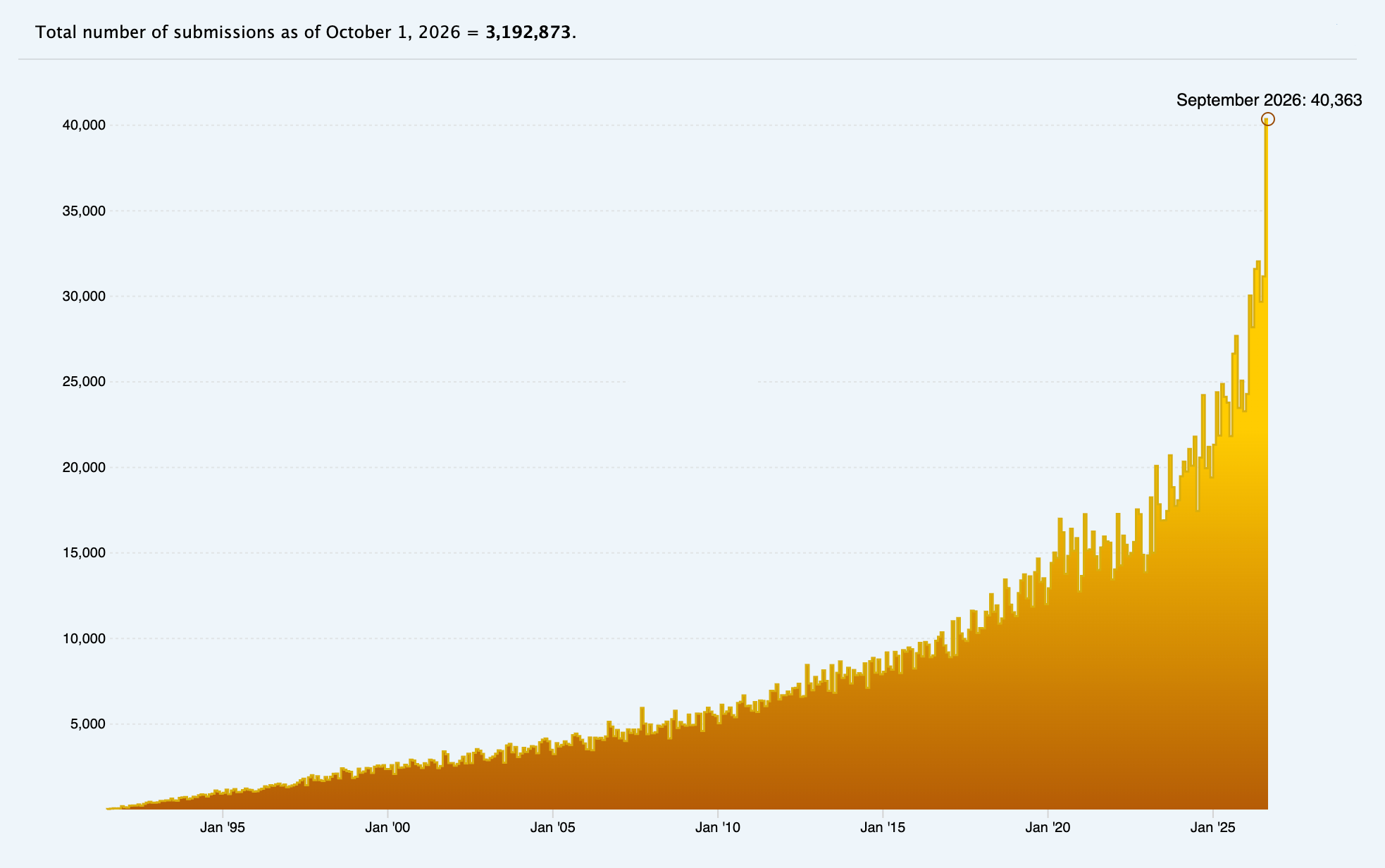
This policy adjustment is directly related to the rapid growth in the number of submissions to arXiv in recent years. Data shows that in September 2016, arXiv received 9,869 submissions in one month, which increased to 20,569 in September 2024, and further reached 40,363 in September 2026, setting a record high in a single month. In just two years, the number of monthly submissions has doubled, and those submissions have generated nearly 9,000 support requests to arXiv staff and volunteer reviewers.
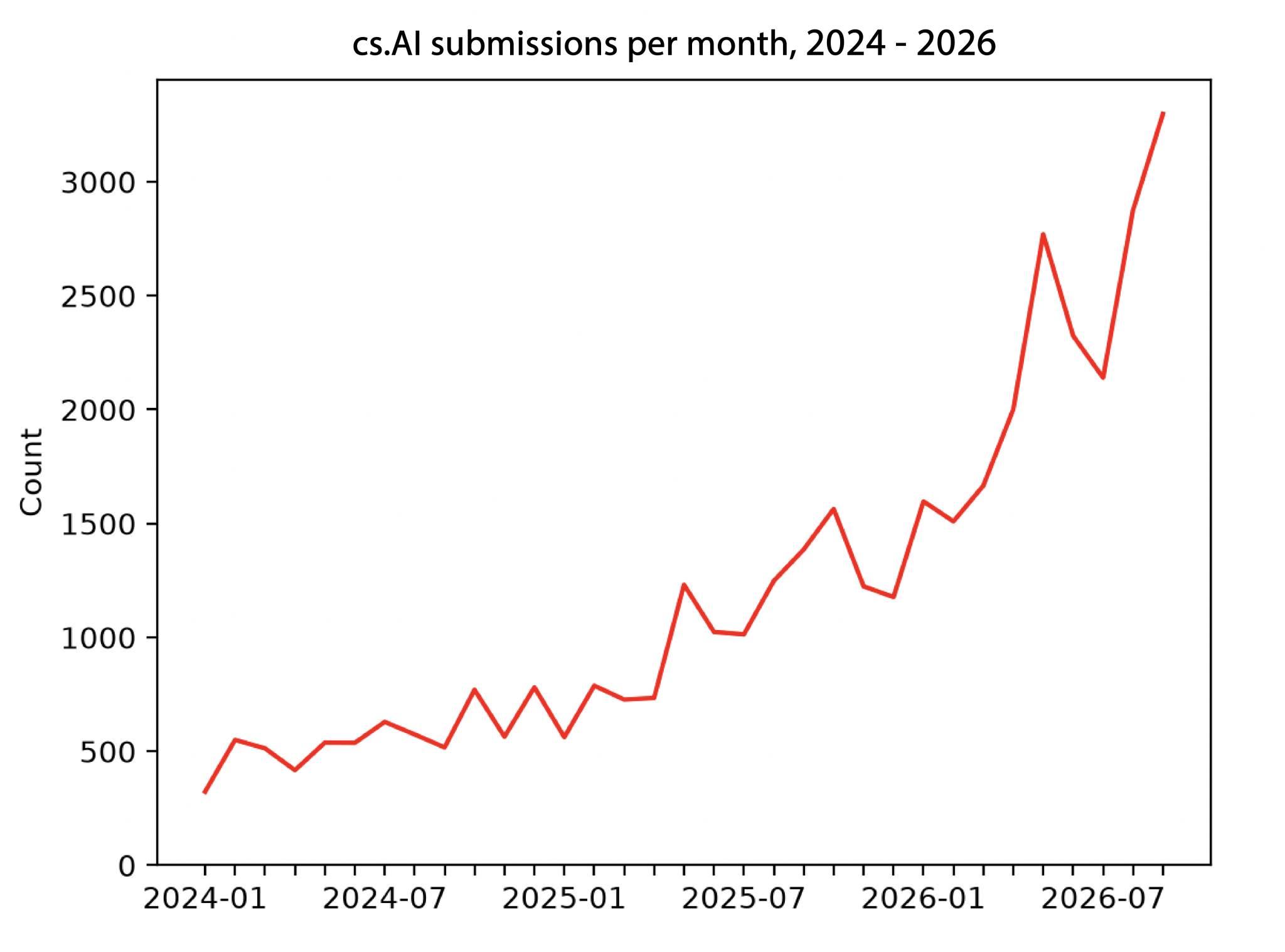
Among them, the growth in the field of artificial intelligence is particularly obvious. arXiv pointed out that the number of submissions in the artificial intelligence category in computer science has increased more than six times in the past two years, while the number of submissions in other categories has also roughly doubled. As generative AI tools become more mature, it has become easier to produce paper texts, organize structures, and generate large amounts of seemingly complete research materials. This has also put greater pressure on the model that relied on manual review to maintain quality in the past.
arXiv does not prohibit researchers from using AI. The platform's current policy allows authors to use AI as a scientific research aid, as long as the relevant use is disclosed and the paper itself meets arXiv's requirements for academic value, originality, and research quality.
What really puts pressure on arXiv is the structural change in submission content. Platform reviewers have observed that in recent years, there have been an increasing number of “thin papers” with very narrow research scope and limited content, as well as “sausage-cutting” papers that split a complete study into multiple small papers and submitted them separately. At the same time, reviewers also found a large number of papers with dense text that were obviously generated by AI.
arXiv believes that a small number of high-frequency contributors submit a large amount of low-quality content, which will take up a disproportionate amount of the time of volunteer reviewers, thereby delaying the review of truly valuable papers. Some normal submissions may even wait for days or even weeks as a result. These reviewers themselves are not full-time employees of arXiv, but volunteers from the scientific research community who have participated in platform review work for free for a long time.
Thomas Dietterich, chairman of the arXiv Computer Science Advisory Board and emeritus professor at Oregon State University, said that the core purpose of limiting the frequency of submissions is to prevent a small number of high-producing contributors from consuming too much review resources, while allowing different authors to obtain review services more equitably.
The most noteworthy thing about the new rules is that "two papers" refers to the number of submissions, not the number of papers that are ultimately successfully published. In other words, if an author submits two papers within a month, even if both papers fail to pass review, the two submission quotas for that month will still be consumed. Authors must wait until the next calendar month to submit again.
The number of submissions between different disciplines cannot be counted separately. For example, a researcher who submits one paper to the Computer Science category and one paper to the Physics category that month has already reached the limit of two for that month. Subsequent submissions to computer science, physics, or other categories will have to wait until next month.
At the same time, arXiv’s previously existing “maximum 3 active submissions” limit remains in effect. In other words, each contributor can only have a maximum of 3 active papers at any time. If papers submitted last month are still under review or on hold in the new month, these papers will not occupy the "two submissions" quota for the new month, but will still count toward the total limit of three active submissions.
This rule may create additional planning pressure for researchers who need to publish papers by specific dates. For example, some research teams need to upload papers to arXiv before academic conference deadlines to establish public timestamps or meet conference-related requirements. If the monthly submission quota has been used before, researchers must arrange their submission time in advance.
However, arXiv also made an exception for one situation. If an author submits a paper but then deletes it before it is officially published, the submission will not be counted in the number of submissions in that month, nor will it be counted in the number of active submissions. This is mainly because the author may find important errors after submission and need to withdraw the paper and revise it again.
There is another feature of the new policy that is easily overlooked: the restriction targets "contributors" rather than all authors of the paper. If a paper has multiple co-authors and one of them is responsible for uploading the paper, then the contribution will only be counted towards the actual submitter's quota and will not consume the number of submissions from other co-authors at the same time. Therefore, scientific research teams can manage their own submission arrangements by properly coordinating contributors.
Judging from arXiv’s explanation, this policy is not to permanently restrict researchers from publishing papers, but to re-find a balance between open preprint platforms and manual review mechanisms after AI tools significantly reduce paper production costs.
In the past, how many papers a researcher could submit in a month was actually naturally limited by the actual workload of writing, experiments, data analysis, and paper organization. Nowadays, AI tools can significantly speed up some of these processes, so that the "natural upper limit" of the past is falling. arXiv believes that this change has made the original model of relying on auditors to limit frequency on a case-by-case basis increasingly difficult to cope with.
This also explains why the new regulations do not limit restrictions only on AI papers, but directly cover all authors and all disciplines. arXiv is currently not trying to build a system that can accurately determine whether each paper is generated by humans or AI. Instead, it directly reduces the pressure on the review system caused by high-frequency and low-quality submissions through a unified upper limit of submission frequency.
For ordinary researchers, the limit of two articles per month does not actually mean that normal scientific research activities cannot be carried out, because the vast majority of researchers do not submit papers to arXiv frequently. But for large AI labs, high-production research teams, and authors accustomed to quickly publishing multiple follow-up papers around the same research, the impact of the new rules will be more obvious.
Especially in the field of artificial intelligence, a research may simultaneously produce a main paper, a method improvement paper, an experimental paper, a data set paper, and a follow-up analysis paper. If these results need to be published separately in a short period of time, the new submission restrictions will require the research team to arrange the release time more carefully, and may even prompt the reintegration of some results that were originally planned to be published separately.
arXiv emphasized that the current two-article restriction is just a "stopgap", which is a temporary transition plan. The platform will continue to observe the impact of this policy on authors, readers, paper quality, and review work, and adjust the rules based on actual results. In other words, the future monthly submission limit may not necessarily remain at two articles permanently.
This change also reflects that generative AI is changing not just paper writing itself, but the entire academic information dissemination system. In the past, the main problem faced by preprint platforms was how to make scientific research results public faster; now, when AI can reduce the threshold for paper text production on a large scale, the new problem that the platform needs to solve becomes how to prevent the open submission mechanism from being overwhelmed by a large amount of low-value content.
For arXiv, which was founded in 1991, the increasing number of submissions during its more than 40 years of operation is not a new problem in itself, but the growth rate in 2026 is obviously different from the past. In particular, the more than 6-fold increase in submissions in the field of artificial intelligence in the past two years has forced an open platform that relies on voluntary review by scientific researchers to reconsider its operating methods.
Therefore, this limit of two articles per month is not so much the beginning of arXiv's restriction on academic publishing, but rather a temporary "current restriction" adopted by this open preprint system after the speed of content production in the AI era far exceeds the ability of manual review. In the future, it remains to be seen whether arXiv will further improve its automated review capabilities, continue to adjust the submission limit, or establish a new academic screening mechanism for the AI era.
Comments