
Abstract:
A latest survey covering 37 countries and regions around the world shows that artificial intelligence is causing increasing employment anxiety. A majority of those surveyed believe AI is more likely to lead to job losses over the next 20 years than to create more. Respondents in 34 of the 37 countries surveyed were more inclined to this judgment.
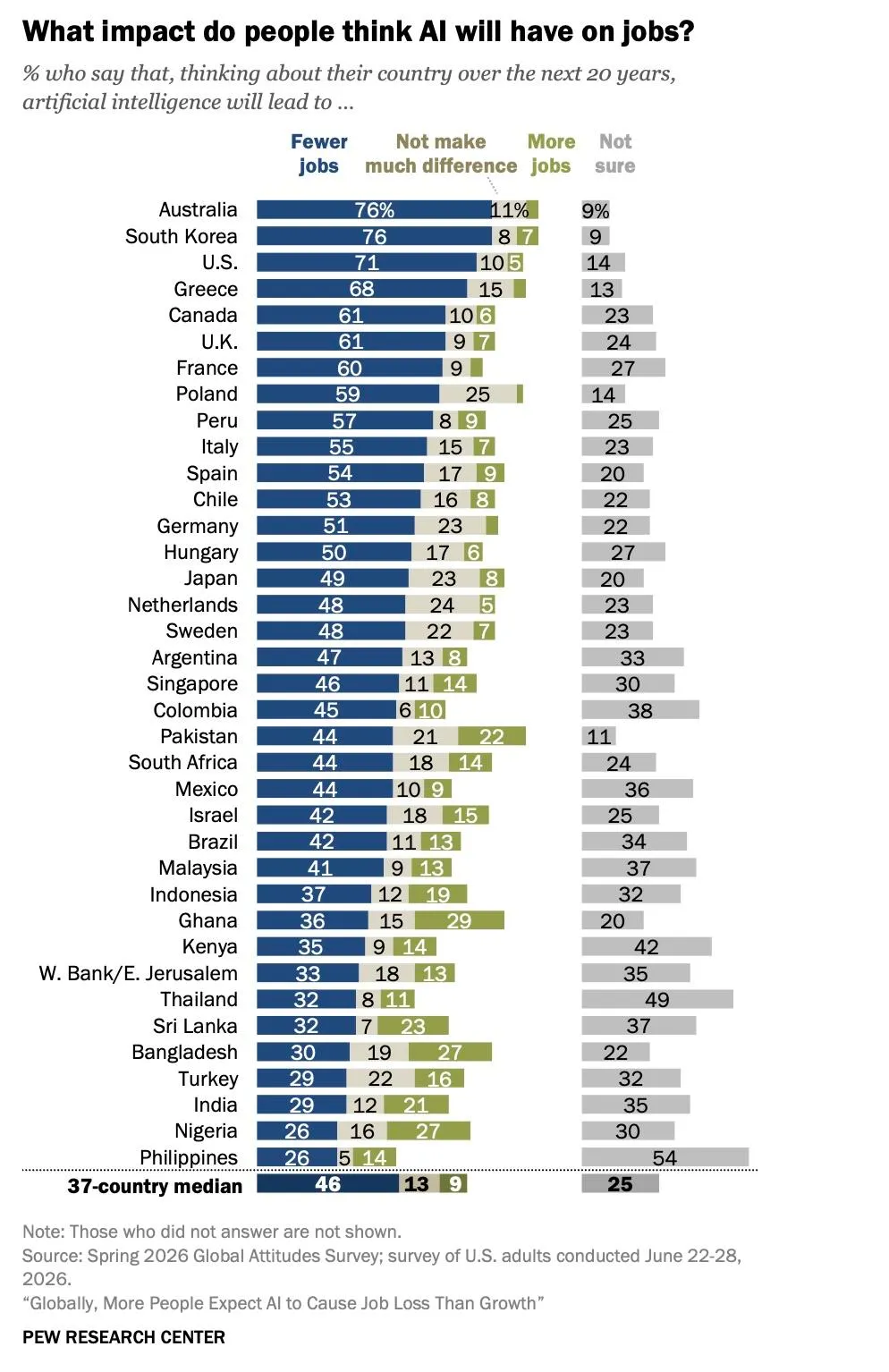
This survey was conducted by the Pew Research Center, with a total of 42,151 people participating. The survey period was from February 8 to May 13, 2026. However, it should be noted that most of the surveys predate the recent series of warnings about the serious social and economic impacts of AI, so the current level of public concern about AI may even have changed.
From a specific country perspective, AI’s concerns about employment are particularly prominent in some economically developed countries. 76% of respondents in both Australia and South Korea believe that AI will cause job losses in the next 20 years, and 71% in the United States. Survey results from these countries show that the employment issue brought about by AI is no longer just a discussion within the technology industry, but has become a social and economic issue of widespread concern to the general public.
In recent years, artificial intelligence has gradually developed from tools mainly used to assist office work and information processing to systems capable of performing writing, programming, image generation, data analysis, and a large number of other knowledge-based tasks. As the capabilities of AI models continue to increase, people are beginning to worry that companies may use AI to reduce the need for some employees in the future.
This concern also echoes some of the more pessimistic predictions within the AI industry. Anthropic CEO Dario Amodei has previously warned that AI could eliminate half of entry-level white-collar jobs in the next few years. Although this is a prediction by business executives rather than a fact that has already happened, similar remarks have further exacerbated public concerns about the impact of AI on the job market.
The survey also shows that people are not only worried about job losses, but also generally believe that AI may further widen the gap between rich and poor. Overall, respondents are more likely to believe that the development of AI will widen the economic gap between the rich and the poor, rather than narrow it.
This view is especially evident in countries with more developed economies and generally left-leaning political stances. The survey results show that the level of economic development and the social and political environment may affect people's judgments about the economic impact of AI. For countries that already have higher incomes and complete digital infrastructure, the productivity improvements and employment structure changes brought about by AI may be more obvious at the same time, so the public is more concerned about its potential impact.
Age is also an important factor affecting public attitudes. Older respondents are generally more worried about the impact of AI on daily life, while younger adults aged 18 to 34 are more likely to express complex or even ambivalent attitudes.
Young people are not simply for or against AI. Compared with other age groups, they are more likely to see both the convenience and potential risks brought by AI, but at the same time, their concerns about AI may change their future employment opportunities and the economic environment are also rising.
In countries such as Sweden, Poland, Japan, Australia, Brazil and the United States, young people’s concerns about AI have increased significantly in the past year. The younger generation in some countries has even shown similar or even higher anxiety about employment and wealth gaps than older groups.
This change is of particular concern because young people are often the main participants in the labor market in the coming decades. If AI continues to change the structure of entry-level jobs and knowledge jobs, young people who have just entered the workforce or are about to enter the workforce may feel this change more directly than those who already have stable careers.
However, the Pew Research Center's survey results do not mean that the global public has generally viewed AI as a negative technology. In fact, there are still significant complexities in people's attitudes towards AI.
Among global respondents, 41% said they were both worried and excited about AI increasingly entering their daily lives. This proportion is the highest among all attitudes. Another 37% of respondents said they were mainly worried, while only 13% said they were mainly excited.
In other words, although the issues of employment and the gap between rich and poor are becoming one of the public's main concerns about AI, a considerable number of people still recognize the positive effects that AI may bring. People are worried about AI changing the existing work and income distribution model, but they also expect it to improve productivity, improve lifestyles, and create new opportunities.
This also shows that the current global society's attitude towards AI is far from forming a simple "support" or "opposition" camp. People in different countries, age groups and economic environments have obvious differences in the possible impact of AI.
As AI continues to enter office software, search engines, education, medical care, manufacturing and various daily service fields, how many jobs will be automated in the job market in the next few years, how many new jobs will be created by AI, and how the economic benefits brought about by increased productivity will ultimately be distributed are still questions that have yet to be clearly answered. What this survey reflects is a common trend that has emerged among the global public in the early days of the large-scale popularization of AI technology: people are full of expectations that AI can change the economy and life, but there is still a strong uneasiness about whether it will come at the expense of a large number of traditional jobs.
Comments