
Abstract:
I am afraid that the anonymous review will be messed up by Claude in the future...
15136 ICML anonymous review comments that have never been made public, Claude Fable 5.2 actually guessed 55.4% of the author names
. Note - all the researcher did was throw the review comments to Claude and ask "Who wrote this?" There was no Internet connection, no list of candidates, and not even a historical article for comparison. Just like that, did it really recognize the person? ?
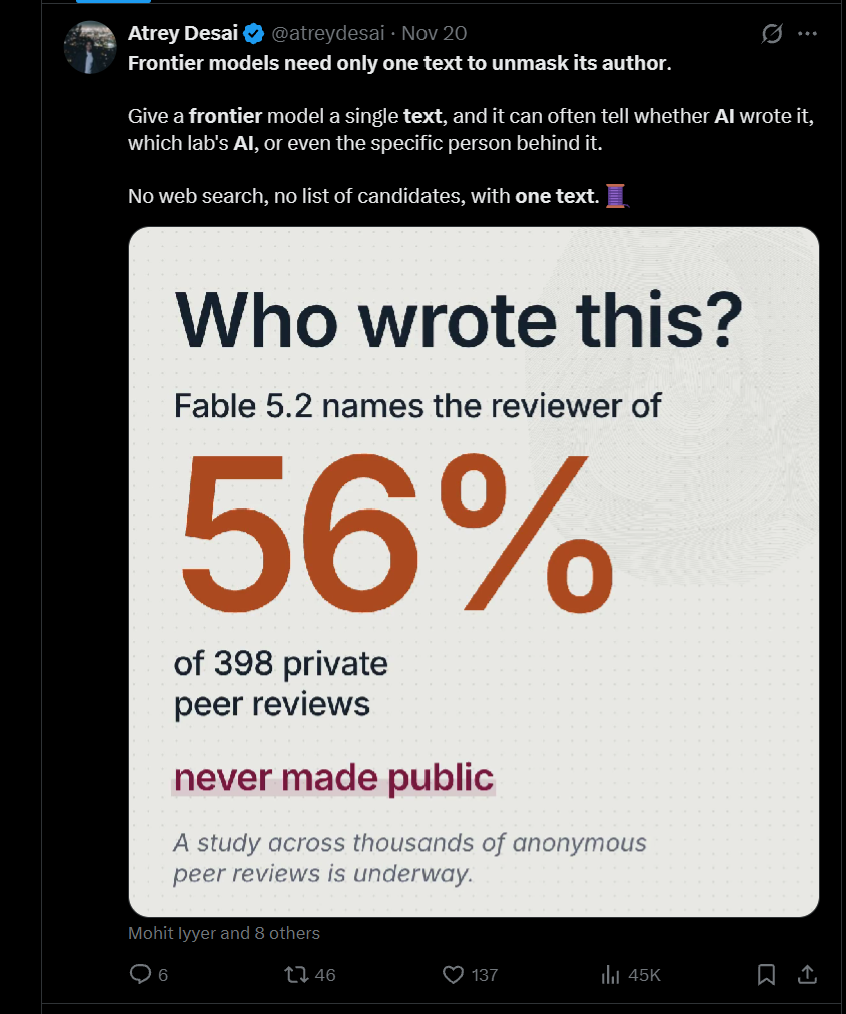
If you don’t believe it, the research team exchanged 398 private review opinions from different academic conferences.
As a result, Claude guessed 56% correctly.
Hey guys, I am anonymous, but not completely anonymous...
Moreover, uncovering the identities of anonymous reviewers is only part of the research.
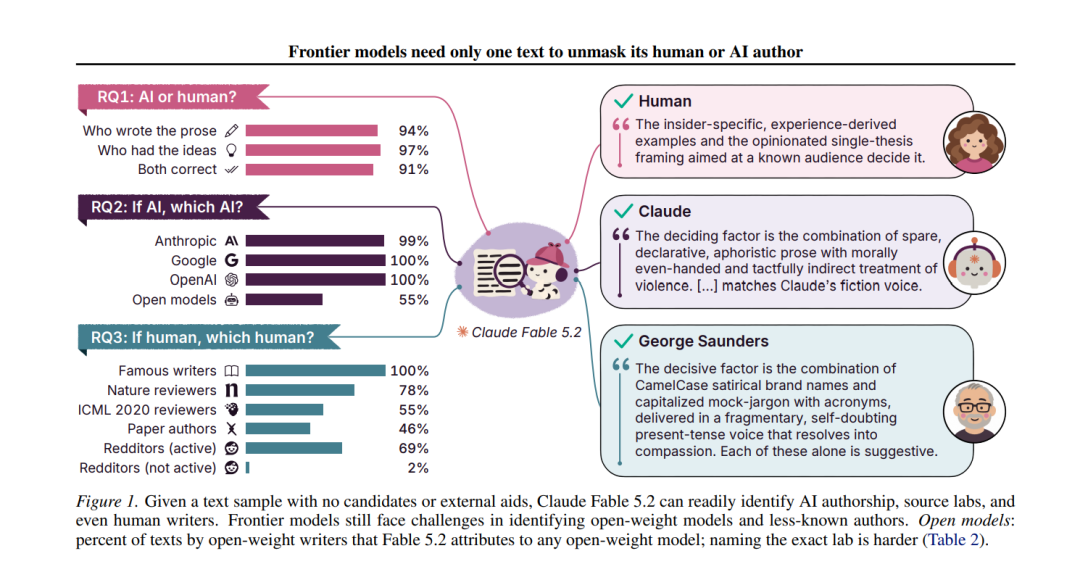
Researchers from the University of Maryland, Simon Fraser University, Google DeepMind, Pangram Labs and other institutions found that the current cutting-edge large-scale model has made "guess who wrote this" three difficulty levels——
Enter Edition: Was this article written by a human or by AI?
Advanced version: If it was written by AI, which company's AI was used?
Hell Edition: If it was written by someone, who specifically?
It turned out that Claude had passed all three levels.
It can even analyze the writing styles of colleagues such as Kimi and Qwen clearly.
The researchers also issued a warning:
Anyone who has published enough online can no longer assume that an unsigned article will keep them anonymous.
Hiss...
In the future, do you have to think carefully about opening a small account online to complain about your boss? (doge)
Claude angrily attacked the anonymous reviewer
The whole thing goes like this.
In order to verify whether AI can guess who wrote the review comments, the research team dug out the internal review data of ICML 2020.
There are a total of 3342 reviewers and 15136 review comments. The content and author's identity have not been disclosed.
(You ask why they can get the data? Because one of the authors of the paper, Hal Daumé III, was the co-chairman of the ICML program committee that year)
Then they threw the review comments to the five models one by one and got the following results:
Claude Fable 5.2 (55.4%)>Claude Opus 5.5 (48.8%)>Gemini 4 Argon (37.7%)>GPT-6.1 Sol (22.3%)>DeepSeek V4.1 Flash (5.4%).
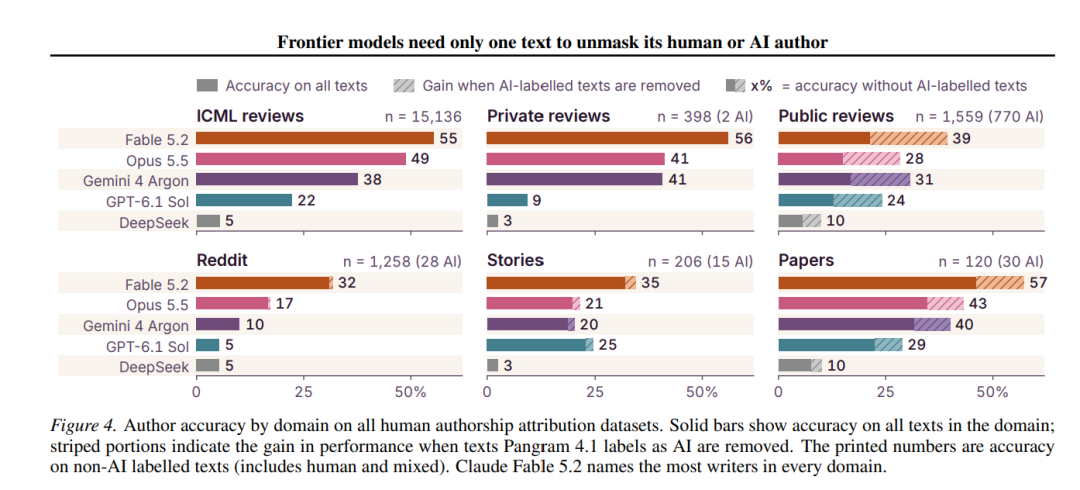
Hey guys, Company A directly takes the top two places, and Fable 5.2 is the only model with an accuracy rate exceeding 50%.
And after replacing 398 private review comments from other academic conferences, Fable 5.2 can still guess 56% correctly.
If you only look at the longer regular review comments, the accuracy rate can even reach
68%
.After testing and testing, the research team simply expanded the scope beyond the academic circle.
Novel in literary magazines, comments from netizens on Reddit...all are left to AI guessing.
As a result, this guess even revealed the vests of netizens.
For active users who posted more than 500 times on Reddit in the past year, Fable 5.2 was able to guess the username with
69% accuracy from just one comment
.Especially in C++-related communities, the recognition accuracy has even reached 79%.
Programmers, are you sweating...
But what’s interesting is that for those users who don’t usually speak on Reddit, the recognition accuracy of Fable 5.2 plummeted to about 2%.
This raises a question:
It is also a piece of text that the AI has never seen before. Why do some people guess it accurately, while others fail to guess it?
AI has learned "text fingerprint recognition"
Researchers found that this depends largely on "how well the AI knows you."
After all, people have their own little habits when writing.
Some people are quick to put parentheses, and some people are eager to use three exclamation points in one sentence. They even have their own way of choosing words to form sentences and developing arguments.
The combination of these details is a bit like a person's "text fingerprint".
The more text you leave online, the more likely the AI will remember these features in the pre-training stage
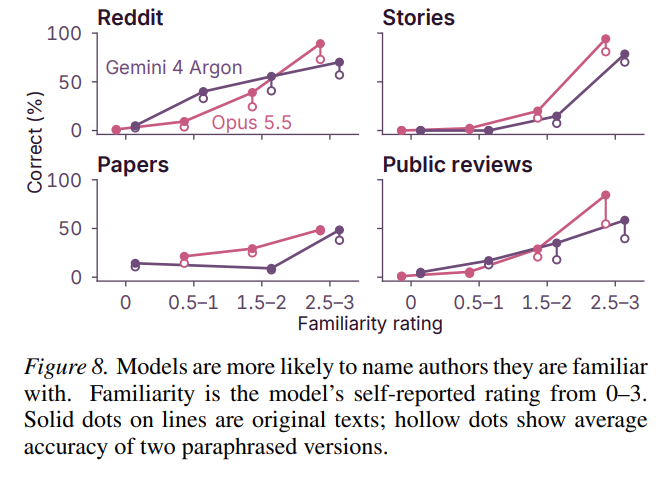
.To verify this, the researchers simply asked the AI directly: How familiar are you with this person?
The result is indeed right.
In the novel author recognition experiment, Opus 5.5 achieved a recognition accuracy of 92% for authors it claimed to be familiar with.
For unfamiliar authors, this number is less than 2%.
What is even more noteworthy is that if the AI is given more time to think, it can also recognize people it is not familiar with.
For example, in the Reddit user identification experiment, for those users who had only a little impression, when the inference intensity of Fable 5.2 was pulled to the highest level, the identification accuracy directly soared from
8% to 38.2%
.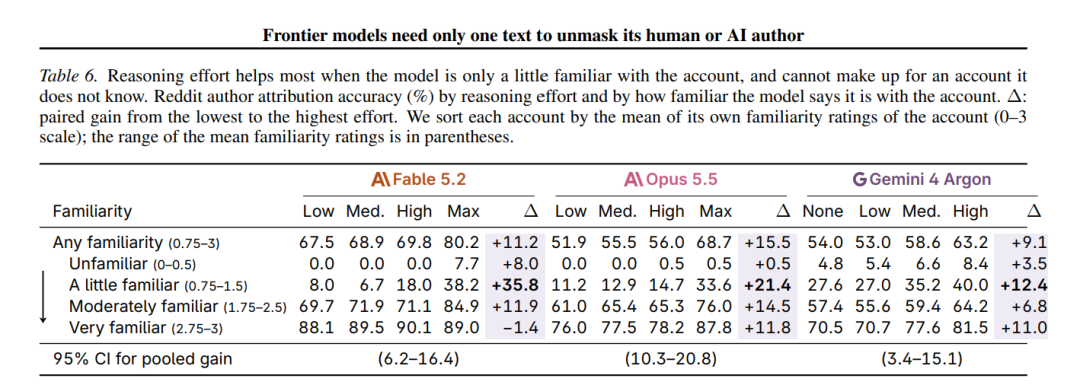
Okay, okay, the stronger the AI's reasoning ability, the less tight our vest may be.
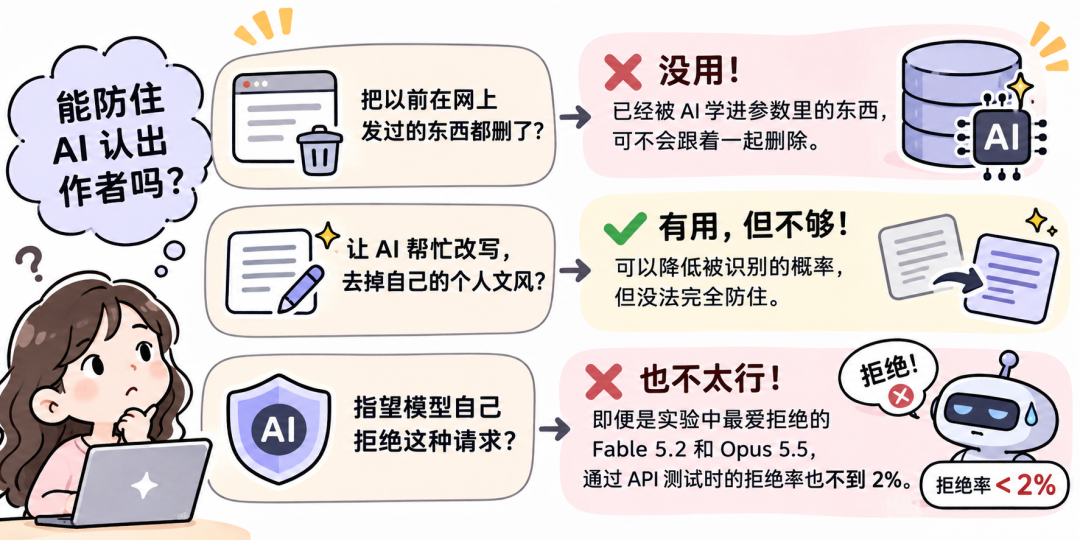
Is there any way to remedy this?
The researchers also thought about it for a while and concluded that:
Yeah, it's quite magical.
In the past, in order to protect privacy, everyone might check before sending something to see if they had accidentally disclosed their name, address, and workplace.
Who would have thought that one day,
even the way I speak may reveal my identity
.Not only can it recognize people, AI can also recognize AI
And even people can be picked out, let alone the AI itself.
Some netizens were horrified to discover: Could it be possible to use large models as AI detectors now?
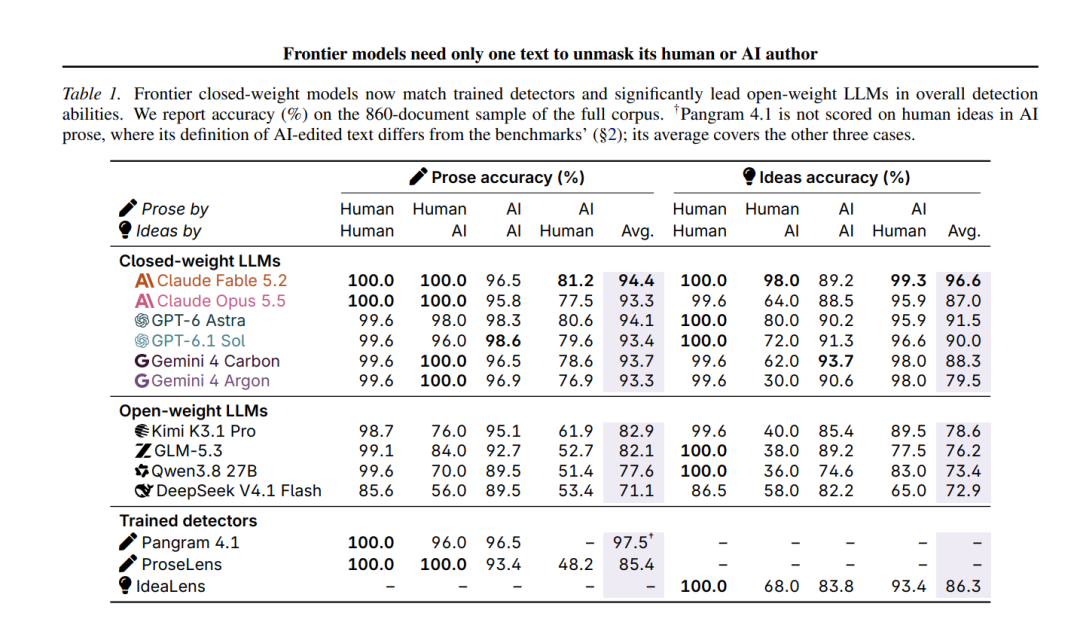
The researchers used more than 36,000 texts from 24 benchmark data sets to compete between large models and professional AI text detection tools.
As a result, Gemini 4 Carbon’s detection rate of pure AI-generated text reached 97%, directly tying the professional detection tool Pangram 4.1.
Even today’s large-scale models can even tell who the
text and ideas of an article come from
.For example, I think of a story myself and ask AI to help write it into a novel, or AI helps me conceive a story and I write it in my own words.
Fable 5.2 can distinguish between these two situations.
In related tests, its accuracy in judging text sources reached 94.4%, and its accuracy in judging creative sources reached 96.6%.
And the experiments continue to increase.
Now that I know it was written by AI, can you tell me which AI company specifically wrote it?
They found 34 models from 11 AI companies and asked them to write novels, news and commentary articles respectively, and then handed them over to other large models for recognition.
Results: Fable 5.2 achieved a manufacturer attribution recognition accuracy of 99.8% for text generated by models from OpenAI, Anthropic and Google.
Following the paper, the researchers even summarized the writing portraits of three AI companies.
GPT: I like to use aphoristic expressions, and my wording is relatively cautious.
Claude: Prefers dry humor, is used to caring for opposing viewpoints, and tends to be restrained in endings.
Gemini: Likes to stack adjectives, use idiomatic expressions, and is prone to fictional characters and quotations when writing news.
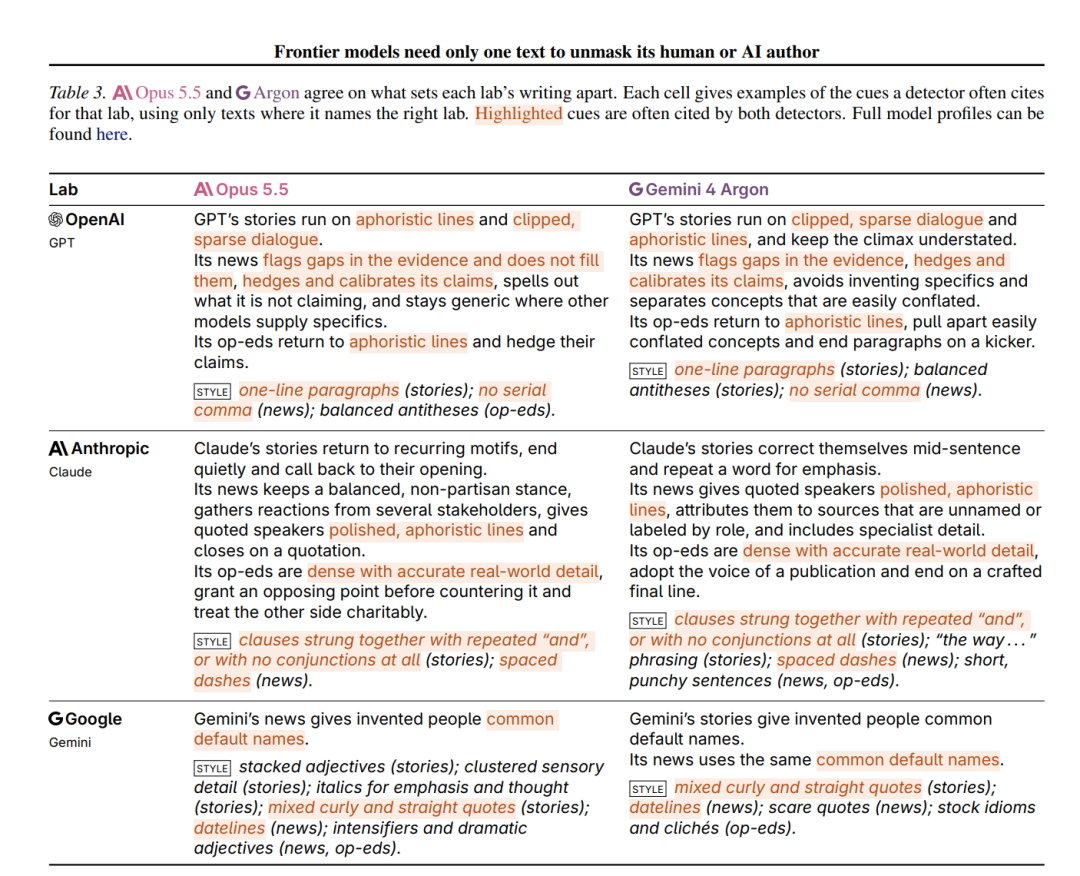
Don’t mention it, friends who deal with these AIs every day may have started nodding wildly when they saw this.
But then, things get a little more subtle.
Fable 5.2 has a 77% probability of correctly identifying the article generated by Kimi K2.6 as coming from The Dark Side of the Moon.
When it comes to Kimi K3, the style of painting suddenly changes.
97% of the text was recognized by Fable 5.2 as written by Claude
.A similar situation also happened to Qwen.
89% of the articles generated by Qwen3.6 can be correctly identified as produced by Alibaba.
When it comes to Qwen 3.8 Max, 95% of them are recognized as GPT.
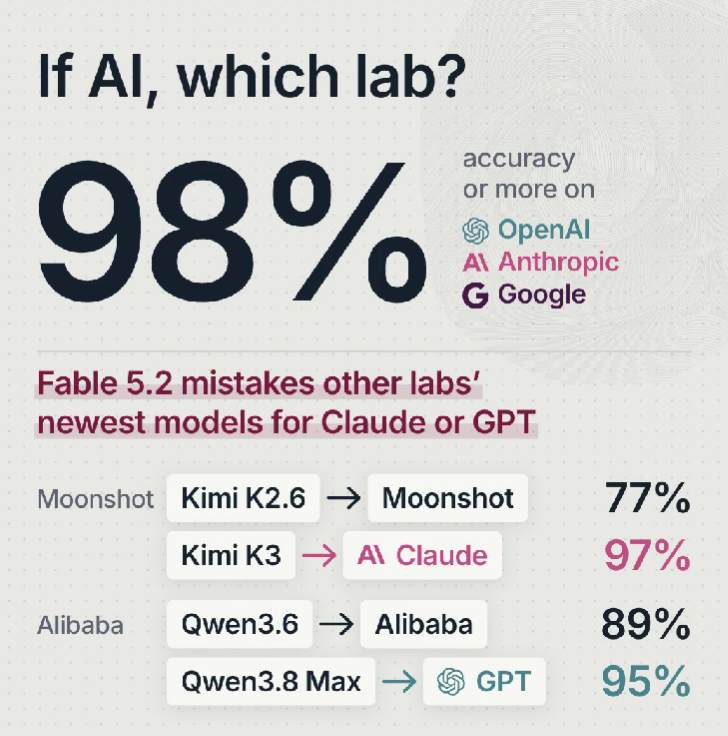
As for why this happens, the author of the paper actually gave an explanation (cough, everyone understands).
However, once the three companies of OpenAI, Anthropic and Google are excluded, Fable 5.2's recognition accuracy for the other eight manufacturers is only about 35%.
It is even more difficult to get an accurate model version.
Of the 1,792 texts generated by models released in 2026, Fable 5.2 only accurately guessed the specific model version of one
.It seems that AI agrees with this and needs to continue practicing...
One More Thing
If you think about it carefully, this is actually quite scary.
Suppose an author has his manuscript rejected, and the more he thinks about it, the more angry he becomes, and then he throws the review comments to Claude:
Here, help me find out who wrote it.
You guessed it, the anonymity protection of the double-blind review may be invalid.
Guessed wrong... Well, I can't tell which researcher is sitting at home and the pot comes from the sky.
And it’s not just the academic circle that needs to worry about this.
For those of you who usually like to open a small account to complain about your boss and share your personal experiences, you may have to worry about it.
What’s even more terrible is that
the amazing recognition results in this paper were achieved without the AI being connected to the Internet or using external tools
.In early experiments, researchers encountered a rather magical situation.
At that time, they used Claude Code to test the author identification ability. They threw a piece of text written by the logged-in account to Claude and asked him to guess who the author was.
As a result, Claude directly quoted the email address bound to this account during the analysis process.
Co-author account information can also be a clue for AI to identify the author.
In order to eliminate this kind of interference, the research team later mainly tested through the API call model.
But what about in a real-life scenario?
If AI combines Internet searches, historical conversations, and even information on different social platforms to determine a person's identity...how difficult will it be to remain anonymous?
It’s scary to think about it.
Comments