
Abstract:
A research team at North Carolina State University in the United States has developed a wearable technology called EpiPad, which can turn the wearer's forearm skin into a usable trackpad for controlling smart watches. The system uses micro millimeter-wave radar and lightweight machine learning models to identify finger clicks, slides, two-finger scrolling, pinch-to-zoom, and presses of different strengths on the forearm, allowing users to obtain an operating experience similar to a laptop trackpad outside of the watch.
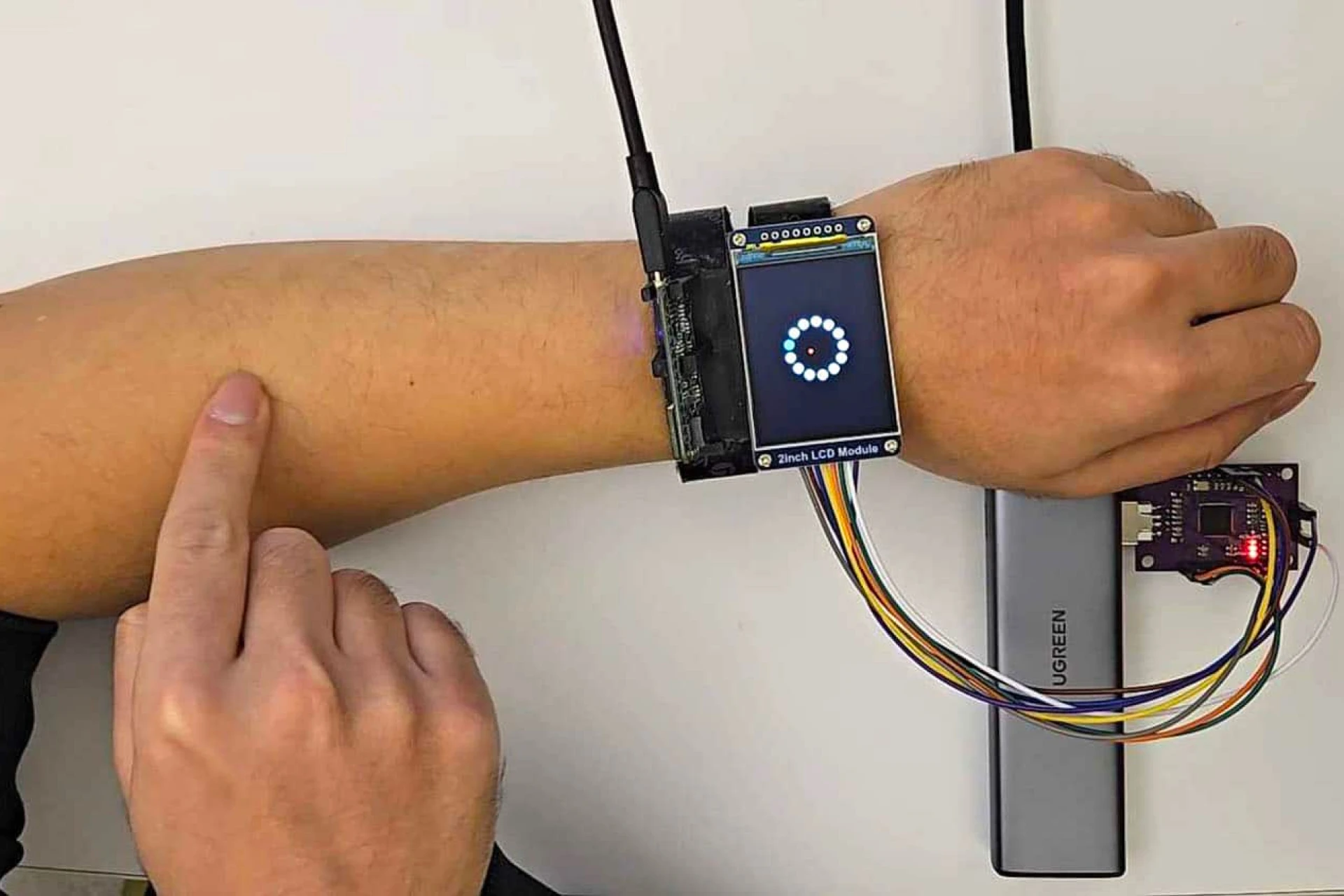
In recent years, smart watches have developed from timers, calculators and exercise trackers to devices that can make calls, play videos, perform GPS navigation and other functions. However, their screens are often smaller than the average person's thumb and cannot accommodate the touch operations people are accustomed to on phones and laptops, such as two-finger scrolling, pinch-to-zoom, or pressing to trigger different commands. The research team hopes to solve this limitation with small wearable technology and provide users with more complete interactive control capabilities.
The core of EpiPad is a compact array of millimeter-wave radar sensors mounted on a wristband, as well as supporting electronic components and signal processing systems. Millimeter-wave radar emits high-frequency electromagnetic waves and analyzes the signals that reflect back from nearby surfaces. When a user places their fingertips on the skin of their forearm, the skin deforms slightly; sliding the finger, clicking continuously, or increasing the pressure will produce different patterns of movement and depression, thereby changing the reflected signal. The system uses this to identify finger movements without the need for any electronic components to be mounted directly on the forearm.
The research team said that the millimeter-wave radar on the wristband can read the tiny indentations formed when the fingertips press the skin, so it can track the position of multiple fingers and the pressing force of each finger. The goal of this system is to allow users to interact with smartwatches in a familiar way and gain input expression capabilities close to those of a MacBook trackpad.
In order to convert radar reflection signals into effective instructions, EpiPad uses a set of processing processes with a lightweight machine learning model as the core. The system can estimate finger position, recognize gestures, and differentiate between different pressure levels, so it can not only tell if a user has touched their arm, but also understand multi-finger movements and pressure-sensitive commands.
In a proof-of-concept experiment, the researchers tested gesture recognition, finger position tracking, and pressure detection on 20 participants. After calibration, EpiPad achieved 92.8% gesture recognition accuracy, 90.2% force detection accuracy, and 10.2 mm ranging accuracy on unseen users. The results show that the system can reliably identify a variety of common touchpad input methods.
The current prototype still looks like a wristband with an exposed circuit board and is not suitable for daily wear. However, the actual radar sensor array measures only 5 by 4 mm, which is small enough to potentially be integrated into an ordinary smart watch. Researchers believe that this technology can not only be used in smart watches in the future, but may also allow screen-less wearable devices such as AI glasses to use the wearer's skin as a complete touch surface, especially for small devices that require complex controls but do not have enough space to install a touch screen.
Using the human body as an electronic interface is not a new concept. As early as 2010, researchers at Carnegie Mellon University developed a wearable system called Skinput, which uses acoustic sensors to detect the unique vibrations produced when users tap different parts of the body, turning arms and hands into touch interfaces. EpiPad uses radar sensing technology based on this idea to support continuous finger tracking, simultaneous multi-finger gestures and pressure-sensitive interaction, making the experience closer to a traditional laptop trackpad.
Cost may also be an advantage of the technology. Researchers say functional components, including radar sensor arrays, are relatively cheap and could cost less than $10 if applied on a large scale in wearable devices.
At present, EpiPad is still in the research prototype stage, and its performance in real daily environments outside the laboratory has yet to be verified. The research team expressed its willingness to cooperate with industry partners to explore how to further miniaturize the technology and integrate it into the next generation of wearable devices. Relevant research papers have been published in the "Transactions of the American Computer Society on Interactive, Mobile, Wearable and Ubiquitous Technologies".
Comments