
Abstract:
“This is a once-in-a-century flood.” A few months ago, Tim Cook described the memory price increase triggered by AI data centers. Now, John Ternus, who took over, has handed over his first financial report since taking office. The situation is very clear: The flood that Cook said has flooded the entire mobile phone industry. Apple has temporarily stood on the shore by raising prices, but the water level is still rising.
Article | "Silicon Valley Observation" column Zheng Jun
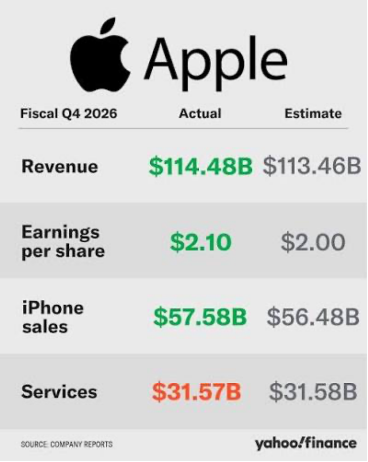
On November 2, Western Time, Apple announced its fourth quarter financial report for fiscal year 2026. Revenue for the quarter was US$114.5 billion, a year-on-year increase of 12%; net profit was US$30.7 billion, both exceeding Wall Street expectations. Among them, iPhone revenue was US$57.58 billion, a year-on-year increase of 17%, setting a historical revenue record for the quarter.
But another set of numbers is equally worthy of attention. According to statistics from market research firm IDC, global shipments of Apple mobile phones fell by 4% year-on-year during the same period. Sales are decreasing, but revenue is rising. This may mean that Apple’s iPhone revenue growth this quarter comes almost entirely from price increases and tariff refunds. Apple shares fell 3% in after-hours trading.
Why did revenue increase when sales dropped?
It should be noted that IDC counts shipments, while Apple confirms sales revenue from channels. The two calibers are not completely consistent. iPhone revenue increased by 17% in the quarter, and shipments according to IDC dropped by 4%. Rough calculations indicate that the average iPhone price needs to increase by approximately 22%.
Although iPhone sales have declined, Apple has increased revenue by raising prices. There are three mechanisms behind this.
First of all, the starting price of last year’s iPhone 17 Pro was US$100 more expensive than the previous generation. This more expensive model was sold in July and August this year. Secondly, users are increasingly choosing Pro and high-capacity versions, and the product mix itself is becoming more expensive. Finally, Apple raised prices across the entire iPhone product line in early September.
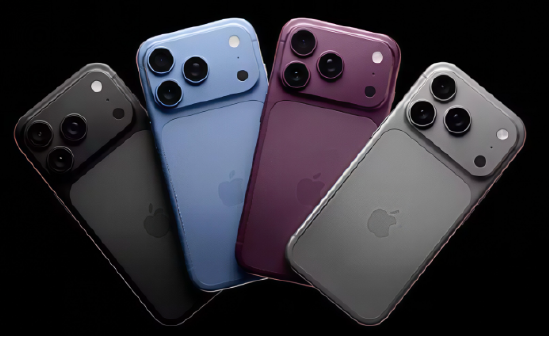
At the September 9 press conference, Apple increased the price of almost every iPhone. The starting price of iPhone 18 Pro has increased from US$1,099 to US$1,199, and the Pro Max has increased from US$1,199 to US$1,299. The large-capacity version has increased even more: the 1TB version has increased by $300, and the 2TB version of Pro Max has directly increased by $500, selling for $2,499.
不仅是新品,连老款也一样涨价。iPhone 17起售价格从799美元涨到899美元,iPhone Air、iPhone 17e和iPhone 16统统涨了100美元。苹果还新推出起售价1999美元的折叠机iPhone Duo,而售价最低的Plus机型则干脆被砍掉。
Under these measures, according to media statistics, the average price of iPhones in the US market has increased by 13%.
What’s more noteworthy is that Apple has not released an “affordable version” at all this fall. The iPhone 18 series has only launched Pro and Pro Max. The standard version of iPhone 18 and the entry-level 18e will be postponed until next spring. Asked by analysts on the call why, Turners dodged the question.
It should be pointed out that in this financial reporting quarter, iPhone 18 Pro was only sold for about 9 days, because Apple’s financial report ended on September 26. The full effect of the price increase will not be truly felt until the next quarter.
Apple can no longer suppress its suppliers
Apple has to raise prices because it has no choice. In the past, Apple was the world's largest buyer of flash memory, purchasing nearly twice as much as Microsoft, Amazon, Meta and Google combined two years ago. Apple is extremely forceful in negotiations, requiring suppliers to provide "most favored customer" treatment, ensuring that no one can get a lower price than Apple, and also has the right to audit suppliers' books.
In order to get Apple's big orders, almost all suppliers chose to swallow their anger and accepted Apple's "unequal demands." More than ten years ago, Apple discovered that the price Micron offered it was not the lowest, and it received tens of millions of dollars in compensation through arbitration. In 2023, flash memory prices will fall to 5 cents per GB, and the entire industry will lose approximately $19 billion. In the same year, Apple made approximately US$14 billion in gross profit from selling storage upgrades.
Now that the situation is changing, it is time for Apple to beg its suppliers for flash memory. Suppliers who have been exploited by Apple for many years no longer need to look at Apple’s face. Amid the tide of the AI arms race, various data centers are frantically purchasing goods. The cloud computing giant's flash memory purchase volume is already about twice that of Apple. Meta, Microsoft and Amazon have also signed more expensive long-term contracts. These are incomparable even to Apple.
According to TechInsights estimates, flash memory prices have increased approximately four times a year. Apple will spend about $25 billion on flash memory this year, while the same amount only cost $6 billion last year. A Kioxia executive made no secret of saying that he hopes days like 2023 will never come again.
In fact, not only Apple, but the entire mobile phone industry is paying for this. IDC data shows that global smartphone shipments plummeted 22% year-on-year from July to September, the largest decline in history. In contrast, Apple only fell 4% during the same period, the smallest decline among the top five manufacturers, and its market share has once again approached Samsung.
Price increase and transfer cost increase
Apple’s response is straightforward: transfer the bill to consumers. Turners said in an interview that Apple raised prices "reluctantly" to offset rising component costs. Judging from revenue growth, Apple has indeed achieved its goals.
The distribution of price increases is also very particular. Apple's biggest increase is precisely the high-capacity version. This is Apple's "invisible money printing machine" for many years.
According to media analysis, by adding an extra level of storage to the iPhone 17 Pro, Apple’s cost increased from about US$15 to about US$66, but it still charged users US$200. Where costs have risen the most, Apple's prices have also risen the most.

Mac’s numbers are even more exaggerated. Mac revenue this quarter was US$10.79 billion, a year-on-year increase of 24%, making it the best-performing hardware business. But IDC data shows that Mac shipments fell 11.3% year-on-year. A sharp decline in sales can still achieve a surge in revenue, relying on sharp price increases.
Apple raised the prices of Mac and iPad as early as June, and the price of MacBook Pro increased by US$300. The first touchscreen MacBook Pro, released last week, has a starting price of $2,899.
But the price increase has not completely caught up with the cost. Apple's total gross profit margin in this quarter was 47.9%, which is ostensibly higher than the 47.2% in the same period last year. However, Apple CFO Kevan Parekh admitted during the conference call that about 1 percentage point came from tariff refunds, and that this refund has basically been collected. After deducting this tariff factor, the gross profit margin for the quarter was approximately 46.9%, slightly lower than the same period last year. Parekh revealed that after deducting refunds, the gross profit margin dropped by about 1 percentage point month-on-month, mainly due to the increase in memory prices.
The story in the Chinese market is exactly the same. Apple’s revenue in Greater China was US$17.54 billion, a year-on-year increase of 21%. Turners said on the call that both the U.S. and Greater China achieved strong double-digit growth and set September quarter records. But the figure was still about $1 billion less than Wall Street expected.
What’s more important is sales. IDC data shows that China’s smartphone market overall shrank by 15.4% in the third quarter, and Apple’s shipments fell by 4.3% year-on-year. Apple's share increased from 15.8% to 17.8% because it fell less than others, not because it sold more than others.
毛利率下滑三个百分点
More pressure is yet to come. Apple shares fell nearly 3% after hours.
This is mainly because Apple expects December quarter revenue to grow 7% to 10%, lower than Wall Street's forecast of 11.4% and the lowest guidance in the past five quarters. The gross profit margin is expected to drop to 45% to 46%, which is two to three percentage points lower than the 48.2% in the same period last year. This is mainly due to the continued rise in memory costs and the new costs brought about by the launch of Siri AI.
The biggest risk in relying on price increases to drive growth is that users don’t buy it. But at least so far, iPhone users are still footing the bill. Apple said it had a record number of replacement users in the September quarter and a record number of active iPhone users. However, iPads and wearable devices did not meet expectations this quarter, indicating that not every product line can withstand price increases.
Apple’s confidence comes from market demand. After the folding screen iPhone Duo opened for pre-order on October 16, it was sold out within a few hours, and the official website delivery time is currently scheduled for late January next year. Turner said frankly that Apple is making every effort to get Duo into the hands of users, but cannot say when it will catch up with demand.
The iPhone Duo also encountered quality problems. Previously, some users reported that the internal screen was cracked. Apple has admitted that the problem does exist, but insists that only a "very small number" of Duos have been returned due to screen problems, and Apple will directly replace the users with new ones. For a new category priced at $2,000 and just launched, this is no small problem.
The iPhone Duo only went on sale on October 23 and was not included in this financial report at all. Its first full quarter will be the biggest variable for Apple this Christmas season.
Comments