
Abstract:
U.S. federal regulators have launched an investigation into Tesla and its steering-wheel-less Cybercab to verify whether the model meets safety standards. Tesla launches Cybercab, a two-seat gold coupe with no pedals or mirrors. Tesla said on Thursday that consumers in Austin, Texas, can already call for rides on its model through its ride-hailing app.
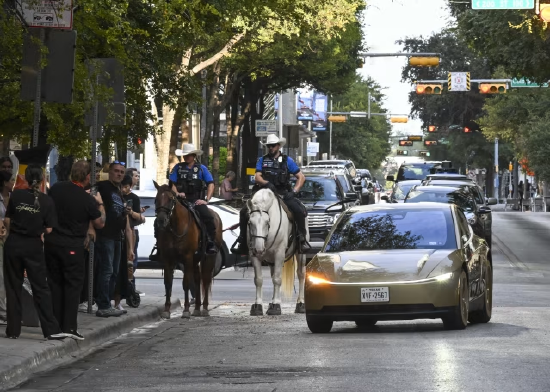
At this week's robot taxi launch event, a Tesla Cybercab drove on the streets of Austin, Texas.
The vehicle’s innovative design has the potential to conflict with federal safety standards established decades ago primarily for conventional motor vehicles. Tesla told the National Highway Traffic Safety Administration (NHTSA) that Cybercab met "all applicable" standards, regulators disclosed in documents made public on Friday.
But regulators want to verify the processes and technical data Tesla relied on to reach compliance conclusions. NHTSA said it would conduct a review to assess the extent to which Tesla's certification work was based on the judgment that "some safety standards do not apply to Cybercab."
This investigation may trigger conflicts between regulatory agencies and car companies. Tesla is working to transition from a traditional electric car manufacturer to building fully autonomous vehicles. The document shows that Tesla informed NHTSA that it plans to "gradually expand the commercial deployment of Cybercab, increase the number of vehicles launched, and expand operating areas."
If NHTSA determines that the Cybercab does not meet federal safety standards, after going through a series of statutory procedures, the regulator can order a recall to resolve the issues. If Tesla refuses to implement the recall order, it will face huge fines.
It is also possible that regulators will determine that the model is compliant without any changes.
Tesla did not respond to a request for comment; an NHTSA spokesman also had no immediate comment.
This survey reflects the current situation of the industry: more and more companies are launching vehicles that eliminate traditional manual control components such as steering wheels and brakes, and regulatory authorities are facing numerous challenges. In the United States, car companies generally do not need to obtain NHTSA approval in advance to produce new vehicles.
Car companies adopt
self-certification
mode to self-certify that the vehicle sold meets all relevant safety regulations. But the rules were set decades ago and did not take into account new forms of vehicles like the Cybercab.Relying on the self-certification system, NHTSA often has to wait until the vehicle has been driven on the road before NHTSA can determine whether the vehicle complies with all regulations.
NHTSA has proposed new regulations to eliminate the mandatory requirement that autonomous vehicles must be equipped with manual pedals, with the purpose of accelerating the implementation of autonomous driving technology. However, this new set of regulations has not yet taken effect.
Regulators have previously taken action against companies that claimed that vehicles without steering wheels and pedals met federal safety standards. In 2022, Amazon's Zoox completed self-certification, claiming that its steering wheel-less and pedal-less self-driving taxis meet NHTSA safety standards. Regulators objected and ultimately determined that the Zoox driverless taxis did not meet some safety standards.
In July of this year, NHTSA approved Zoox’s application for paid commercial operations. But there are restrictions: Zoox vehicles are not allowed to operate in heavy rain or snow, or on roads with speed limits higher than 45 mph.
NHTSA said Tesla did not submit a similar exemption application.
Tesla revealed that it aims to sell Cybercab to ordinary consumers in the future, with a starting price of less than $30,000. Tesla has currently built an annual production capacity of more than 125,000 Cybercab vehicles.
As of Thursday, Tesla has registered 45 Cybercabs in Texas for self-driving ride-hailing business. After adding the self-driving version of Model Y, the state’s total robotaxi fleet reaches 420 vehicles.
Comments