
Abstract:
Prime Medicine, an American biotechnology company, officially announced that it has completed the world’s first in-human Prime Editing drug delivery trial.
This is also the first time that leading editing technology has directly rewritten DNA in a living patient, which is a milestone event in the field of gene editing. In the trial, they infused the experimental drug PM577a into a patient with Wilson's disease (hepatolenticular degeneration).
Wilson's disease is caused by mutations in the ATP7B gene. The patient's liver cannot metabolize and excrete copper normally, and copper continues to accumulate, causing continuous damage to the liver and nervous system. Existing solutions can only be controlled by long-term medication and cannot be cured
, the goal of this therapy is to correct this pathogenic mutation.Unlike CRISPR-Cas9, pilot editing does not cut the double strands of DNA. It is more like a "find and replace" tool in the genome. It relies on Cas9 nickase and reverse transcriptase to complete base modifications. In theory, it has lower off-target risks and more accurate editing.
The drug is delivered through lipid nanoparticles (LNP), enters the blood through intravenous infusion, and reaches the liver cells in a targeted manner to perform DNA modification. It is an in vivo editing. There is no need to remove the cells for modification outside the body and then reinfuse them. If it matures in the future, it is expected to significantly reduce the cost of treatment and simplify the process.
This administration took place on October 5 and is a phase 1/2 clinical trial. Only administration has been completed so far. Safety and effectiveness data have not yet been released. The first batch of research results are not expected to be announced until 2027.
Patients will undergo long-term monitoring to track copper metabolism indicators, liver status, and potential gene editing side effects.
From an industry perspective, CRISPR in vivo editing therapies have entered clinical practice in the past, but pilot editing has always remained in the laboratory stage. The implementation of this trial has opened up a new direction for the treatment of precise single-base genetic diseases.
However, this therapy also has certain risks.
The long-term safety of LNP delivery and in vivo gene modification is still unknown,
There is still a long clinical trial period before official launch.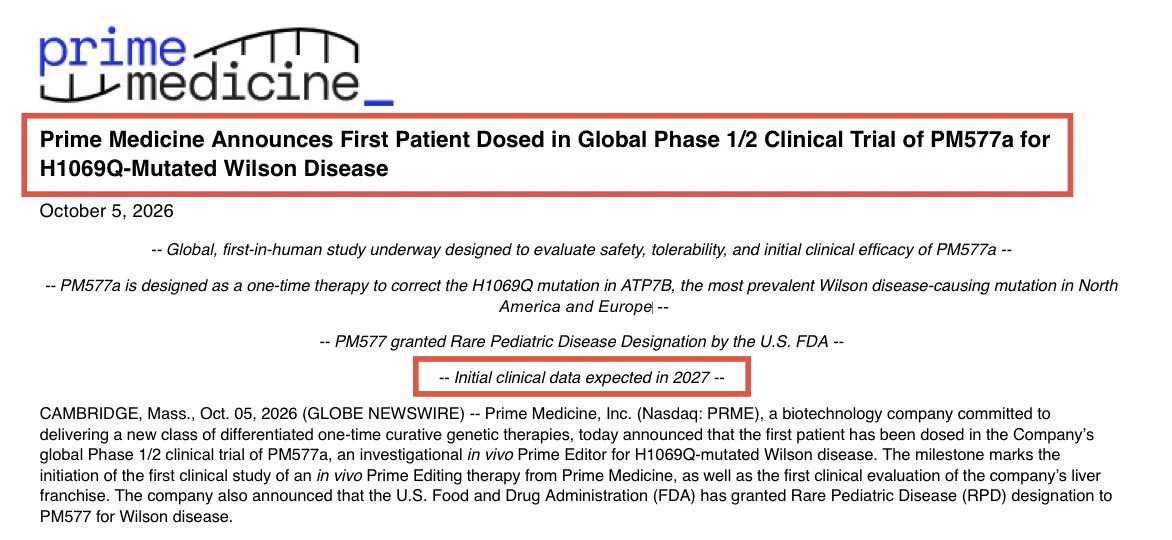
Comments