
Abstract:
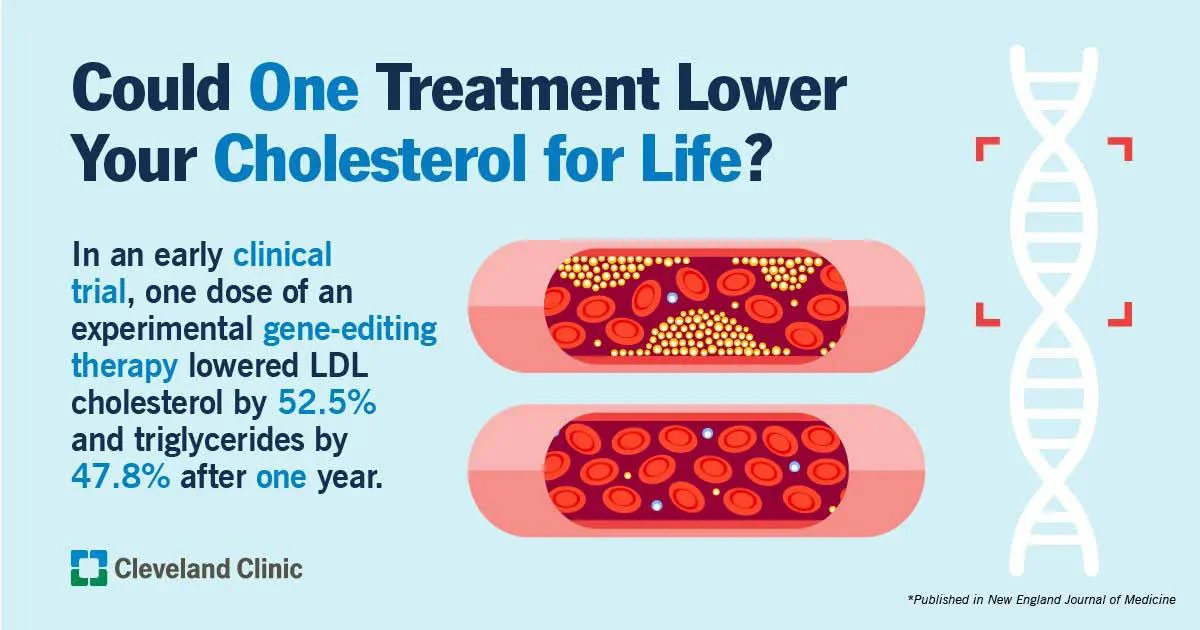
An experimental CRISPR-Cas9 gene-editing therapy showed interesting lipid-lowering effects in a first-in-human clinical trial. The researchers found that patients experienced significant decreases in low-density lipoprotein cholesterol (LDL-C) and triglyceride levels after receiving just one infusion, and the effects lasted for at least 12 months. Among patients who received the highest dose of treatment, LDL-C was reduced by 52.5% and triglycerides were reduced by 47.8% after one year compared with before treatment.
The experimental therapy, called CTX310, was developed by CRISPR Therapeutics and is targeted at people whose cholesterol and other blood lipids cannot be adequately controlled even with existing drug treatments. Unlike traditional lipid-lowering treatments that require long-term medication, CTX310 is designed to fundamentally change the way the liver regulates blood lipids through one gene editing, so that the lipid-lowering effect can be maintained for a long time.
The target gene targeted by CTX310 is ANGPTL3. This gene is involved in the regulation of human lipid metabolism, and the protein it produces affects blood cholesterol and triglyceride levels. The researchers hope that by turning off ANGPTL3 in liver cells, these harmful blood lipids can be maintained at lower levels over the long term.
CTX310 uses the CRISPR-Cas9 system to accomplish this. CRISPR-Cas9 can cut and edit specific regions in DNA. In the design of CTX310, the gene editing tool is delivered to the liver to disable the ANGPTL3 gene in liver cells. Since the liver is an important organ in the human body for regulating blood lipids, only changing a part of its cells may produce sustained systemic lipid-lowering effects.
A total of 15 patients participated in this phase I clinical trial, which is the first time CTX310 has been tested on humans. Subjects received an intravenous infusion at doses of 0.1, 0.3, 0.6 and 0.8 mg per kilogram of body weight. Patients also need to receive pretreatment with corticosteroids and antihistamines before receiving CTX310 to reduce risks associated with the infusion and immune response.
Researchers continued to measure patients’ ANGPTL3 levels, LDL cholesterol and triglyceride levels after treatment. Previously published early results showed that the patient's blood lipids had dropped significantly after two months of treatment, and the data released this time focus on answering a more critical question: How long can the lipid-lowering effect of this gene editing last?
The results showed that the lipid-lowering effect persisted throughout the 12-month follow-up period, and sustained reductions were observed in all dose groups. In the highest-dose group, LDL-C was still 52.5% lower than baseline levels after one year of treatment, and triglycerides were 47.8% lower.
This means that after a patient receives one treatment, the "bad cholesterol" in their blood a year later is still only about half of what it was before treatment. For people who need long-term control of high cholesterol, if this effect can be verified in larger clinical trials, one-time gene editing treatment may theoretically change the model of traditional lipid-lowering treatments that require long-term continuous medication.
The persistence of this effect is particularly concerning because gene editing is fundamentally different from ordinary drugs, the researchers said. Traditional drugs usually require continuous administration to maintain their efficacy, while CTX310 aims to permanently shut down ANGPTL3 at the DNA level of liver cells. Therefore, as long as the edited liver cells continue to exist and maintain the corresponding state, the lipid-lowering effect can theoretically continue to be produced.
However, the current trials are still very small. The data from 15 patients can be used to judge whether CTX310 is worthy of further study, but it is far from enough to prove that this therapy is safe and effective, let alone whether it can replace statins or other mature lipid-lowering treatments in the future.
Safety is also one of the most important observation indicators in this study. Researchers found no serious adverse events related to CTX310 treatment during the 12-month follow-up period. The research team believes that the current results are encouraging, but due to the very limited sample size, larger clinical trials are still a necessary step to evaluate the safety of the therapy.
Gene editing therapy also has an important problem that is different from ordinary drugs, that is, the therapeutic effect may be long-term or even permanent. Once the DNA has been altered, the effects of the treatment cannot be lost immediately by simply stopping the drug. So, in addition to short-term side effects, researchers must watch patients long-term for delayed immune responses, liver problems, off-target editing or other previously unanticipated effects.
Therefore, the U.S. Food and Drug Administration (FDA) requires long-term safety follow-up for all clinical trial participants who receive gene editing therapies. Subjects in the CTX310 trial will receive additional follow-up for up to 15 years to observe possible long-term effects of gene editing.
Another important significance of this study is that it demonstrates the possibility of expanding CRISPR gene editing from rare genetic diseases to common chronic diseases. Previously, CRISPR therapies have mainly attracted attention in serious genetic diseases such as sickle cell disease, but CTX310 attempts to target more common cardiovascular disease risk factors.
High LDL cholesterol and high triglycerides are both important risk factors for cardiovascular disease. Elevated LDL cholesterol promotes atherosclerotic plaque formation, while long-term elevated triglycerides are also associated with increased risk of cardiovascular disease. If a single gene edit could simultaneously and long-term reduce these two blood lipids, it could theoretically reduce the risk of future cardiovascular events.
However, it should be noted that this current study only proves that CTX310 can continuously reduce blood lipids, and does not prove that patients reduce clinical events such as myocardial infarction, stroke or death. To answer this question, larger and longer follow-up clinical trials are needed.
The findings were announced by the Cleveland Clinic research team and published in the New England Journal of Medicine. Luke Laffin, the first author of the study and a cardiologist at Cleveland Clinic, said that compared with the preliminary data released in November 2025, the one-year follow-up results show that the lipid-lowering effect of CTX310 is significantly sustained.
The research was funded by CRISPR Therapeutics, and Laffin’s institution has also received research funding from the company. The research team currently plans to continue to expand the scale of clinical research to further evaluate the safety, optimal dosage and long-term lipid-lowering effect of CTX310.
If follow-up trials can prove its long-term safety and cardiovascular benefits, this type of "one-time treatment, long-term lipid-lowering" gene editing therapy may provide new treatment methods for some patients who are difficult to control blood lipids through traditional drugs. But from the current point of view, CTX310 is still in the very early stage of clinical development, and there is still a long way to go before it becomes a routine treatment that ordinary patients can accept.
Comments