
Abstract:
A biotechnology company that focuses on the research and development of artificial intelligence drugs recently announced research results that an experimental drug it participated in the development of using AI showed the potential to reduce biological age indicators in clinical trials. In just four weeks, the biological age assessment results of some patients who received the treatment dropped for several years, triggering widespread concern in the medical community about the development of AI-assisted anti-aging drugs.
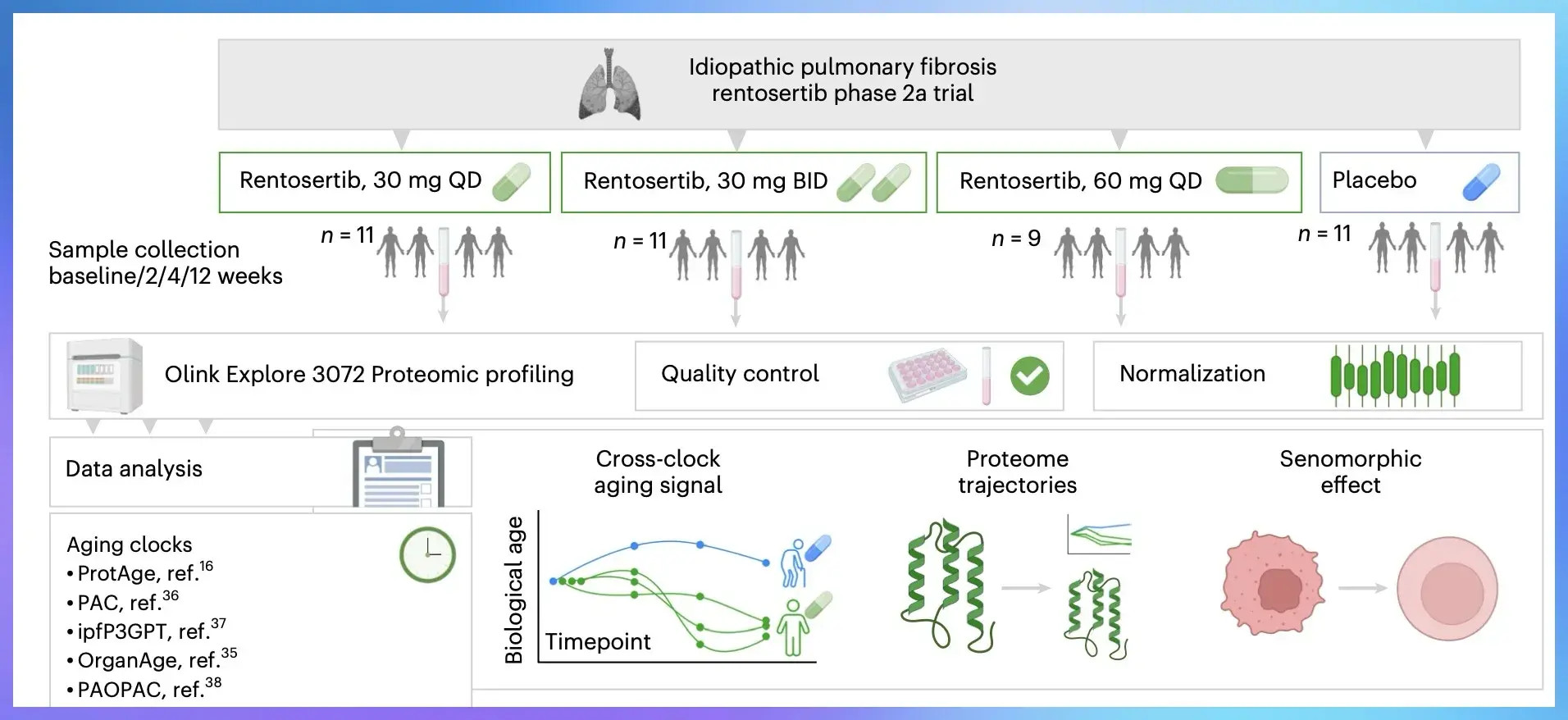
This experimental drug called Rentosertib was developed by Insilico Medicine. It was not originally targeted at delaying aging, but was used to treat idiopathic pulmonary fibrosis. The disease causes progressive scarring of lung tissue, causing ongoing respiratory deterioration. According to the company, the artificial intelligence system not only helped researchers identify the key target protein TNIK, but also participated in the design process of the drug's molecular structure.
The newly published study reanalyzed data from a Phase IIa clinical trial. The trial originally included 71 Chinese patients, of which the data of 42 patients were used for aging-related assessments. The average age of these participants was about 67 years old, and the research team continued to track changes in their blood samples during the 12-week observation period.
To assess the drug's impact on markers of aging, the researchers used six different "aging clock" models. Such computational models analyze the composition of proteins in the blood to estimate a person's biological age or risk of death. The results showed that all six models detected signs of a transition to a "younger state" in patients receiving drug treatment, while there was basically no significant change in the placebo group, and some indicators even showed slight deterioration.
Across different dosage regimens, researchers observed varying degrees of improvement. Four age-based prediction models showed an average decrease in biological age of approximately 2.7 to 3.5 years after four weeks of treatment for patients taking the 60 mg daily dose. However, two other models that primarily assessed mortality risk did not observe statistically significant changes.
The research team also found that dosing 30 mg twice a day showed a more stable and consistent improvement trend. In some models evaluated, patients' biological age decreased by as much as several years.
However, scientists involved in the study also reminded the outside world that these results should not be simply understood as the human body really "getting a few years younger." The so-called age decline mainly refers to the prediction results made by relevant models based on changes in blood proteins, rather than the regression of the natural age of the human body.
The researchers point out that it is still not possible to clearly distinguish whether these improvements are due to the drug's effect on the aging process itself, or whether the overall health of the body is improved after the lung disease condition is alleviated, thus affecting related indicators. It is worth noting that the dosage regimen with the most obvious effect in improving lung function is not exactly the same as the dosage regimen with the most obvious decrease in biological age, which means that the drug may indeed have an anti-aging effect that is partially independent of the lung treatment effect.
This research is also regarded as an important case of the application of artificial intelligence in drug research and development. Artificial intelligence not only participates in the discovery of drug targets and molecular design, but also subsequently uses machine learning models to evaluate changes in aging indicators in clinical trials, forming a complete AI participation chain from research and development to verification.
While the results are encouraging, the study was small and all participants had idiopathic pulmonary fibrosis. It's unclear whether the drug will have similar effects in healthy people, or whether it can extend lifespan or actually slow down the aging process.
At the same time, there is also debate in the academic community about the reliability of the "aging clock" itself. Different models use different biomarkers and calculation methods, and there is currently no uniformly recognized biological age measurement standard. Therefore, some experts believe that these indicators can serve as important research tools, but they are still far from becoming the ultimate standard for measuring human aging.
Insilico Medicine has announced the launch of a larger phase III clinical trial. The trial is expected to recruit 320 patients, continue observation for 52 weeks, and focus on evaluating the drug's impact on lung function. At present, Rentosertib is still an experimental drug and has not yet been approved by regulatory agencies for marketing.
Analysts believe that although there is still a long way to go before a true anti-aging drug, this study demonstrates for the first time a drug candidate discovered and assisted in the design of targets by artificial intelligence, which may affect human aging-related indicators in addition to disease treatment. This provides new research directions for using artificial intelligence to develop life extension and healthy aging therapies in the future.
Comments