
Abstract:
Anthropic and medical knowledge platform OpenEvidence announced a partnership. The two parties plan to provide artificial intelligence-based clinical decision support tools for free to doctors in areas outside the United States and Europe where medical resources are relatively scarce. They hope to use AI to expand the scope of access to evidence-based medical knowledge and help local medical staff cope with problems such as insufficient medical literature, specialists, and continuing medical education resources.
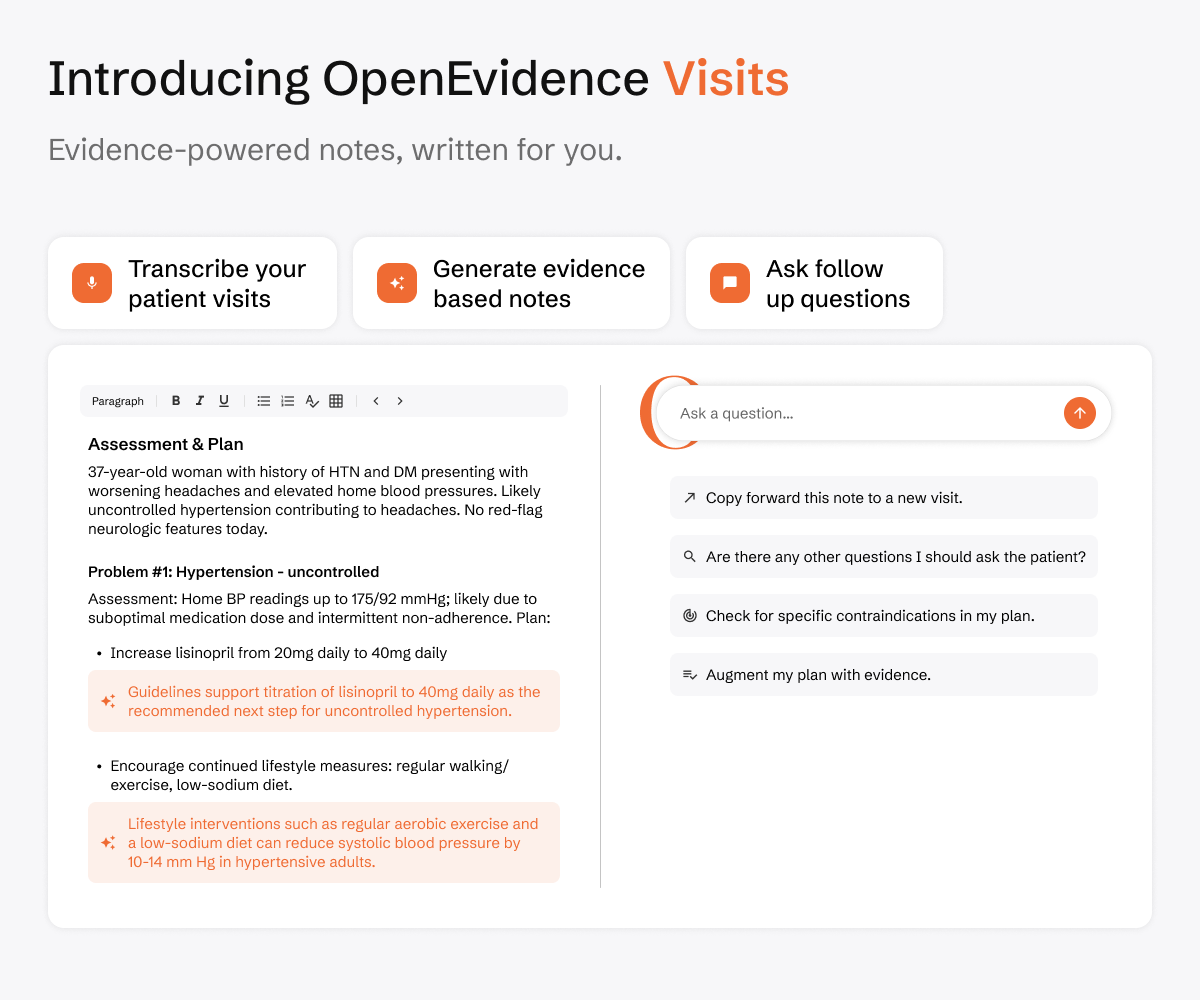
OpenEvidence is a medical knowledge platform for clinicians that answers questions from doctors based on peer-reviewed medical research and clinical treatment guidelines. Currently, the platform is open to clinicians in the United States and Europe for free. The collaboration between the two parties is to launch a special version for areas with limited resources, which will be provided free of charge to medical workers in dozens of low- and middle-income countries.
According to the list published by OpenEvidence, this plan is being gradually promoted in about 100 countries, including Uganda, Angola, Sudan, Haiti and Mongolia. In this way, the two companies hope to reduce the restrictions on access to medical knowledge caused by geographical location, because in some areas with insufficient medical resources, doctors may lack the latest medical literature, specialist expert support and access to continuing medical education. These factors may further affect patients' access to high-quality medical services.
Healthcare systems around the world are currently exploring whether generative AI can alleviate the shortage of doctors and medical specialists. Supporters believe that AI can help doctors quickly retrieve and organize large-scale medical information to provide assistance in the diagnosis and treatment process; but at the same time, some people are worried that if the AI system mainly uses medical data from high-income countries for training, then the recommendations they provide may not be fully consistent with the actual situation in areas with fewer resources, including common local diseases, diagnostic conditions, medical equipment and available drugs.
OpenEvidence founder Daniel Nadler said that access to medical knowledge should not depend on the geographical location of the doctor. He revealed that in August this year alone, American clinicians conducted 42 million consultations through OpenEvidence, and it is expected that by 2026, hundreds of millions of American patients will receive medical services provided by doctors who use OpenEvidence to assist work.
In this cooperation, Anthropic is mainly responsible for providing back-end support at the AI technical level, while OpenEvidence is responsible for adjusting the system according to the medical environment in different countries and regions. The parties say the system will not simply copy tools designed for U.S. or European healthcare systems into low-resource settings, but will take into account differences in local healthcare infrastructure and clinical practices.
Daniela Amodei, President of Anthropic, said that artificial intelligence technology has made great progress in recent years, making it technically possible to provide such medical assistance tools to areas with limited resources. But she also believes that relying solely on traditional market mechanisms, it is difficult for these technologies to naturally enter areas that lack commercial returns. Therefore, entrepreneurship and public welfare investment are needed to promote them.
In fact, OpenEvidence has already begun similar attempts before. Earlier this year, the company announced it was working with medical institutions in Rwanda and Botswana to adapt AI tools based on differences in disease types, diagnostic resources and available treatments between local and developed countries.
Nadler said that the systems developed by the company for these regions will attach great importance to the local environment and emphasized that relevant tools need to have "context adaptation" capabilities. In other words, the same medical question may need to be answered in different countries with completely different medical conditions, such as whether a certain examination can be performed locally, whether the hospital has the corresponding equipment, whether a certain drug is available, and what kind of treatment path local doctors usually use.
This plan also has the special advantage of having relatively low infrastructure requirements. Nadler pointed out that even if medical institutions in some areas cannot guarantee 24/7 power supply, most doctors still have smartphones, so it is still possible to access high-quality medical information through mobile devices that in the past could only be provided by the world's top medical institutions such as the Mayo Clinic.
This model is particularly attractive in countries with limited access to medical journals and expertise. Ahmed Bendary, a cardiologist at Benha University in Egypt, said that if this medical AI service can be further expanded to regions outside the United States and Europe, it will bring significant changes, especially when local medical institutions have difficulty subscribing to major medical journals. Tools that can quickly obtain evidence-based medical information at the clinical site may be of higher value.
However, the global promotion of medical AI also means that the system must face huge differences in the medical environment between different countries. Disease spectrum, medical equipment, drug supply, doctor training level, and diagnosis and treatment specifications may all be significantly different. Therefore, even if the information provided by AI is accurate at the level of medical knowledge, it may not necessarily be directly translated into locally executable treatment plans. This cooperation therefore places more emphasis on adjustments to specific regions, rather than simply copying the same AI system to all countries.
Anthropic is accelerating its expansion into the medical and life science fields recently. Shortly before the announcement of this collaboration, Anthropic had established its own biology laboratory, started conducting actual biological research, and tried to further extend its artificial intelligence capabilities to the field of drug development. This cooperation with OpenEvidence represents that Anthropic is moving further from drug and biological research into the field of clinical medical knowledge and physician decision support.
The two parties did not announce the financial terms involved in this cooperation. For OpenEvidence, this cooperation means that its medical knowledge platform, which originally mainly served clinicians in the United States and Europe, has begun to expand globally; for Anthropic, it means that its AI models are entering more areas where advanced medical information was previously difficult to obtain through the medical professional platform.
As generative AI gradually enters the medical system, this type of cooperation also reflects an increasingly obvious trend: the competition in AI medical applications is no longer just about the capabilities of the model itself, but begins to turn to how to combine medical knowledge, clinical guidelines and AI reasoning capabilities, and adapt them according to the medical reality in different regions. This Anthropic and OpenEvidence plan covers about 100 countries. Whether it can truly improve local doctors' ability to obtain medical knowledge and make clinical decisions will also depend on the degree of localization of the system and how doctors use it in actual medical environments.
Comments