
Abstract:
Scientists have discovered that the gradual loss of the Y chromosome in men as they age may not only be a common genetic phenomenon in the aging process, but may also be more directly linked to the formation and development of cancer. A new study by researchers at the University of Arizona found that the degree of Y chromosome loss in a tissue changes significantly with the distance from the cancerous tissue. The closer to the tumor area, the more severe the Y chromosome loss is. This phenomenon may provide a new biomarker for early identification of cancer.
The Y chromosome itself is a relatively small chromosome in the human genome, carrying only a few dozen genes. In addition to participating in processes such as male sex determination and sperm production, many genes on the Y chromosome are not directly involved in daily physiological activities of the human body like a large number of genes on other chromosomes. Therefore, in the past, the scientific community believed that the gradual loss of the Y chromosome in some cells of adult men might just be a genetic change with limited impact during the aging process.
But in recent years, more and more studies have found that the situation may not be that simple. About 40% of 70-year-old men have lost part of their body tissue; by the age of 90, this proportion is close to 60%. Because not all cells in the body lose the Y chromosome at the same time, but some cells undergo this change, the human body will form a "mosaic" state: different cells of the same person may have normal XY chromosomes, or only the X chromosome may be left.
This phenomenon is called "mosaic Y chromosome loss", or mLOY in English. Past studies have found that mLOY is statistically associated with a variety of health problems, including chronic kidney disease, tissue fibrosis, and an increased risk of severe COVID-19 infection. In recent years, scientists have frequently observed Y chromosome loss in renal cell carcinoma and esophageal cancer tissues, so they began to further study whether it is just an accompanying phenomenon after the formation of cancer, or whether it may be involved in the development of cancer.
This time the research team analyzed approximately 1,000 tissue samples from more than 400 male donors. The samples covered 11 major organs, and also included normal tissue, precancerous tissue, and malignant tumor tissue. The researchers thus established a map of the degree of Y chromosome loss and changes in gene expression in different tissue states.
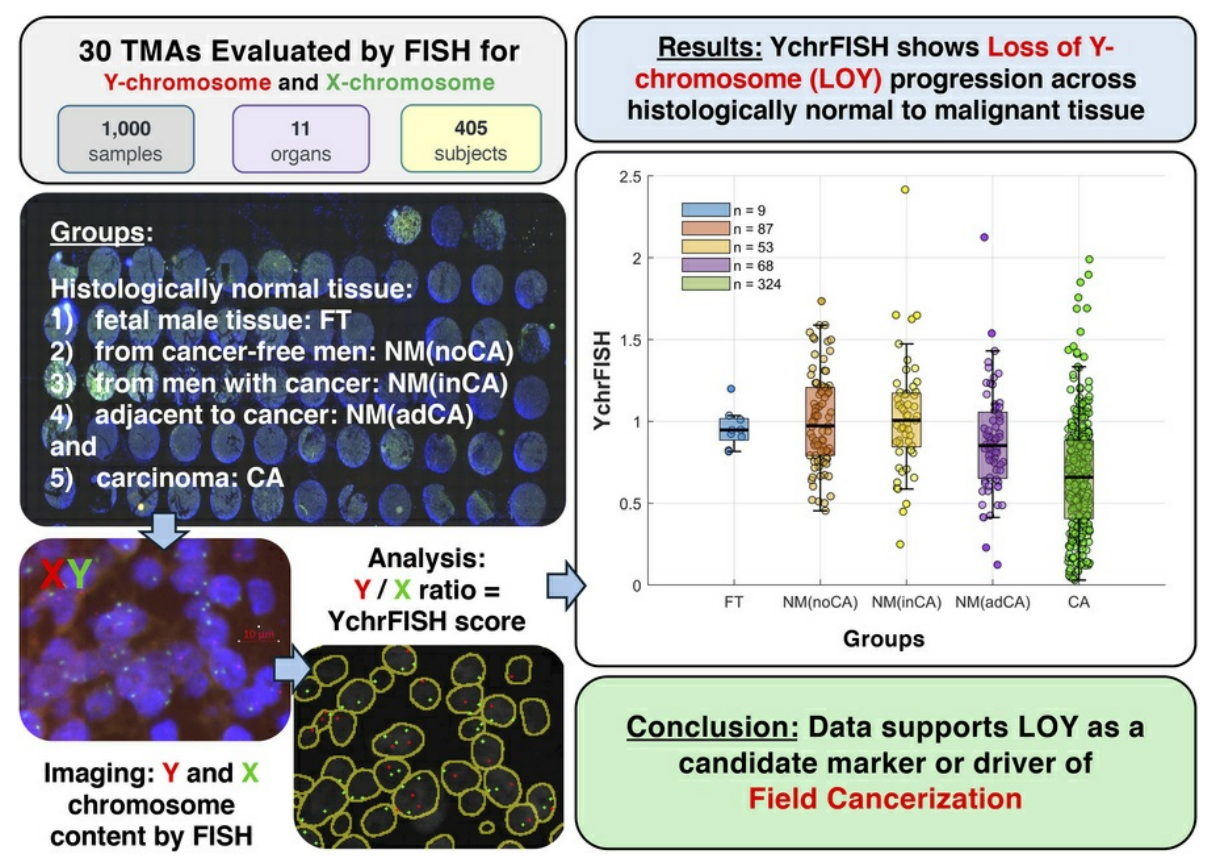
The results show that Y chromosome loss is not simply a "yes or no" state in cancer tissues, but more like a continuous gradient. The degree of Y chromosome loss in normal tissues is relatively low, further increases after entering precancerous areas, and is more obvious in malignant tumors and nearby tissues.
The researchers describe this phenomenon as a gradually steepening hill: the closer the tissue is to the cancer, the more severe the Y chromosome loss becomes. This discovery changes part of the past understanding of the relationship between mLOY and cancer, because it suggests that Y chromosome loss may not only occur within already formed tumor cells, but may affect the wider tissue environment surrounding the tumor.
The researchers also further measured the transcriptional activity of the genes in the tissues. The results show that the more Y chromosomes a tissue retains, the higher its expression of Y chromosome-related genes is generally. This shows that changes in the number of Y chromosomes may not be purely genetic markers, but may directly change the gene activity of cells.
The research team believes that this change may form a so-called "field effect." In other words, when some tissue cells gradually lose their Y chromosome, the expression of related genes and cell status change. This effect may spread to the surrounding tissue environment, making more cells more susceptible to cancer.
Previous research has found similar gradients between the degree of Y chromosome loss and the severity of other diseases. For example, among patients with heart failure, those with more significant Y chromosome loss are more likely to develop cardiovascular problems. Together, these studies suggest that mLOY may not be a completely harmless age-related genetic phenomenon.
Based on previous research results, the researchers speculated that ongoing Y chromosome loss may lead to local inflammation and further change the biological state of the tissue, making it easier for cells to enter an environment conducive to cancer formation. However, this mechanism is still a research hypothesis, and it cannot be proved that Y chromosome loss itself is the direct cause of cancer.
The really important finding of this study is that there is a clear spatial association between Y chromosome loss and tumors. As the tissue gets closer to the tumor, the degree of Y chromosome loss gradually increases. The researchers believe that this "gradient" may in the future become an auxiliary clue for doctors to determine whether there is a potential tumor in the tissue.

Dan Theodorescu, a urological oncologist at the University of Arizona and senior author of the research paper, said that if this pattern is confirmed in further research, doctors may in the future detect small tumors that are not directly picked up by routine biopsies by detecting the degree of Y chromosome loss in tissue.
This is particularly potentially valuable for cancer diagnosis. Traditional biopsy relies on removing a small piece of tissue from the patient for pathological analysis. If the tumor is very small or the sampling location does not cover the tumor, the diagnosis may be missed. If Y-chromosome loss reflects changes occurring in the tissue surrounding a tumor, it could theoretically serve as an additional "warning sign" to help doctors determine whether an area deserves further testing.
However, researchers currently do not believe that Y chromosome loss can be directly used as a cancer diagnosis method, nor have they proven that all men who develop mLOY will develop cancer. Y chromosome loss itself is very common with age, and cancer development is influenced by a combination of genetic, environmental and lifestyle factors. Therefore, the current more accurate understanding is that mLOY may be a biological marker related to cancer risk rather than a definite cancer predictor.
The research results were published in the journal "JCI Insight". The research team still needs to conduct verification with more samples and different types of cancer in the next step, and further confirm whether Y chromosome loss is one of the causes of cancer development or a result of the carcinogenesis process. If this spatial gradient turns out to have stable diagnostic value, a chromosomal change that was originally thought to be a concomitant of aging may become an important clue in the search for early cancer in the future.
Comments