
Abstract:
In the fight against malignant tumors, lung cancer is still one of the cancer types with the highest fatality rate. Recently, a research team from Columbia University Vagelos School of Medicine published a breakthrough study in the journal Nature Immunology. Scientists have discovered a previously unknown group of special fibroblasts around lung tumors that can act as a "protective umbrella" for malignant tumors and help cancer cells successfully evade recognition and elimination by the host's immune system.
This discovery not only reveals a key mechanism by which lung cancer evades immune surveillance, but also points to a new direction for the future development of targeted anti-cancer therapies.
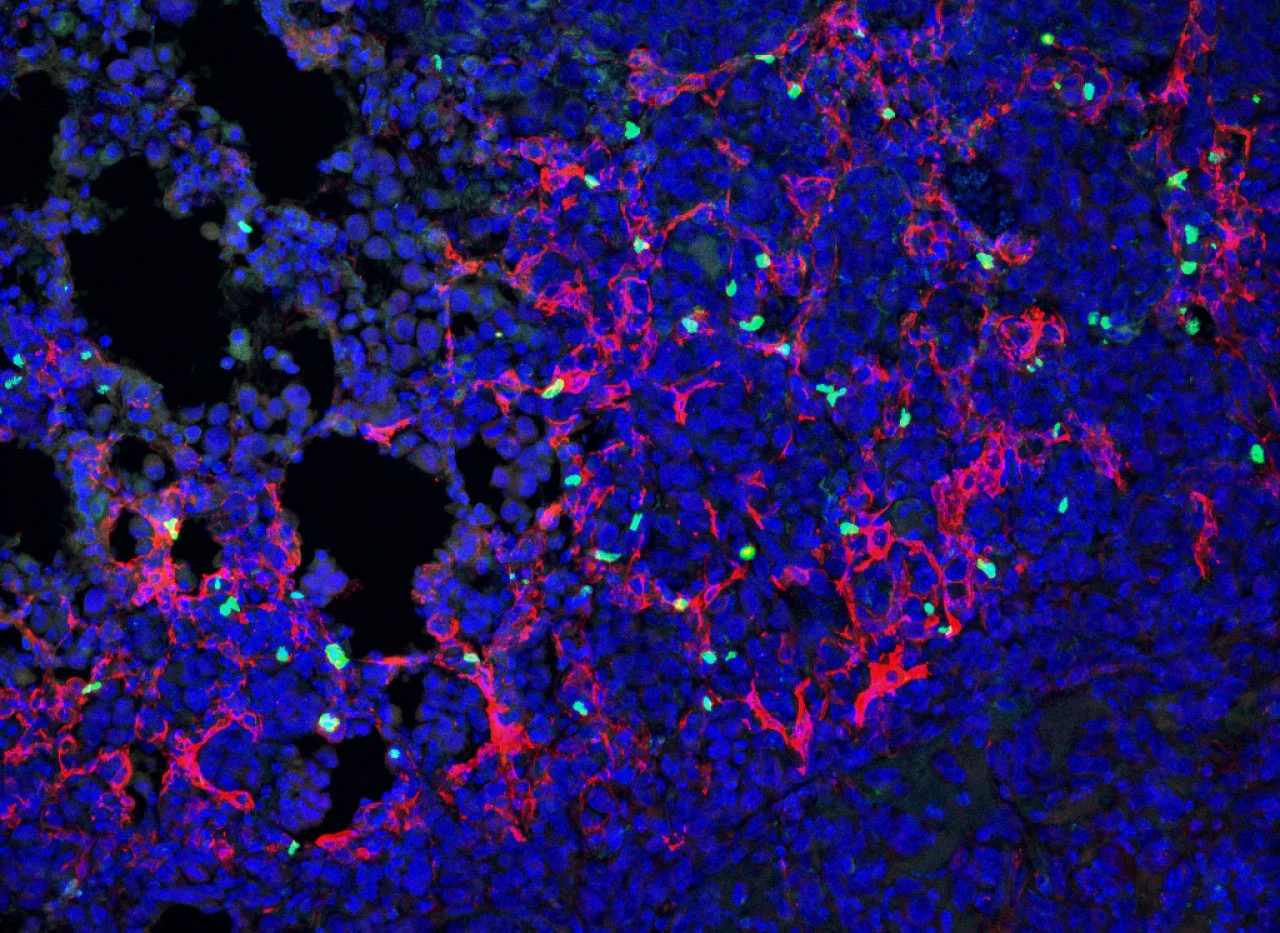
Fibroblasts themselves are a type of common cell that is widely present around solid tumors. For a long time, they were thought to merely constitute a physical barrier surrounding tumors. However, in the past five to ten years, more and more studies have confirmed that some tumor-related fibroblasts actually play an "accomplice" role, directly promoting the survival and deterioration of cancer cells, and their activity level is closely related to the patient's prognosis. Previous academic research on this type of cancer-related fibroblasts was mostly focused on pancreatic cancer, but little is known about their specific operating mechanisms in the lung cancer microenvironment.
Olivia Ringham, the lead author of this study and a graduate student at Columbia University, used single-cell transcriptome sequencing technology to conduct a detailed analysis of various types of fibroblasts in a mouse model of lung cancer. This advanced single-cell resolution sequencing method can capture the gene expression characteristics of individual cells, thereby mining unknown subpopulations hidden in ordinary tissues. The analysis revealed the presence of a specialized population of fibroblasts that express the CHL1 gene in lung cancer tissue, while these cells were completely absent in healthy lung tissue.
Through further tracking and pathological section observation, the researchers elucidated the specific mechanism by which this group of CHL1-expressing fibroblasts assists tumor escape. Under normal physiological conditions, the human lungs inhale a large amount of external environmental antigens every moment. The body must rely on regulatory T cells to suppress excessive immune responses to prevent every breath from inducing strong and destructive inflammation. However, in lung cancer lesions, these abnormal fibroblasts secrete a signaling protein called CXCL9, which recruits a large number of immunosuppressive regulatory T cells to the edge of the tumor, artificially building a dense immune shielding zone. This allows the protective mechanism originally used to maintain the physiological balance of the lungs to be used by tumors, preventing lethal immune cells from attacking cancer cells.
In animal model experiments, a research team from Columbia University and collaborators from the University of Toronto in Canada tried to block this molecular signaling system. When the researchers genetically inactivated the relevant signaling pathways, the number of regulatory T cells accumulated around the lung cancer was significantly reduced, and the immune system in the mice was able to regain its ability to attack lung tumors. This experiment directly confirms that recruitment of immunosuppressive T cells is one of the core survival strategies used by lung cancer to circumvent the body's immune clearance.
More importantly, the researchers also verified the existence of this mechanism in human lung cancer samples. By comparing tumor tissue sections in the Columbia University Biobank with the clinical follow-up data of corresponding patients, the team found that lung cancer patients with a higher number of CHL1 fibroblasts in the tumor had significantly weaker autoimmune responses against the cancer and had significantly lower progression-free survival.
Regarding the clinical translation value of this discovery, Nicholas Arpaia, corresponding author of the study and associate professor of microbiology and immunology at Columbia University, pointed out that this mechanism provides two potential intervention paths for lung cancer treatment: one idea is to directly target regulatory T cells recruited by fibroblasts, thereby lifting the immune brake; another, more precise idea is to directly target CHL1 Intervening with fibroblasts themselves or their signaling pathways, because these cells do not occur in healthy lung tissue, targeting them is expected to minimize damage to normal tissue. The research team stated that future work will focus on clarifying the origin and differentiation triggers of this type of abnormal fibroblasts, striving to block their formation process at an earlier stage, and explore more promising immunotherapy options for conquering lung cancer.
Comments