
Abstract:
On September 17, "Jianjie News" learned from Huawei channels: Many dealers have received notices from Huawei that starting from January 1, 2027, Wenjie will officially withdraw from Hongmeng Zhixing and Huawei stores. Dealers can choose to act as agents for the other four brands of Huawei, Hongmeng Zhixing or Wenjie. This is the third action in 72 hours.
On September 15, Hongmeng Intelligent Publishing released the "Explanation on the Wenjie Cooperation Model". Wenjie's product definition, product design, brand marketing, channel retail, and service system will all be led by Cyrus, and Huawei terminals will retreat to "participation and empowerment."
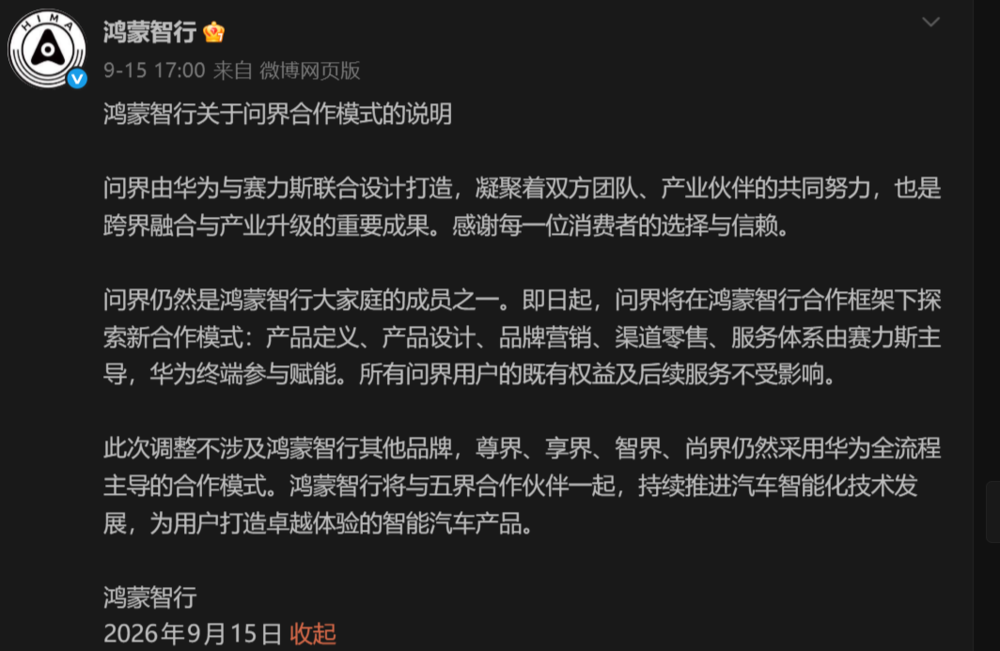
Caption: Screenshot of Hongmeng Zhixing’s official Weibo account
On September 16, Wenjie's "Letter to All Channel Partners" was implemented, and the signing party of the comprehensive service agreement for authorized distribution partners was changed from Huawei Terminal Co., Ltd. to an affiliated company of Cyrus Automobile, and it will be implemented on the same day.
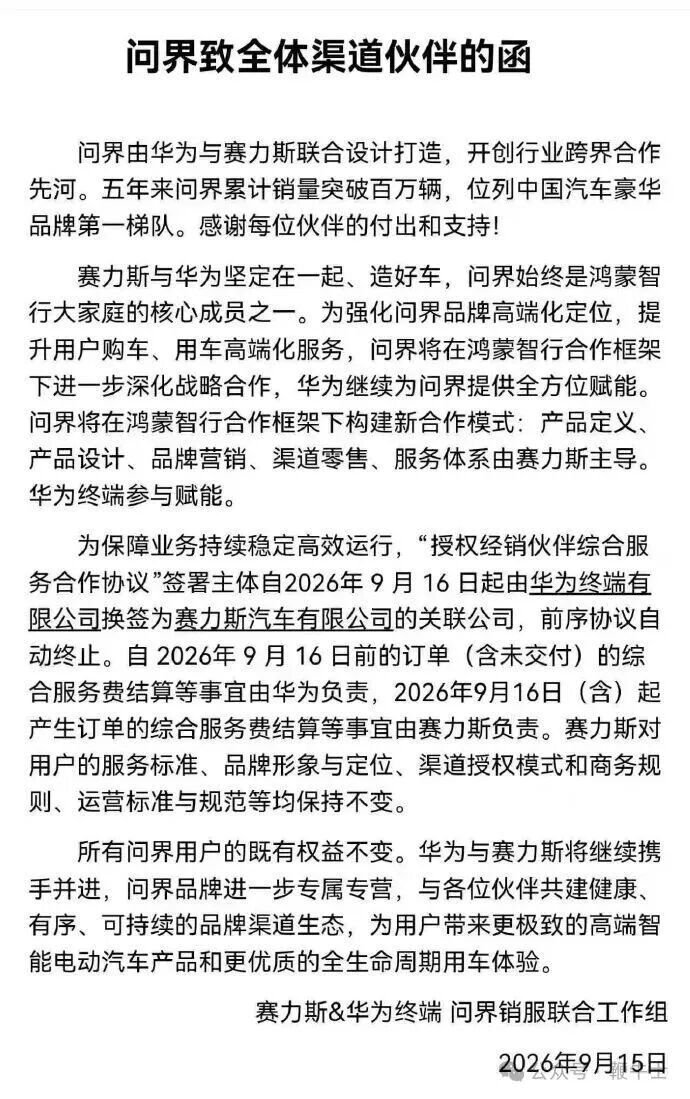
Illustration: Source: Official article of "The Cow Whipper"
Rights and responsibilities, contracts, stores. Three days, three steps, clean and coherent, without a single superfluous word.
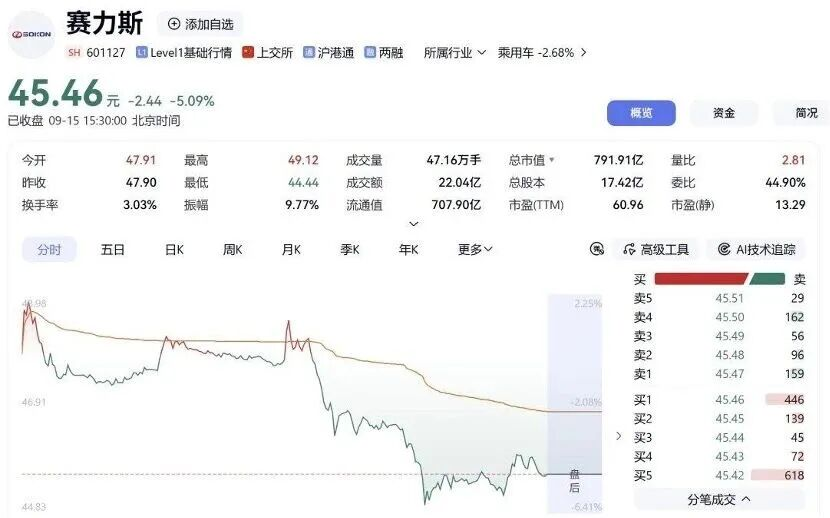
Affected by the news, Thalys's stock price fell sharply. As of the close of trading on September 15, Cyrus A shares fell by more than 5%, and Hong Kong stocks fell by more than 6%. The reaction of the capital market is very honest: the industry that Huawei once "led hand in hand" and the industry that allowed Cyrus to rise from a fringe car company in Chongqing to a market value of hundreds of billions is being moved out of the core circle by Huawei.
Some people interpret this adjustment as "optimization of the cooperation model", while others call it "the graduation of Wenjie". But if we look at the clues of the past seven years together, a colder conclusion is emerging: Huawei's car manufacturing is heading towards a structural end.
This is not because Huawei technology is not good. On the contrary, Huawei's smart driving, cockpit, and electric drive are still among the best in the industry. The problem lies at another level - the path Huawei has chosen to "help car companies build good cars" has conflicts that are difficult to reconcile in terms of business logic. When these contradictions accumulate to a certain extent, retreat may become the only rational choice.
The seven-year itch of an "unequal treaty"
To understand why Huawei’s car manufacturing came to an end, we must go back to the year before the two parties signed the contract.
In 2019, Huawei and Xiaokang Co., Ltd. signed a comprehensive cooperation agreement, which is the starting point for cooperation between the two parties. By 2026, the industry cooperation model will be adjusted, exactly seven years.
In 2020, Thalys, also known as Xiaokang Group, had annual revenue of 14.302 billion yuan, a net loss of 1.729 billion yuan, and sold 273,600 vehicles, of which only more than 20,000 were new energy vehicles. Cars bearing the Thalys brand sold 2,811 units a year. This is a company that is almost negligible in the Chinese automobile industry.
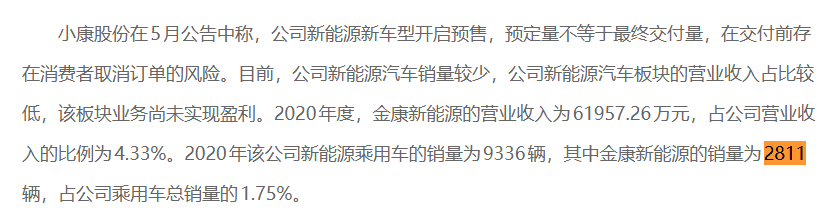
Caption: Source: "Haojiyou" public account article
Why did Huawei choose it? The reason is not difficult to understand: marketing, technology, and R&D are all owned by Huawei. Whose car is this? Traditional major manufacturers are unwilling to hand over product definition and brand lifeline to external suppliers. Only marginalized companies like Cyrus are willing to hand over full say.
Thus, the "intelligent car selection" model was born. In April 2021, the two parties officially signed a smart car selection cooperation agreement; in December of the same year, the Wenjie brand was released. Huawei is deeply involved in product definition, design, marketing, channels, and after-sales, while Cyrus is responsible for manufacturing. Yu Chengdong personally stood on the stage and was exhibited at the C position of Huawei stores. Wenjie M5, M7, and M9 became hot products one after another. In 2024, Cyrus' revenue soared to 145.1 billion yuan, with net profit of 5.9 billion yuan, making it the fourth profitable new energy vehicle company in the world.
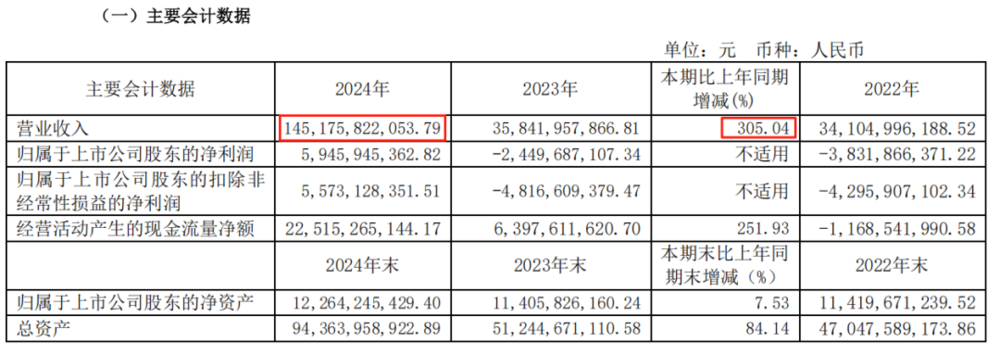
On the surface, this is a win-win situation. But looking through Thalys's account books, another set of figures is shocking.
According to Cyrus’ Hong Kong stock prospectus, from 2022 to the first half of 2025, Cyrus’ cumulative purchases from its largest supplier exceeded 75 billion yuan. The market generally believes that this supplier points to the Huawei system. For the whole of 2025, this figure climbed to 56 billion yuan, accounting for 33.8% of total purchases. This caliber is "goods and service transactions", which includes the supplier's own costs and is not equal to the profits earned by Huawei.
According to the Hong Kong IPO prospectus of Cyrus, as long as Cyrus sells a car, it must pay Yinwang a hardware procurement fee and a 2% technology licensing fee, and also pay an 8% channel service fee to Huawei Terminal BG. The two sums add up to a full 10% hard commission. In a car with an average price of 400,000 yuan, these two items alone cost 40,000 yuan. It should be noted that this ratio has never been formally disclosed; Thalys stated in the Hong Kong stock prospectus that the two parties "are not involved in any profit sharing arrangements."
After four years of cooperation, the cumulative non-net profit of Celis is only about 1.482 billion yuan. In other words, the more cars Thales sells, the more money will flow to Huawei's system, and the actual profits it pockets will be pitiful.
This pattern can still be maintained during the upswing. But when industry price wars intensify, raw material prices rise, and model iterations accelerate, all operating risks fall on Cyrus. In the first half of 2026, Thalys' revenue was 57.493 billion yuan, a year-on-year decrease of 7.87%; the net profit attributable to the parent company was a loss of 1.717 billion yuan, while it was still a profit of 2.941 billion yuan in the same period last year. From a profit of 2.941 billion to a loss of 1.717 billion, 4.658 billion yuan in profit evaporated in one year.
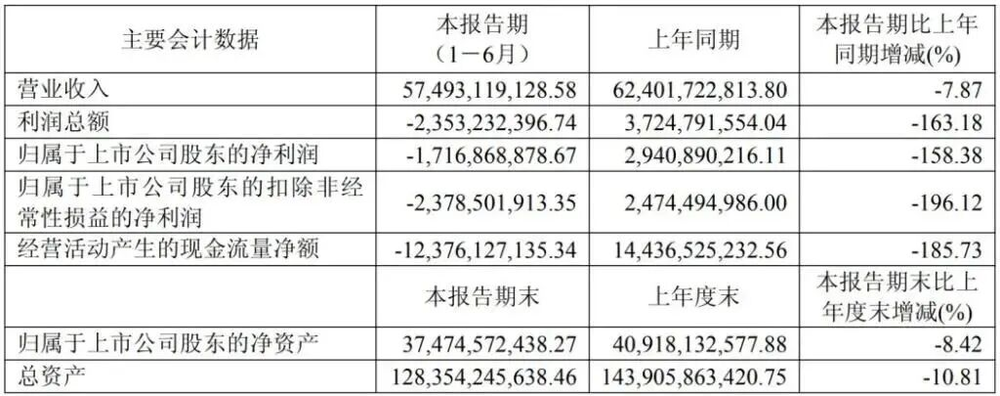
In August, Cyrus sold 20,652 vehicles, a year-on-year decrease of 49.68%, nearly halved.
Huawei has always insisted that "Huawei does not build cars, but helps car companies build good cars." But when the cost of "help" becomes too high for car companies to bear, the foundation of this model begins to loosen.
The "foundation" of partners determines Huawei's upper limit
The second structural problem faced by Huawei’s car-making model is the inherent shortcomings of its partners.
Sales was formerly known as Dongfeng Xiaokang. Its main business was minivans and low-end electric vehicles. At its peak, annual sales exceeded 200,000 units. It relied on the minivan business to accumulate four complete processes and cost control capabilities. However, the shortcomings are equally obvious: the product has stayed in the tool vehicle category for a long time, and the research and development accumulation of high-end passenger cars is almost zero. In 2020, only 732 units of its strategic model SF5 were sold throughout the year. In August 2022, the company officially changed its name to "Sales" in an attempt to break away from the historical label of "well-off = micro car". This Chongqing car company, which started from motorcycles and transformed into new energy, has a manufacturing foundation, but there is a clear gap between it and mainstream high-end car companies in terms of manufacturing technology, quality control system, and supply chain management.
Huawei can export technology, deploy teams, and bring in the IPD integrated product development system, but there is one thing Huawei cannot change: building a car is a hard skill that takes time to settle.
Xiaomi founder Lei Jun took the opposite approach: first build the factory in Yizhuang, monitor the production line himself, and adjust the die-casting by himself. None of the tens of thousands of details between drawings and mass production can be outsourced.
Apple and Foxconn are the most successful foundry combinations. Most people think that Apple is the party A, so Apple is strong. There is another side to the truth: Foxconn founder Terry Gou has been obsessed with molds since he was making TV knobs, and Hon Hai has applied for more than 8,000 patents when making connectors. Apple is making demands, and whether it can meet them depends on Foxconn’s engineering capabilities accumulated over more than 20 years.
Engineers from Huawei's Automotive BU can teach Cyrus how to define products, how to design cockpits, and how to optimize intelligent driving algorithms. However, chassis tuning, body anti-corrosion, assembly accuracy, and durability testing are capabilities that traditional car companies need to accumulate over decades and cannot be achieved quickly with a set of processes.
Since 2026, the number of complaints about Wenjie M7, M8, and M9 on platforms such as Car Quality Network has increased sharply. Problems reported by many car owners include damage to the drive motor hardware, failure of the smart driving system to recognize cars approaching from the side and rear, abnormal noise in the steering wheel of new cars, malfunctioning rearview mirrors, damaged car doors, peeling paint on the roof, rust inside the car, etc. There were complaints from car owners that no one had dealt with for half a year.
In March this year, "China Economic Net" reported that a Wenjie M8 owner spent more than 400,000 yuan to buy the car. In two months, the exhaust pipe was rusty, the central control screen was lagging, and the panoramic image was rippled. The 4S store said that "rusty exhaust pipes are not a product quality problem." To issue a paper report, the old parts had to be dismantled and returned to the factory. The car owner refused to dismantle them, and the report could not be issued. In the end, the car owner purchased the extended warranty at his own expense.
The data on the channel side can also illustrate the problem. As of May 2026, Hongmeng Zhixing has 1,951 sales stores across the country, but only 957 after-sales and maintenance stores. There are more than twice as many places to sell cars as there are to repair them.
The root cause of these problems is not that Huawei's smart driving or cockpit technology is not good, but that the manufacturing quality and quality control system of the entire vehicle have not kept up. Huawei can empower the "soul", but the strength of the "body" requires partners to grow it themselves.
What’s more important is that Huawei has chosen more than one partner, Thalys.
The partners of Zhijie are Chery, Xiangjie is BAIC, Zunjie is JAC, and Shangjie is SAIC. Each of these companies has its own accumulation in the era of traditional fuel vehicles, but in the high-end transformation of new energy, most of them face shortcomings in brand recognition, channel capabilities, and user operations. Huawei tried to use its own brand potential and channel resources to make up for these shortcomings, but the result was that Huawei's resources and attention were severely diluted.
Yu Chengdong himself admitted: "With Huawei's capabilities, it is no longer easy to support two or three industries. It is very difficult to do five industries." The exhibition parking spaces in Huawei stores are limited, and the energy of sales staff is limited. It is impossible for Yu Chengdong to support five brands at the same time. When Wenjie, Zhijie, Xiangjie, Zunjie and Shangjie are crowded into the same store, internal competition is inevitable.
In the first half of 2026, there were approximately 161,000 Wenjie vehicles, accounting for nearly 70% of Hongmeng Smart; approximately 35,000 Shangjie vehicles, approximately 21,000 Xiangjie vehicles, 19,300 Zhijie vehicles, a year-on-year decrease of 56.9%, and more than 7,000 Zunjie vehicles. Except for Wenjie, no one can afford to maintain its appearance. One brother is full and four brothers are hungry. This is the reality faced by Huawei's car-making model.
Yu Chengdong "retired"
The third signal that Huawei’s car manufacturing is coming to an end comes from within. Yu Chengdong is the most determined "car-building faction" within Huawei.
In May 2019, Huawei Smart Car Solutions BU was established. The top person in charge is Xu Zhijun, the then rotating chairman, and the president is Wang Jun. It is positioned as an incremental component supplier for smart connected cars and wants to be the "Bosch in the era of smart electric vehicles." In November 2020, Auto BU adjusted from ICT business to consumer business. In May 2021, Yu Chengdong took over the car BU and served as CEO of Consumer BG and CEO of Smart Car Solutions BU.
When Wenjie M5 was released in December 2021, he set the goal for the brand to enter the top three global new energy brands within five years. In 2023, he personally promoted the launch of Wenjie's new M7, and the price was set to exceed 50,000 yuan in 25 days. He wrote excitedly in the circle of friends: "It is not easy to come back from the dead!" Wenjie M9 even raised the price to more than 500,000 yuan, ranking first in luxury SUV sales for many consecutive months.
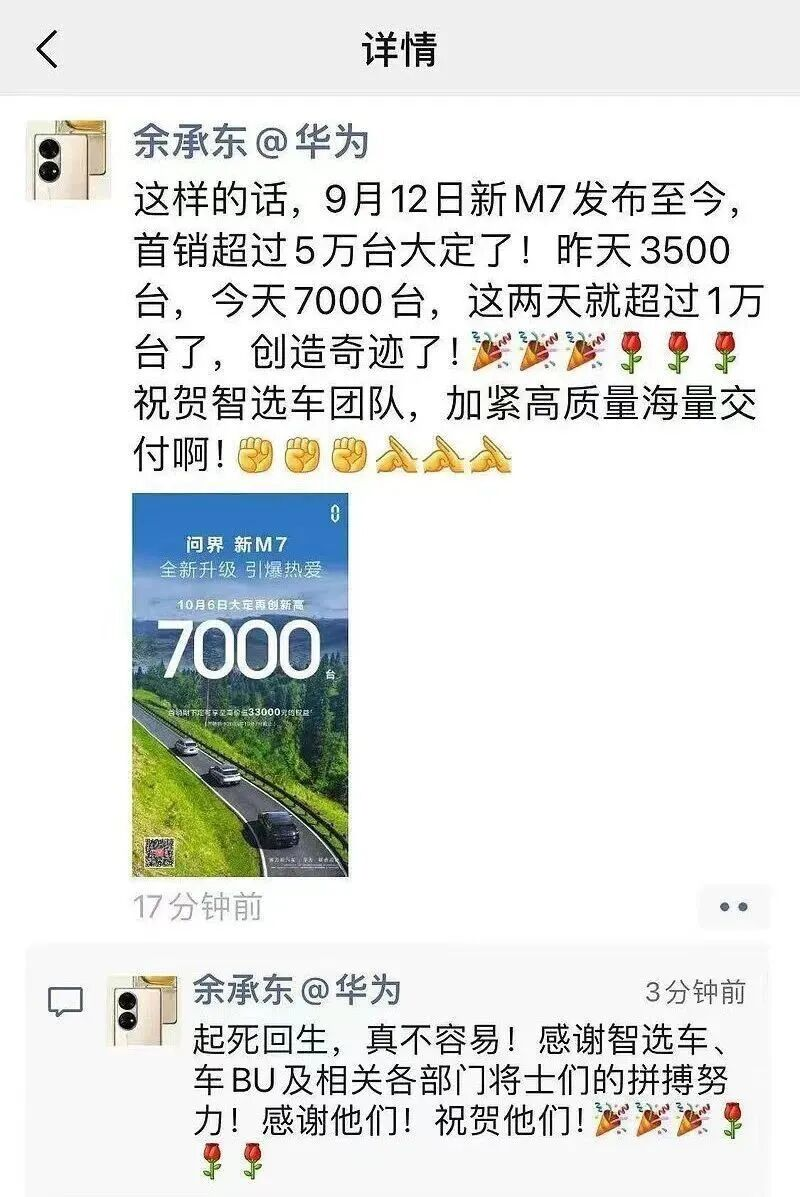
Caption: Source: "Shanghai Securities News" official article
But Yu Chengdong’s ambitions don’t stop there. He once tried to use the "HUAWEI" logo on the Wenjie model, but was urgently stopped by Ren Zhengfei. In 2023, Ren Zhengfei issued a document reiterating that "Huawei does not build cars", which is valid for five years, and clearly requires that the words "Huawei Asks the World" and "HUAWEI" cannot be used.
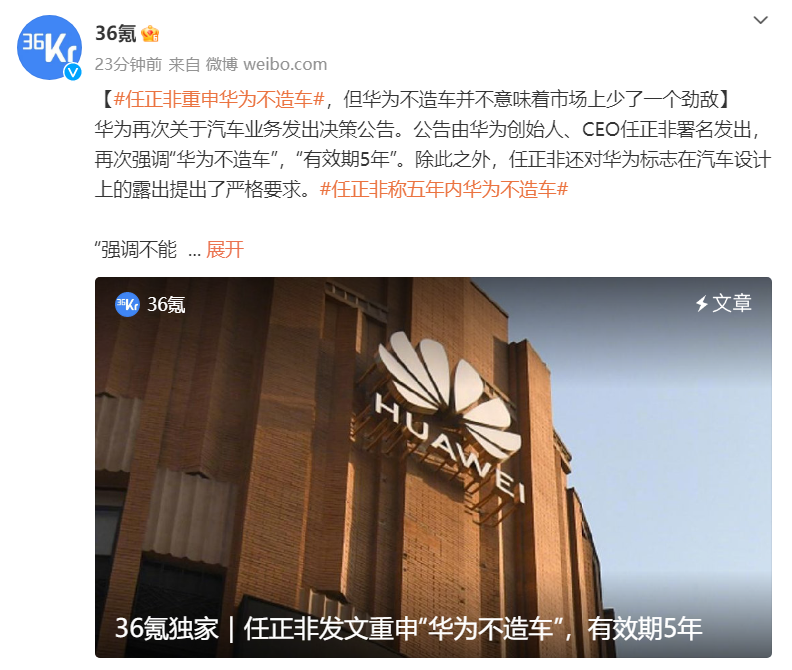
As early as 2020, Ren Zhengfei issued a document emphasizing that "Huawei does not build cars", clarifying Huawei's stance on building cars.
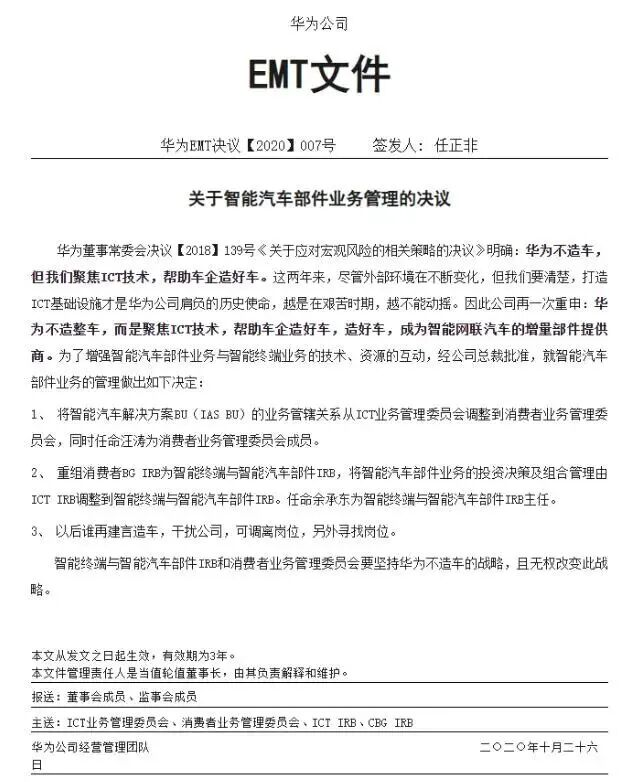
Yu Chengdong advocates deep participation in or even leading car manufacturing, while Ren Zhengfei insists on "not building cars, but helping car companies build good cars." The tension between the two routes runs through the entire development process of Huawei's automotive business.
In September 2023, Yu Chengdong stepped down as CEO of CheBU and was replaced by Jin Yuzhi. He became chairman of CheBU. In March 2025, Yinwang completed the industrial and commercial changes, with Xu Zhijun as chairman and Yu Chengdong as vice chairman. A month later, Yu Chengdong no longer served as the chairman of the car BU. The only certification left on Weibo was "Managing Director of Huawei and Chairman of Terminal BG", and the introduction on Huawei's official website was also updated simultaneously.
In the adjustment of the Wenjie cooperation model in September 2026, Yu Chengdong did not appear in the official statement, nor did he speak out on social media as in the past.
Yu Chengdong's "exit" may mean that the voice of the "car-making faction" within Huawei has been suppressed. Ren Zhengfei's strategic judgment prevailed: Huawei cannot become an automobile company, and its automobile business is positioned as an "incremental component supplier" and the "Chinese version of Bosch."
But the problem is that when Huawei wants to both be a "Bosch" and want to be deeply involved in the definition and sales of complete vehicles through Hongmeng Zhixing, its role becomes blurred. Car companies will ask: If you help me define products and sell cars in my stores today, will you use the same capabilities to support my competitors tomorrow?
On June 30, 2021, at the annual general meeting of shareholders of SAIC Motor, Chairman Chen Hong put it bluntly: "It is difficult for SAIC to accept a single supplier to provide us with an overall solution. In this way, it will become the soul, and SAIC will become the body. SAIC cannot accept such a result and must hold the soul in its own hands." It was ridiculed by the entire network at the time, but it revealed the real concerns of traditional car companies. Perhaps the more powerful Huawei is, the more uneasy its partners will be.
From "making cars" to "being a supplier"
The adjustment of the industry cooperation model in September 2026 is essentially a systematic contraction of Huawei’s automotive strategy.
The official term is the "asset-light model", which is similar to "Hongmeng Zhixing changes from athletes to coaches." But translated into business language: Huawei no longer bears the asset-heavy risks of vehicle operations and has returned to the position of a technology supplier.
This choice is rational from the perspective of Huawei's overall strategy.
Huawei’s full-year sales revenue in 2025 will be 880.9 billion yuan, approaching its historical peak. Smart car solutions business revenue was 45 billion yuan, a year-on-year increase of 72%, making it one of the fastest growing businesses. But Huawei's core battlefield has never been in cars. Chips, operating systems, communications, and AI computing power are what Huawei is really betting on.
Recently, Huawei Xinsheng Community disclosed the minutes of a discussion between Supervisory Board Chairman Guo Ping and new employees. In this nearly 10,000-word summary, Guo Ping responded to hot topics such as artificial intelligence, large model strategy, and 6G. When talking about smart cars, he said it very straightforwardly: Huawei's core strategy is "focus", focusing on the areas of "connection" and "computing" that it is good at, and has no business expansion plan. The smart car parts business provided by Yinwang is an extension of Huawei's ICT business. Huawei directly provides smart driving services through Yinwang. However, Huawei chooses "not to build cars." The choice of car companies to only sell in China or go global depends on each car company's own strategic choice.
Ren Zhengfei put it more bluntly: "Huawei was forced to make cars." In May 2019, Huawei was included in the entity list, and its mobile phone business almost died. In the same month, the car BU was listed. From the day it was established, its mission was not to sell cars, but to find a way for a huge R&D team to survive.
Now, Huawei’s survival problem has been solved. With the return of the mobile phone business and the explosion of the AI computing power business, Huawei has no reason to continue to invest deeply in the automotive industry, which is an asset-heavy, low-profit, and high-risk industry.
What's more, Huawei's "historical role" in the automotive industry has been completed. When Huawei entered the market in 2019, the core technologies of China's smart cars: smart cockpits, smart driving chips, and algorithms were almost entirely monopolized by foreign suppliers. Huawei has used a full-stack self-research approach to transform smart driving from a top-of-the-line luxury product to a standard feature that can be equipped on cars costing hundreds of thousands. This has forced foreign suppliers to cut prices and accelerated the intelligent transformation of the entire industry.
In this process, Huawei has also cultivated a number of partners. Cyrus has grown from a fringe car company to a company with a market capitalization of 100 billion. Chery, BAIC, JAC, and SAIC have made up for their shortcomings in intelligence through Huawei's empowerment. Now, these car companies have begun to develop their own smart driving, build their own channels, and operate brands independently. Huawei's technology has been "seeded" into the industry, and car companies have to walk the rest of the way on their own.
The end is also the starting point of a new road
The end of Huawei's car manufacturing is not the failure of Huawei, nor the failure of Cyrus. This is a necessity of business logic.
The "intelligent car selection" model has had structural contradictions since its birth: Huawei charges a fixed fee and guarantees income regardless of drought or flood, while car companies bear all operating risks; Huawei wants scale, but car companies want uniqueness; Huawei hopes that the more partners the better, but partners are worried that Huawei will support its competitors. These contradictions can be covered up by growth during the industry's upswing period, and will explode once the growth slows down.
Sales' losses in the first half of 2026, the halving of Wenjie sales, Yu Chengdong's withdrawal, and the adjustment of the cooperation model are all the externalization of these contradictions.
But "the end" does not mean the end. Huawei's return to the position of a technology supplier may open up greater space. Qiankun Zhijia has been equipped with more than 25 brands and more than 60 models, and the cumulative installed volume has exceeded 2 million vehicles. Yinwang’s shareholding structure: Huawei 80%, Cyrus 10%, Avita 10%, is forming an open smart car technology platform.
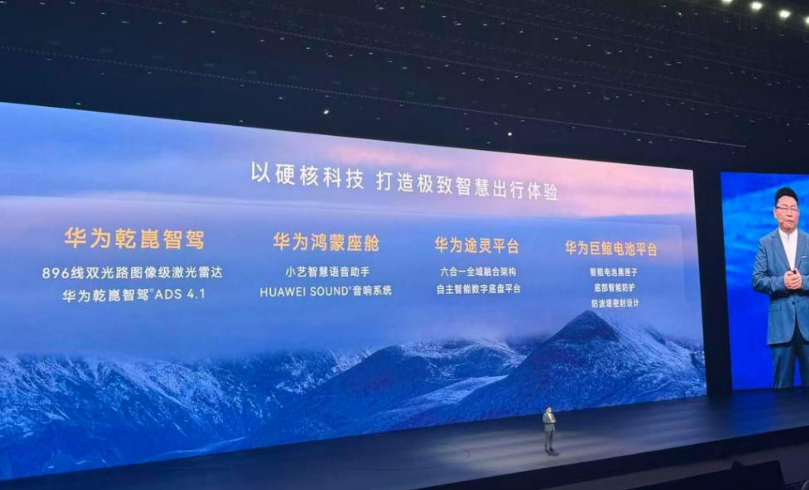
Picture note: Yu Chengdong was at the launch of Hongmeng Smart, with Huawei’s five major technology matrices behind him
Sales will experience pain in the short term when it takes back the dominance of the industry, but in the long term, it must prove its ability to independently operate high-end brands. The foundation of 1 million vehicles, the brand assets purchased for 2.5 billion, and the prospecting equity of 11.5 billion shares are all real bargaining chips.
China's smart car industry needs a technical base like Huawei, but it does not need Huawei to become another vehicle brand. When Huawei withdraws from its obsession with "making cars" and focuses on the technical fields it is best at, its contribution to China's automobile industry may be greater than building cars itself.
Retiring after success is the best ending for a hero.
Comments