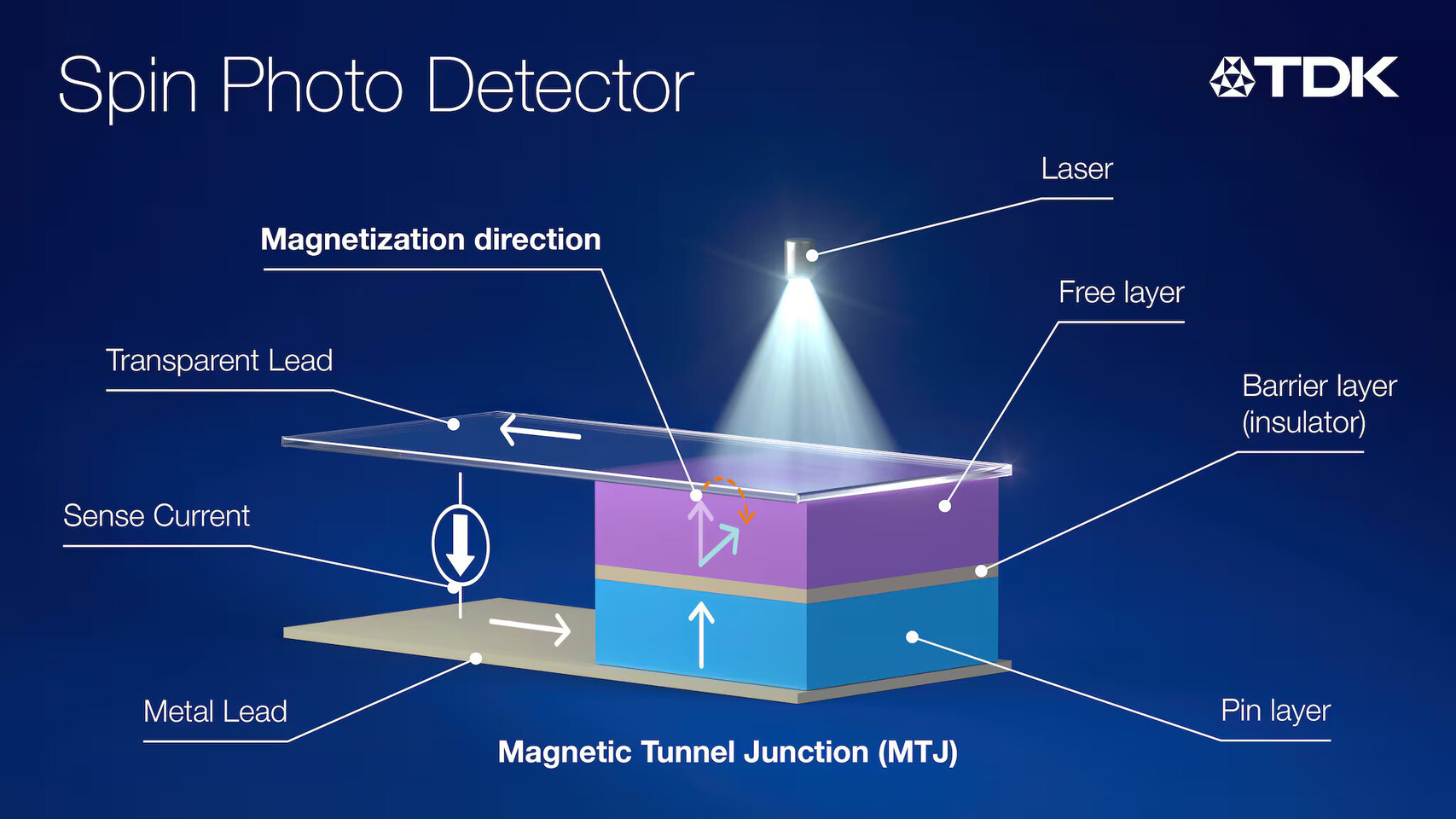
TDK Corporation announced that it has developed the world's first "spin photodetector". This is an optical spin electron conversion element that integrates optical, electronic and magnetic elements. It can respond at an ultra-high speed of 20 picoseconds (20×10⁻¹² seconds), using light with a wavelength of 800 nanometers, and the response speed is more than 10 times faster than traditional semiconductor photodetectors.
The new device is expected to be a key driver in enabling photoelectric conversion technology that increases data transmission and data processing speeds, especially in artificial intelligence applications, while reducing power consumption.
With the development of artificial intelligence, it is inevitable to transmit massive data at higher speeds and lower power consumption. In order to process data and perform calculations, data is currently transmitted between CPU/GPU chips and between memories through electrical signals. Therefore, there is a growing demand for optical communications and optical interconnects that can provide high-speed transmission speeds that do not degrade as the interconnection distance increases. Photoelectric conversion technology, a compact fusion of optical and electronic components, is also attracting global attention.
To address these challenges, TDK is applying its magnetic tunnel junction (MTJ) technology, which is now used in billions of HDD heads, to photonics. One of the main advantages of this technology is that there is no need to use a single-crystal substrate for crystal growth, and the formation of devices is not limited by the substrate material. In contrast, conventional semiconductor-based photodetectors have physical limitations at shorter wavelengths. Because the spin photodetector works on a completely different principle and exploits the phenomenon of electron heating, it can operate at ultra-high speeds even with shortened wavelengths. In addition, it has a wide operating wavelength range and has been proven to work in the visible to near-infrared range. TDK has successfully demonstrated a spin photodetector with Nihon University, a research pioneer in the field of measuring ultrafast phenomena in magnetic materials.
Additionally, due to their ability to detect visible light at high speeds, spin photodetectors will be useful in applications expected to grow in the future, such as AR/VR smart glasses and high-speed image sensors. Traditional semiconductor light-sensing devices have weak resistance to cosmic rays, while MTJ components are known for their strong resistance to cosmic rays and are expected to be used as light detection elements in aerospace applications. In the future, TDK will continue to improve high-speed optical detection components based on these achievements and further maximize their practicality.