The reporter learned from the Chinese Academy of Sciences on the 17th that Chinese researchers have made breakthrough progress in the research of next-generation lithium batteries. They found that the lithium-rich manganese-based cathode material will automatically shrink when heated. This characteristic can actually help the aging battery restore its voltage and make the old battery "rejuvenate".
This discovery not only reveals the working mechanism of the material, but also provides a new direction for the development of next-generation lithium batteries that are more durable and self-repairable. Relevant research results were published online in the journal Nature.
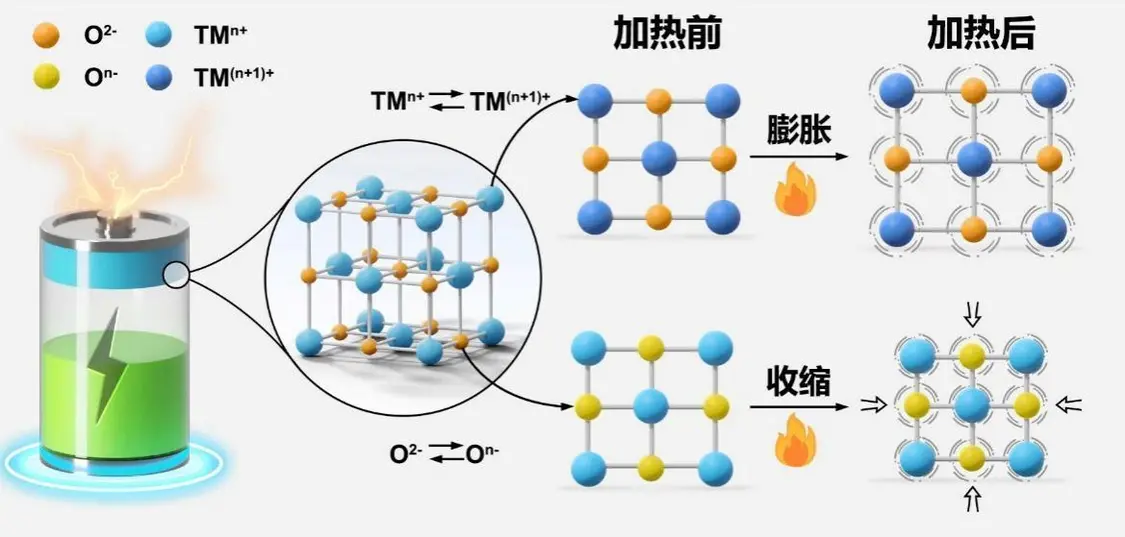
Schematic diagram of the relationship between transition metal and oxygen active centers and the thermal expansion of the material. Photo courtesy of Ningbo Institute of Materials Technology and Engineering, Chinese Academy of Sciences
To solve the "range anxiety" of electric vehicles and electric aircraft, it is necessary to develop the next generation of high-energy lithium battery technology. Scientists have focused on lithium-rich manganese-based cathode materials. Batteries made with it can increase the power storage capacity by 30% compared to existing batteries, which is like directly expanding the capacity of a fuel tank by 30%. In addition, manganese is cheaper than cobalt and nickel, so this material can be called a "hexagonal warrior" that is both strong and affordable.
Although the lithium-rich manganese-based cathode material has an ultra-high discharge specific capacity, as an oxygen-active cathode material, it still has a serious problem in actual use: after multiple charges and discharges, the voltage of the lithium-rich manganese-based battery will gradually decrease and aging will occur. "This makes it still difficult for lithium-rich manganese-based batteries to be used in practical applications. Therefore, how to maintain high energy density and long-term stable operation of this lithium-rich manganese-based battery has become an urgent problem for scientists to solve." Liu Zhaoping, co-corresponding author of the paper and researcher at the Ningbo Institute of Materials Technology and Engineering, Chinese Academy of Sciences, said.
In this study, the researchers revealed an interesting property of the lithium-rich manganese-based cathode material: it shrinks when heated. Appropriate heating can restore the material from a disordered state to a more stable, lower-energy ordered structure, causing the battery to shrink in size and thus exhibit the characteristic of "heat shrinkage." "Based on this, we have found a new method to achieve 'reverse growth' of aging lithium-rich manganese-based batteries through electrochemical means." Liu Zhaoping said.
Reviewers of the journal Nature spoke highly of this achievement. He said that the research team discovered for the first time that the structure of lithium-rich manganese-based cathode materials can transform from a disordered state to an ordered state driven by temperature or electrochemistry. This discovery breaks through the theoretical framework of the structural transformation of traditional electrode materials and opens up a new research direction for understanding the structure-performance relationship of electrode materials.