Researchers at the University of Liège have developed a breakthrough method that uses a combination of geometry and quantum control to quickly generate quantum superposition states (ie, NOON states). This innovation drastically reduces preparation time from minutes to milliseconds, opening the door to practical applications in quantum computing and ultra-precision sensors.
Creating quantum superpositions of ultracold atoms has long been a major challenge, with existing methods proving too slow for practical use in the laboratory. Researchers at the University of Liège have now developed a new method that combines geometry with "quantum control" to significantly speed up this process and open the door to practical applications of quantum technology.
Imagine pushing a shopping cart full to the supermarket. The goal is to get to the checkout faster than everyone else and not lose items in sharp turns. The key to success is finding the straightest, smoothest path and maintaining speed without slowing down.
This is exactly what Simon Dengis, a doctoral researcher at the University of Liège, achieved. He's not in a supermarket, but in the complex realm of quantum physics.
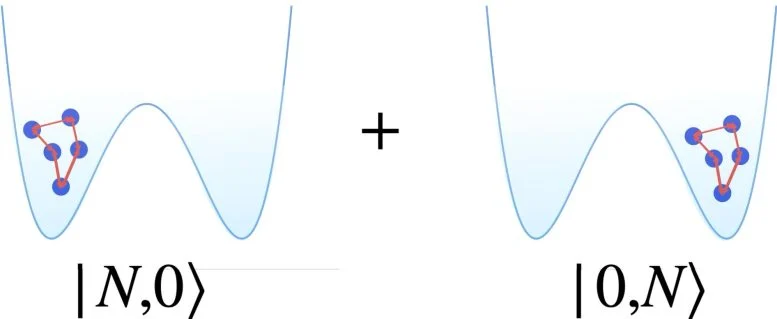
The NOON state is a superposition quantum state in which N particles are in one state "simultaneously" and in another state "simultaneously". Here, the particles are trapped in two wells, inside the well created by the laser. The superposition state therefore consists of a state in which all particles are in the left well and a state in which they are trapped in the right well. When particles are in the same location, they interact and "stick" together, preventing individual particles from leaving the trap. Image source: University of Liège / S. Dengis
Dungis collaborated with the Statistical Quantum Physics (PQS) team to develop a protocol for rapid generation of NOON states. "These states look like miniature versions of Schrödinger's famous cat, quantum superpositions," he explains. "They are critical for technologies such as ultra-precise quantum sensors or quantum computers."
What are the main challenges? Creating these states often takes too long. We're talking tens of minutes or more, which is often beyond the lifetime of the experiment. What's the reason? Energy bottlenecks, “sharp turns” in the evolution of a system, force it to slow down.

Antidiabatic control compensates for the inertia of the system by changing it in some way. In this example, to compensate for the movement of water caused by the waiter's movement, the waiter can tilt the tray to counteract the inertia of the glass, preventing it from tipping over. Image source: University of Liège / S.Dengis
This is the breakthrough work of the University of Liège team. They successfully paved the way for atoms by combining the two powerful concepts of antidiabatic driving and optimal geodesic paths. The result: The system can evolve more quickly without deviating from the ideal trajectory, like a driver anticipating a bend by tilting the pallet.
"This strategy saves a lot of time: in some cases, the processing speed can be 10,000 times faster, while maintaining 99% fidelity, that is, a near-perfect result," says Peter Schlagheck, director of the laboratory. Previously, it took about ten minutes to create this state, but the researchers managed to significantly reduce the waiting time... to 0.1 seconds!
With this breakthrough, we can finally produce the NOON state using ultracold atoms. This opens up promising prospects for quantum metrology (ultra-sensitive measurements of time, rotation or gravity) and quantum information technology. Ultimately, these tools could improve instruments such as quantum gyroscopes or miniature gravity detectors.
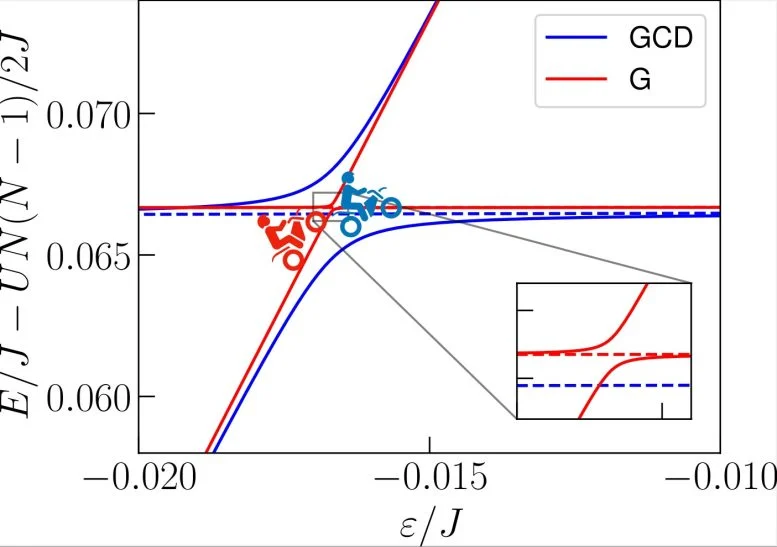
The proposed protocol (blue, GCD) can enlarge the energy bottleneck (compared to the usual red protocol G) and therefore requires less braking when approaching the bottleneck. This picture can be understood in terms of motorcycle racing: the red motorcycle needs to brake more than the blue motorcycle because the cornering is less "smooth." Therefore, the blue motorcycle will reach the destination before the opponent. At this point, the changes in the energy of the system (and therefore its state) are less sudden, thus speeding up the entire process significantly. Image source: University of Liège/S.Dengis
This study shows how theory and experiment can be combined to drive concrete progress in quantum physics. By combining mathematical concepts, fundamental physics and experimental feasibility, researchers at the University of Liège have made breakthroughs that could transform what was once theory into the technology of the future.
Quantum superposition is when a quantum system (such as an atom, electron or photon) can be in multiple states at the same time without being observed. The example most commonly used to explain this concept is Schrödinger's cat: a cat locked in a box. According to quantum mechanics, the cat is both alive and dead until the box is opened. This simultaneous combination of two states is called superposition.
Only by opening the box and observing can we "force" nature to choose one state: alive or dead. The NOON state is an example of quantum superposition: all atoms are in the left well and the right well at the same time. Only at the moment of measurement do they appear in one of them.
Compiled from /scitechdaily