Scientists have developed the world's first new generation betavoltaic battery. This advanced power source is made by connecting radioisotope electrodes directly to a perovskite absorber layer, a cutting-edge material known for its high efficiency.
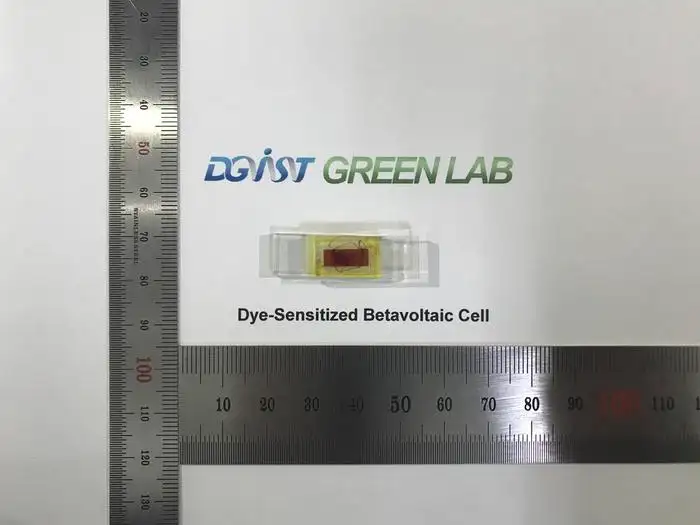
To improve performance, the team embedded carbon-14-based quantum dots into electrodes and improved the structure of the perovskite layer. These innovations result in highly stable power output and impressive energy conversion efficiency.
The findings, published in the journal Chemical Communications, were led by Professor Su-Il In (Chancellor Kunwoo Lee) of the Department of Energy Science and Engineering at the National Institute of Science and Technology of the Republic of Korea.

The newly developed technology provides a stable, long-term power supply without the need for charging, making it a promising next-generation energy solution for areas requiring long-term power autonomy, such as space exploration, implantable medical devices and military applications.
With the rapid development of miniaturization and sophistication of electronic devices, there is a growing need for innovative power supply technologies to minimize the need for frequent charging. However, currently mainstream batteries, including lithium and nickel batteries, have short lifespans and are susceptible to high temperatures and moisture, limiting their reliability in extreme environments. Betavoltaic battery technology, capable of providing stable power for years or even decades, is emerging as a powerful alternative.
Betavoltaic cells generate electricity by capturing beta particles released during natural radioactive decay. In theory, they can operate for decades without maintenance. Beta particles also offer excellent biosafety advantages because they cannot penetrate human skin. However, practical progress has been limited due to challenges in handling radioactive materials and ensuring material stability.
To overcome these challenges, Professor In's team developed a hybrid quantum betavoltaic cell that combines a carbon-14-based isotope electrode with a high-efficiency perovskite absorber layer. They significantly improved charge transport properties by precisely controlling the perovskite crystal structure and using additives such as methylammonium chloride (MACl) and cesium chloride (CsCl).
Ultimately, the developed betavoltaic battery achieved an approximately 56,000-fold increase in electron mobility compared to traditional systems and maintained stable power output for up to 9 hours of continuous operation, demonstrating excellent performance.
Professor Su-Il In commented: "This research marks the first practical realization of betavoltaic batteries in the world. We plan to accelerate the commercialization of the next generation of extreme environment power supply technology and further achieve miniaturization and technology transfer." Co-first author and doctoral student Junho Lee added: "Although this research involves daily challenges that often seem impossible, we are driven by a strong sense of mission and know that the country's future is closely related to energy security."
Compiled from /scitechdaily