A team of chemists has developed a new magnetic molecule that could be the key to storing large amounts of data on tiny drives. "This new molecule could lead to new technologies that could store around 3TB of data per square centimeter," said Professor Nicholas Chilton from the Australian National University (ANU). "This is equivalent to putting about 40,000"The Dark Side of the Moon"The CD of the album crams into a hard drive the size of a postage stamp, or about 500,000 TikTok videos. "
To achieve this data density, a team of chemists from the Australian National University and the University of Manchester had to break through existing magnetic storage technology. Current drives can retain memory by magnetizing small areas of material, which is fine — but researchers are working on single-molecule magnets (SMMs) that can store data individually, allowing for higher densities than ever before.
Imagine a tiny magnet storing 1s or 0s, similar to computer memory. In order for these molecular magnets to function, they need to reliably maintain their magnetic orientation (i.e. their "memory") over a range of temperatures. Today's single-molecule magnets, especially those made from the metallic element dysprosium, lose their magnetic memory below about 80 Kelvin, or -193 degrees Celsius or -315 degrees Fahrenheit.
Researchers are working on making these magnets work at higher temperatures. They achieved this by designing and synthesizing a new dysprosium molecule called 1-Dy. The new molecule maintains its magnetic memory (called hysteresis) at temperatures up to 100 Kelvin (-173°C or -279°F), which "is feasible in large data centers such as Google," according to Professor David Mills, co-first author of the study.
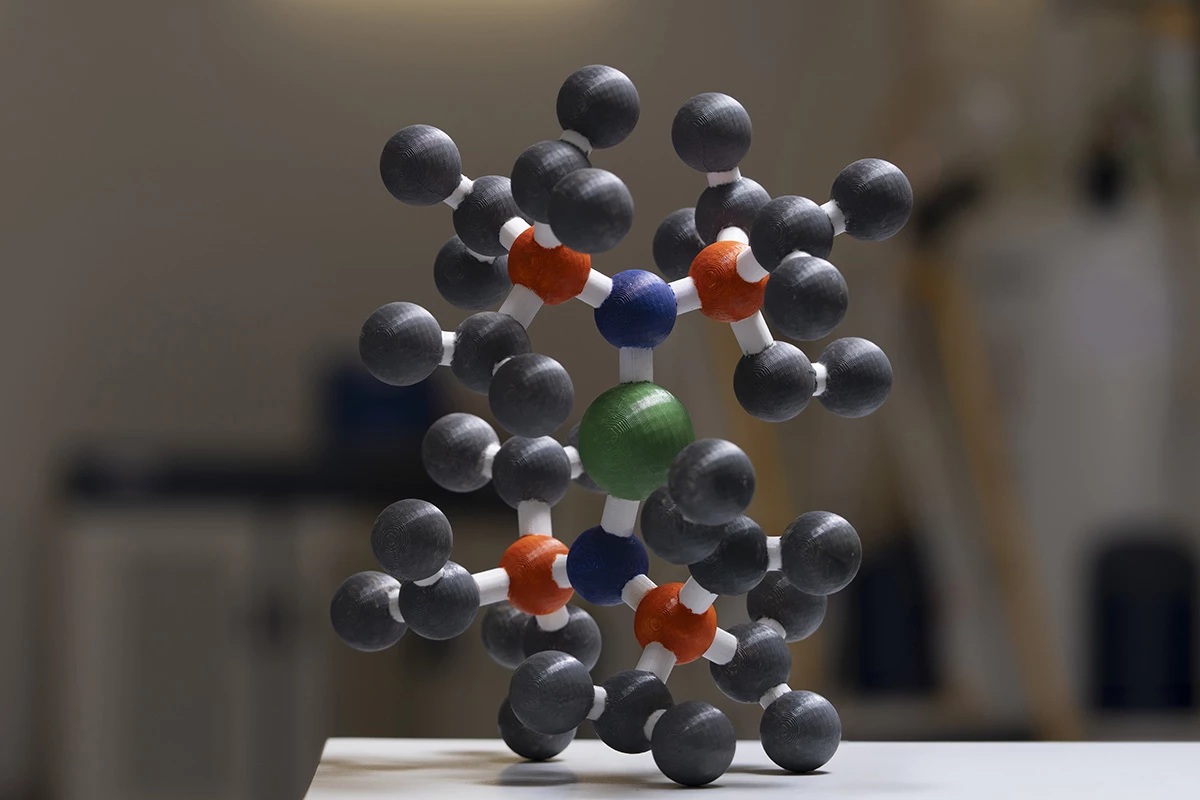
A new molecule based on the rare earth element dysprosium could pave the way for next-generation hardware the size of a postage stamp that could store 100 times more digital data than existing technology
The new molecule is also said to be more stable, meaning it can withstand a higher magnetic reversal energy barrier than previous SMMs, and requires greater energy to unexpectedly flip its magnetic state. The team published their findings earlier this week in the journal Nature.
Due to its unique molecular structure, 1-Dy maintains magnetic memory at higher temperatures than previous magnets. Because the rare earth element 1-Dy is located between two nitrogen atoms and anchored by an alkene bonded to dysprosium, the molecule's magnetic properties are significantly better than those of other single-molecule magnets (SMMs).
The team believes their breakthrough in simulating the magnetic behavior of this molecule will help design better SMMs capable of retaining memory at higher temperatures and ultimately create ultra-compact, high-density memories for future data centers.