Llama was abandoned!MetaThe engineer revealed that Meta’s internal developers have now replaced their own Llama.Use Claude Sonnet insteadWrite code.However, Llama 4 has indeed had a bad review since the day it was released. First, it received a flood of negative reviews within 36 hours of its release, and later it fell into a storm of rankings in the large model arena.
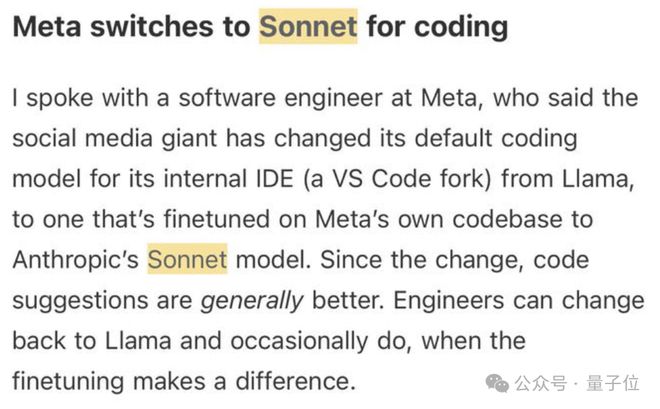
Now even the inside of Meta is no longer used, so some people began to wonder, will there really be a Llama 5?
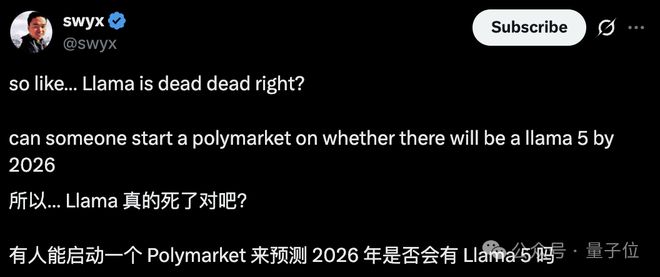
What's more, Zuckerberg has newly establishedMSL(Meta SuperIntelligence Labs), to cooperate with the original GenAI teamparallelDevelop the next generation of large models.
Llama 5 or other? We'll just have to wait and see.
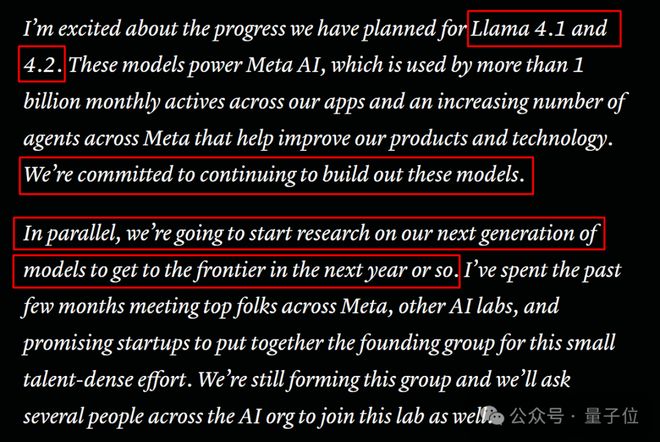
Xiao Zha: Llama-4.1 and 4.2 are under development
Zuckerberg’s MSL team has almost been formed. The team will start research on the next generation model and said it will strive to reach the cutting-edge level in the next year or so.
However, they did not disclose whether the next-generation model will continue to use the Llama product name, and may be rebranded.
Although it is unclear whether there will be Llama 5, the poaching memo leaked by Xiao Zha stated that,Llama-4.1 and 4.2 are under development
However, an outgoing Meta employee sharply criticized the company's cultural shortcomings in an internal article, which he believes are hindering the success of projects such as LLaMA.
Few believe in Meta’s AI mission
This employee believes that Meta’s generative AI team is filled with flaws such as a culture of fear, lack of vision, and destructive competitive thinking, and even most team members do not care about the AI mission.
Despite investing billions of dollars and recruiting many prominent members, he believes these issues remain an obstacle to the project's success.
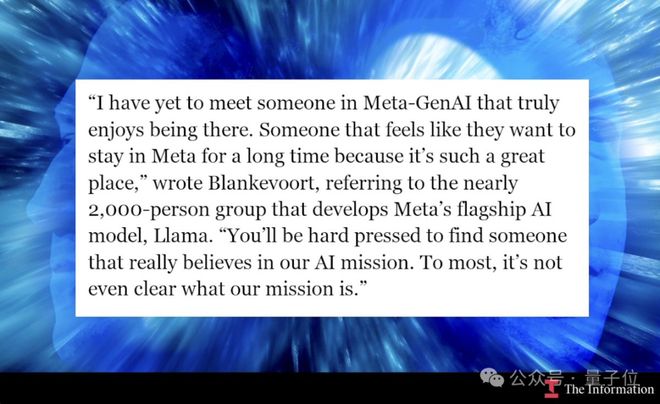
From The Information
In view of Meta's huge investment in Llama products, replacing its own Llama this time and switching to Claude Sonnet to write code is equivalent to admitting that Llama's performance is poor.
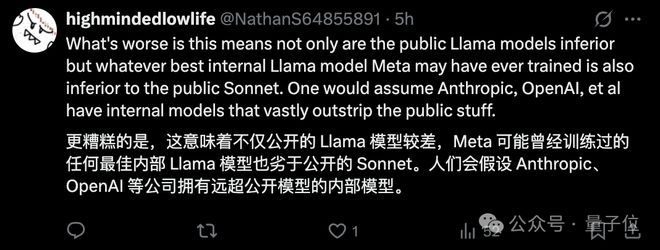
Although Meta will increase its investment to enhance the performance of the next generation Llama, before that, it does not want to hinder the work efficiency of engineers, so it made the decision to replace it.
According to insiders, since switching to Claude, the coding ability has indeed become significantly better.
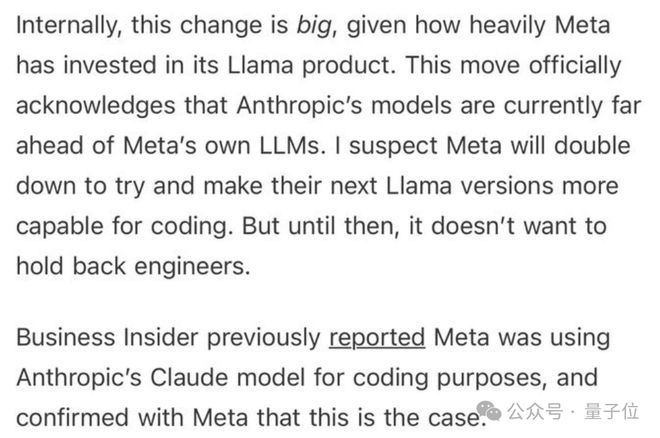
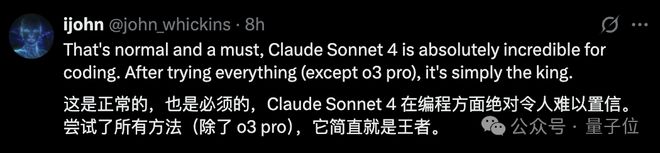
In fact, the coding capabilities of Claude's latest generation model are indeed top-notch at the moment.
Not only netizens have praised it:
Not evenapple developerI also used it to write almost an entire MacOS application calledContext, is a developer tool for debugging MCP servers.
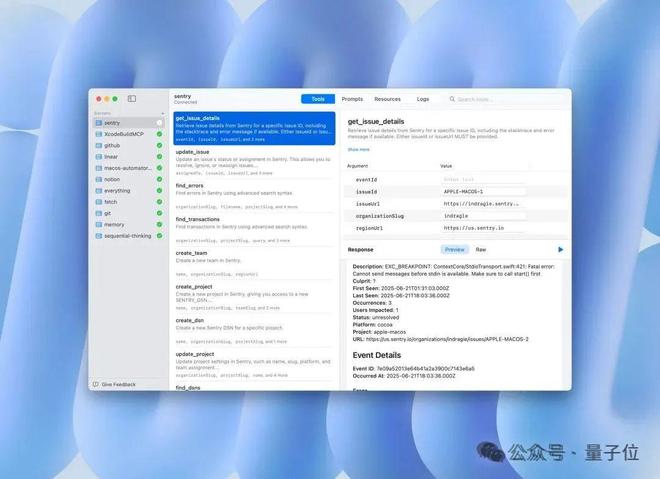
The developer said: In this20,000 linesIn the code project, the code I wrote personally is estimated to beLess than 1000 lines
I have to say that Claude is still capable.
According to the latest news, the company behind ClaudeAnthropicannualized income has reached4 billionUS dollars (monthly revenue of US$333 million), an increase of nearly four times from the beginning of the year, accounting for approximately 40% of the US$10 billion announced by OpenAI in June.
But at the same time, Claude users only account for OpenAI’s1/25
Some people say that such amazing data are the contributions of a small number of developers.

Indeed, one of the driving forces behind Anthropic's rapid revenue growth is its programming tool Claude Code, launched in February this year.
One More Thing
FAIR researcher Zhu Zeyuan made it clearThe difference between FAIR, GenAI and MSL
FAIR ≠ GenAI or MSL
FAIR is made up ofYann LeCunThey are a small world-class laboratory founded by others. Their work is driven by curiosity, using public data to conduct long-term open research, and does not train large models at the production level.
Zhu Zeyuan emphasized that FAIR, GenAI, and MSL have great advantages in data, code, infrastructure, and computing clusters.completely independent, the success, failure or Internet memes of GenAI/MSL do not represent the working conditions of FAIR.
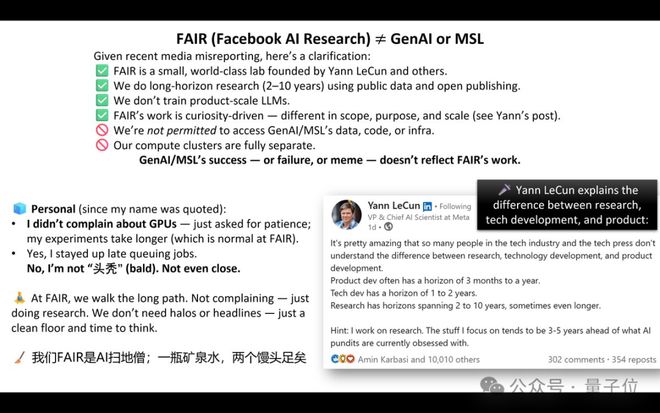
At the same time, LeCun explained the differences between research, technology development and product development:
The product development cycle is usually 3 months to 1 year.
The technology development cycle is generally 1 to 2 years.
The research cycle spans from 2 to 10 years or even longer.
He is engaged in research work and said:
The content I focus on is often 3-5 years ahead of the current directions that artificial intelligence experts are obsessed with.
[1]https://x.com/swyx/status/1943017429430604115
[2]https://x.com/kimmonismus/status/1943060343263236227
[3]https://x.com/Yampeleg/status/1942592878342963379
[4]https://x.com/ZeyuanAllenZhu/status/1942156231558488563