Most comets, including the famous Halley's Comet, orbit the solar system like cosmic time capsules, having formed along with the sun and planets about 4.5 billion years ago. But from time to time, there will be some more peculiar traces across the sky; they are like interstellar wanderers, either born in alien galaxies, or floating in the void forever, unclaimed.
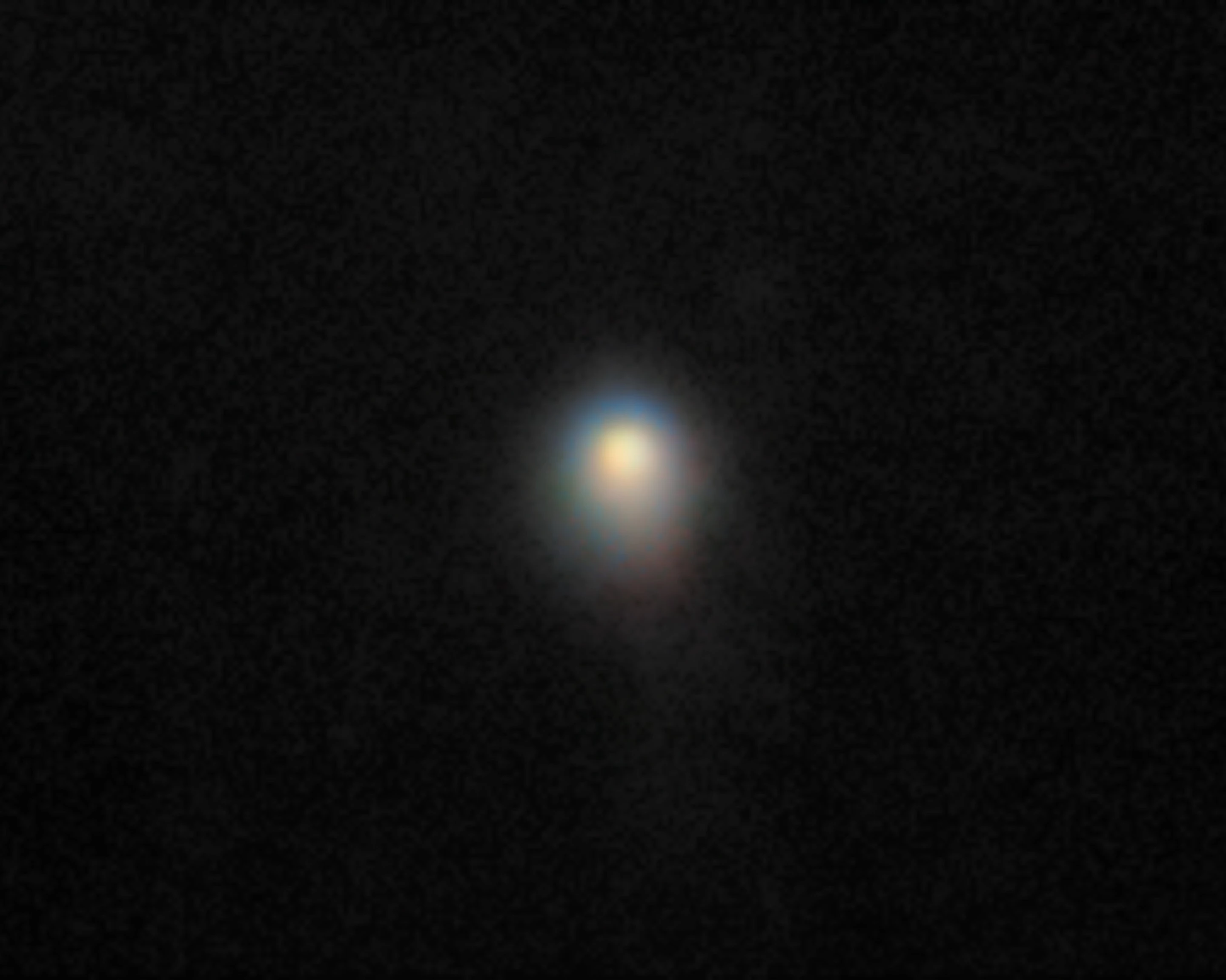
Comet 3I/ATLAS in this photo taken by the Gemini North Telescope
On July 1, 2025, Chile's ATLAS survey telescope scanned the sky and captured an unusual light - a visitor that may be older than the solar system itself. The discovery of the comet, named 3I/ATLAS, surprised astronomers.
Long before the solar system formed, before there were oceans, trees or trilobites on Earth, something extraordinary was wandering the distant universe. Now, billions of years later, it has finally arrived at the doorstep of our universe.
3I/ATLAS is a ghostly interstellar traveler, rich in water ice and with a rich history. 3I is the third such object detected so far, and it's not just a visitor from outside our solar system; it's from an entirely different quadrant of the galaxy.
To decipher its origins, the researchers used the Ōtautahi-Oxford model, an astronomical object detection tool that simulates interstellar objects based on their orbital properties and possible star birthplaces. According to the team's analysis, this ancient comet may be more than 7.5 billion years old, more than 2 billion years older than our sun, and is the oldest celestial wanderer observed by humans so far.
Unlike the previous two space objects that visited the solar system, 3I/ATLAS is approaching rapidly along a steep path. This path suggests it comes from a region of the Milky Way known as the "thick disk," where ancient stars orbit above and below the Milky Way's main plane. Because it may have formed near one of these ancient stars, scientists believe it is filled with water ice.
"This is an object from a region of the galaxy that we have never seen up close," said study co-author Dr.night skyShow host Chris Lintott explains. "We think there's a two-thirds chance that the comet is older than the solar system and that it has been drifting through interstellar space ever since."
As comet 3I/ATLAS approaches the Sun, the heat triggers a cosmic transformation, and its icy surface begins to evaporate gas and dust, creating a glowing halo and tail like the mist of a celestial dragon.
Preliminary observations indicate that this interstellar traveler may be larger and brighter than the two previous interstellar guests, "Oumuamua" (2017) and "Borisov" (2019).
If this hypothesis holds true, it may be surprising how many such ancient comets future observatories will discover. More importantly, it may suggest that comets from the far corners of the Milky Way have been quietly spreading the ingredients for star and planet formation wherever they go.
"We are at an exciting moment: 3I is already showing signs of activity," said paper co-author Michelle Bannister of the University of Canterbury in New Zealand. "The gas that may appear in 3I in the future as it is heated by the Sun will test our models. Some of the world's largest telescopes are already observing this new interstellar object - one of them may be able to find the answer!"
Just days before the celestial reveal, Oxford University astronomer Matthew Hopkins finished his thesis, probably while dreaming of taking a nap on the beach and admiring the tranquil night sky. However, the universe had other plans. When 3I/ATLAS suddenly appeared in view, his inbox was suddenly filled with messages such as "3I!!!!!!", so he began an impromptu in-depth exploration of interstellar data.
Far from relaxing, Hopkins found himself testing the predictions of the Ōtautahi-Oxford model he helped develop, which was now suddenly a reality. This marks the first time a predictive model has been applied in real time to an interstellar comet, turning a theoretical framework into a real galaxy experiment.
So what about for us stargazers here on Earth? 3I/ATLAS is expected to appear in our skies in late 2025 and early 2026, visible with a decent amateur telescope, giving us a chance to get a close look at this relic that's older than the sun.
Hopkins and his co-authors have published the results of their analysis as a preprint inarXivsuperior.