The National Science Foundation's National Radio Astronomy Observatory (NRAO) and partner institutions recently announced that astronomers have clearly captured for the first time in observational data the high-temperature cosmic wind emitted by the supermassive black hole Sagittarius A* (Sgr A*) at the center of the Milky Way, providing direct evidence for half a century of theoretical inference.
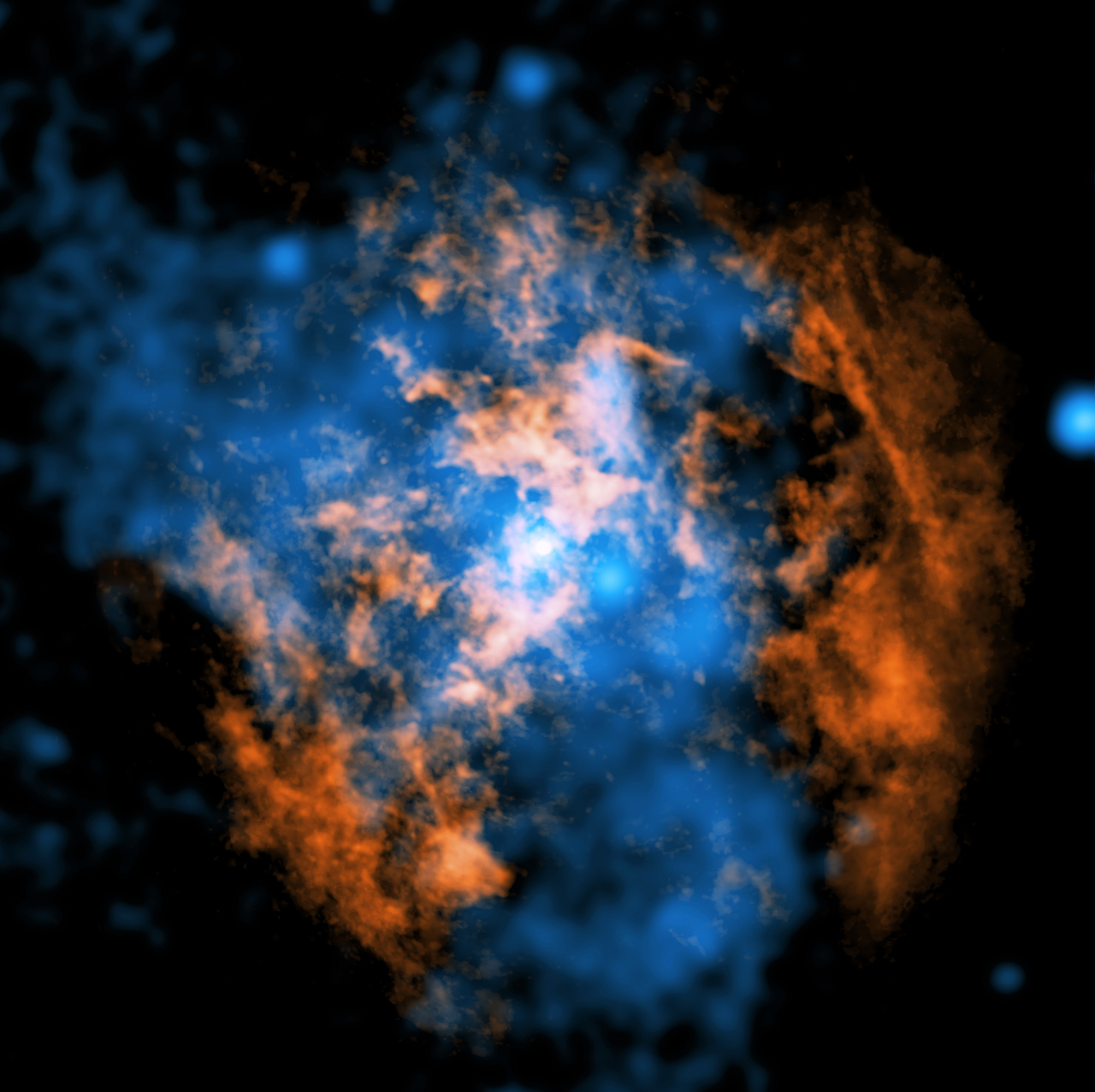
According to astrophysical theory, when a black hole swallows surrounding gaseous material, in addition to part of it being sucked into the event horizon, some of the material should also be thrown outward in the form of jets or winds. However, this "wind" of the black hole at the center of the Milky Way has not been clearly observed.
This research relies on the Atacama Large Millimeter/submillimeter Array Telescope (ALMA) in Chile. Based on several years of observations, the scientific research team has drawn the most detailed distribution map of cold gas around Sagittarius A* so far, and found direct traces left by the black hole's "breathing".
Researchers have been observing the radiation of carbon monoxide molecules for a long time in the 1.3 millimeter wave band within a range of about 1 parsec (about 3 light years) from Sagittarius A*. This type of molecules is a typical tracer of cold molecular gases and helps to describe the spatial structure of cold gas near the black hole.
Since the radio radiation intensity of Sagittarius A* itself is high and changes rapidly with time, the team first carefully modeled and subtracted the bright radio signals of the black hole itself to eliminate "glare" interference as much as possible.
After "subtracting" the strong radiation from the black hole, the researchers were able to distinguish the extremely weak and complex structure of the cold gas in the surroundings, and accidentally discovered a huge cone-shaped cavity - which appeared as an obvious missing area on the cold gas distribution map, and its geometric shape pointed directly at Sagittarius A*.
In order to confirm the physical properties of this structure, the scientific research team also compared data from NASA's Chandra X-ray Observatory and found that the same space area is filled with X-ray radiation emitted by high-temperature gases.
This shows that this cone-shaped cavity is not simply missing material, but is filled by high-temperature wind driven by the black hole; this wind either "sweeps away" the original cold gas, or heats it to high temperature so that it no longer appears in the form of cold gas.
Research shows that the cold gas distribution map drawn based on ALMA data is about 100 times more sensitive than previous similar carbon monoxide observations, and its spatial resolution is about 80 times higher. It has become the clearest and most sensitive observation of cold gas in the 1 parsec range near Sagittarius A* to date.
On this basis, scientists not only clearly identified the black hole-driven outflow structure in the center of the Milky Way for the first time, but also solved the "missing wind" problem that has plagued the field for decades, proving that the black hole in the center of our Milky Way is also violently interacting with the surrounding environment in the form of wind.
The scientific research team estimates that this high-temperature wind blown by Sagittarius A* has lasted for at least 20,000 years, showing that the black hole is releasing energy and momentum outwards in a long-term and stable manner.
However, compared with the huge, bright jets visible in the centers of some other galaxies, this wind in the center of the Milky Way is relatively "mild" and does not form an extremely violent jet structure. Instead, it changes the gas ecological environment in the center of the Milky Way in a more "low-key" way.
Scientists pointed out that this discovery helps to deepen people's understanding of the "feeding" and "feedback" processes of supermassive black holes: On the one hand, black holes accretion surrounding gas to obtain energy, and on the other hand, energy and matter are re-injected into the center of the galaxy through outflows or jets, thereby affecting macroscopic processes such as star formation and gas circulation.
As the home galaxy of mankind, the Milky Way's "breathing" rhythm and pattern of its central black hole have important demonstrative significance for understanding the overall evolution of the galaxy. This observation provides one of the clearest empirical samples to date.
As the key equipment for this achievement, ALMA is a large-scale international astronomical facility built and operated by the European Southern Observatory, the National Science Foundation of the United States, and the National Institute of Natural Science of Japan in cooperation with the Republic of Chile. It aims to observe the gas and dust structure in the cold universe using millimeter and submillimeter wavebands.
The National Radio Astronomy Observatory is responsible for the construction and operation of ALMA on behalf of North America. It is an important radio astronomy observation platform under the National Science Foundation and provides open and advanced observation facilities for the global astronomical community.
According to relevant agencies, the first clear evidence of Sagittarius A*'s "breathing" not only fills a gap between theory and observation, but also opens a new window for future joint exploration of the Milky Way center using multi-band and multi-equipment.
As longer-term baselines and higher-precision observations continue to accumulate, people are expected to further characterize the evolution history of this cosmic wind and assess its profound impact on the distribution of gas and star formation activities in the center of the Milky Way.