AMD released its Q2 quarterly financial report yesterday. The performance of CPU and game cards was outstanding. However, the 14% revenue of the data center department did not satisfy the market, causing the stock price to plummet after the market closed. It only regained its lost ground today. The focus of this data center department is actually the hottest AI field at present. Competitor NVIDIA accounts for 95% of the AI market share. Its performance has soared like a rocket in the past two years. Last year, its revenue was more than 130 billion US dollars, and this year it will exceed at least 200 billion US dollars. Most of them are driven by AI graphics cards, and their profits are astonishing.
NVIDIA has achieved a market value of 4 trillion U.S. dollars thanks to the hot sales of AI cards. AMD currently only has a market value of more than 280 billion U.S. dollars. The gap between the two parties is more than 10 times. Therefore, the market has high expectations for AMD's AI business. If it is disappointed, it will naturally cause the stock price to plummet.
AMD's revenue outlook in the AI market in 2024 is US$5 billion. This year it is expected to reach US$8.5-9 billion. It is not impossible to break the US$10 billion mark, but there is still a big gap with NVIDIA.
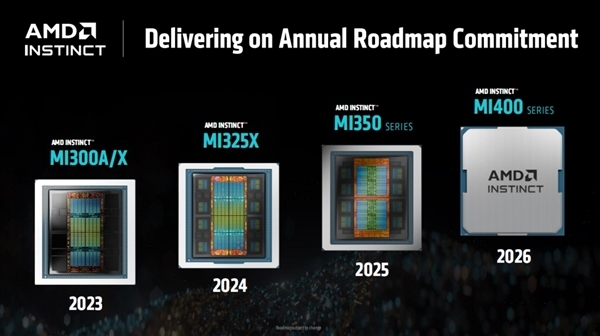
But 2026 will be a critical year for AMD in the AI market, because this year’s AI graphics cards are extremely competitive.The MI400 series will be officially launched, and the memory will be upgraded to the next generation HBM4. The single card capacity is as high as 432GB, and the bandwidth is 19.6TB/s. Compared with the 288GB HEM3E and 8TB/s of the MI350 series, it increases by 50% and 145% respectively. The average memory bandwidth of each CU unit is also increased to 300GB/s.
The performance of FP8/FP6 and FP4 reaches 20PFlops (2 billion times per second) and 40PFlops (4 billion times per second) respectively, which is directly doubled. In fact, in some applications, the ultimate performance improvement can reach an unimaginable 10 times.
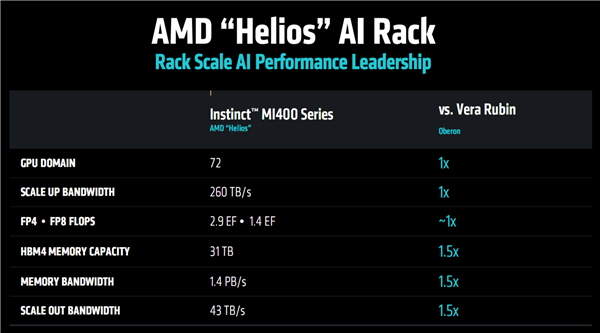
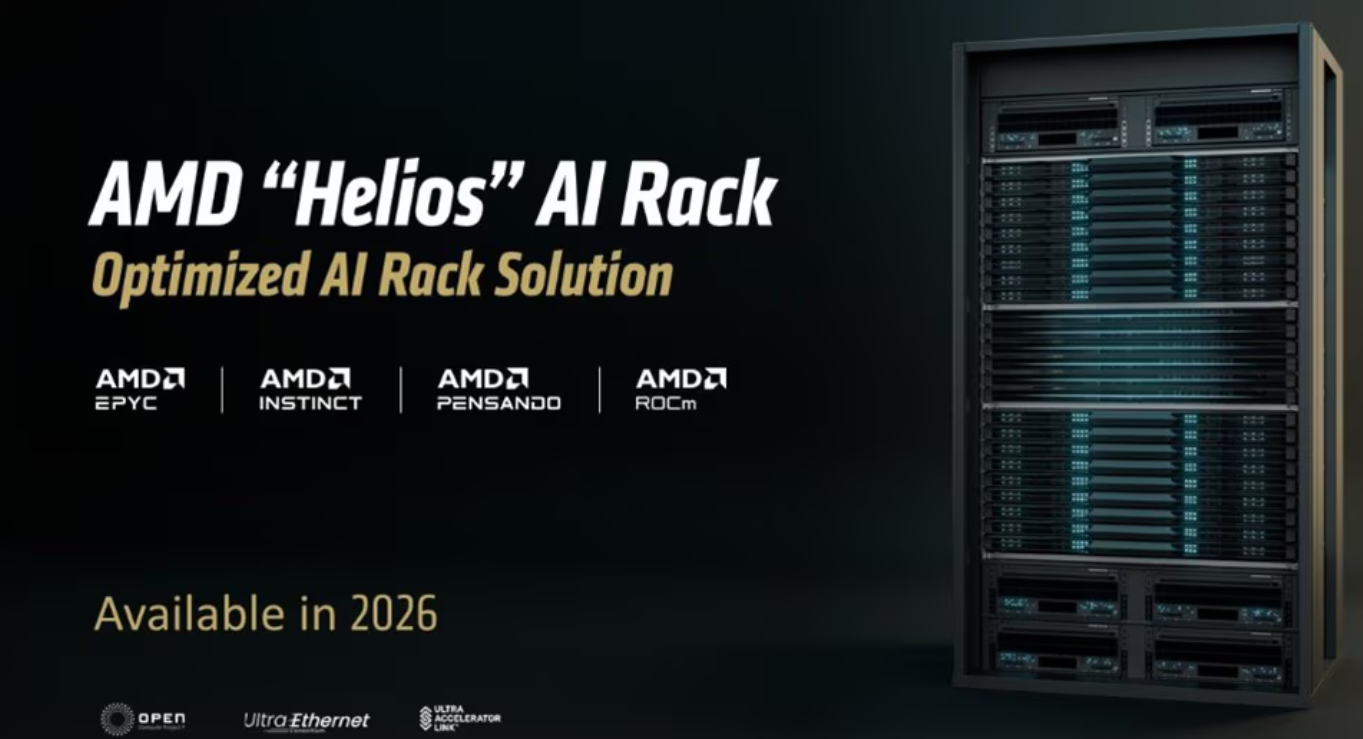
In addition to the MI400 series AI graphics cards, AMD will also launch an AI rack product codenamed Helios next year, which can accommodate up to 72 MI400 series GPUs. Compared with NVIDIA NL72, the total bandwidth is 260TB/s. The total HBM4 memory capacity is 31TB and the total bandwidth is 1.4PB/s, which is more than half of competing products.
The performance of the whole machine is as high as FP8 1.4EFlops (14 billion billion times per second) and FP4 2.9EFlops (29 billion billion times per second), which are basically at the same level as competing products.
At the financial report conference, AMD CEO Su Zifeng also emphasized that the full rack-scale design and implementation details of the MI400 series are numerous, and is currently working with major customers to ensure that when the Helios rack is put into use in 2026, it will be fully compatible with their data center construction.
Su Zifeng said that the MI400 series is advancing rapidly.It will be the most advanced GPU we've ever made, with 50% more memory, bandwidth and scaling throughput than the competition.The Helios rack system is expected to be launched in 2026, which will provide up to ten times the generational performance improvement, and is likely to become the most powerful AI system in the world.
AMD expects Helios to contribute significant revenue in 2026, and it is clear that next year will be the year for AMD to launch N cards.