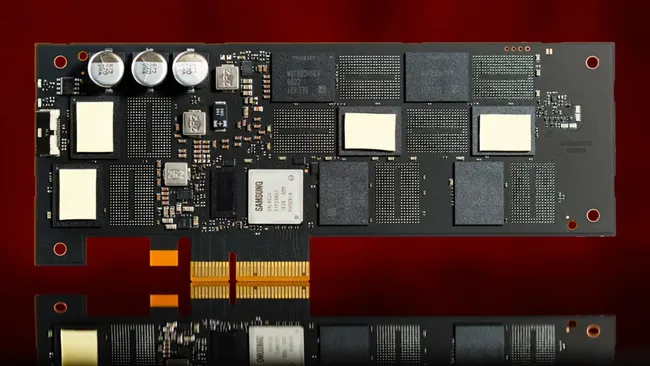
According to reports,Samsung plans to relaunch its Z-NAND storage technology with a target performance improvement of up to 15 times compared to traditional NAND flash memory while reducing power consumption by 80%.In addition, Samsung has also developed a new technology called "GPU-Initiated Direct Storage Access (GIDS)" that allows the GPU to directly access Z-NAND storage devices, similar to Microsoft's DirectStorage API.
Samsung's Z-NAND technology was originally launched in the mid-2010s with the goal of competing with Intel's 3D XPoint Optane storage technology. Both introduce a new type of solid-state storage with performance close to DRAM and system latency far lower than traditional SSDs.
Unlike Intel's 3D XPoint Optane, Samsung's first-generation Z-NAND is essentially an accelerated version of NAND SLC SSD.
It is based on an improved V-NAND design, adopts a 48-layer structure, and operates in single-layer cell (SLC) mode. Its key improvement is to reduce the page size to 2-4KB, thereby achieving faster data read and write speeds and lower system latency.
At the time, drives based on Intel Optane and Samsung Z-NAND were 6-10 times faster than traditional SSDs, and if Samsung's next-generation Z-NAND lives up to expectations, it could perform up to 15 times better than current NVMe SSDs.