Recently, the standard L.1004 "Universal fast-charging solution for mobile terminals" (Universal fast-charging solution for mobile terminals), led by the China Academy of Information and Communications Technology and written in conjunction with Huawei, vivo, and OPPO, passed the review of the International Telecommunications Union Study Group 5 (ITU-T SG5) and was officially released as an international standard.
This is the first global fast charging standard formulated by ITU. In the best practice part of the solution, my country's independently innovative fast charging solution is recommended as the only case in the world.
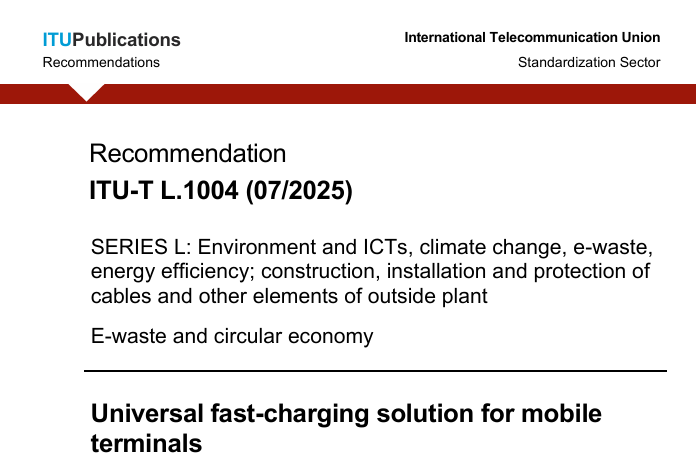
The dual-numbered group standards of China Communications Standards Association (CCSA) and Telecommunications Terminal Industry Association (TAF) [T/CCSA 668|T/TAF 266-2025]; [T/CCSA 394|T/TAF 092-2024] are cited in the references.
This marks that China has achieved a major leap from following, participating to leading in the field of consumer electronics charging technology, and is of great significance to promoting global green environmental protection and industrial integration development.
It is reported that this standard solves the problem of "fast charging protocol incompatibility" that has long plagued consumers and the industry.
The standard solution is jointly tackled by many mainstream domestic manufacturers and innovatively integrates a variety of efficient and safe fast charging technologies to achieve cross-brand and cross-device fast charging function compatibility.
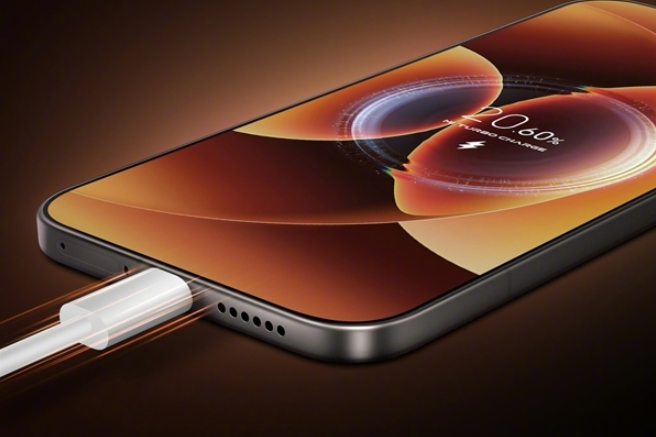
In the future, consumers can use one charger to provide an efficient and convenient fast charging experience for more mobile terminal devices such as mobile phones and tablets of different brands. This will effectively reduce the generation of electronic waste and comply with the global trend of sustainable development.
The successful establishment and release of this standard is a model achievement for my country's science and technology field to adhere to independent innovation and actively participate in global science and technology governance. In the future, it will greatly promote the standardization and standardization process of the global charging market and reduce the cost of the industrial chain.