Recently, the two-year infringement dispute between photographer Dai Jianfeng and Visual (China) Culture Development Co., Ltd. (hereinafter referred to as "Visual China") ushered in the first instance judgment. According to Dai Jianfeng’s personal Weibo “Jeff’s Starry Sky Journey”, the Tianjin Heping District People’s Court found that"Village Under the Milky Way", which was misappropriated by Visual China's contracted contributor Zhou and uploaded illegally, constituted infringement. Therefore, Visual China was sentenced to publicly apologize on the official website and compensate Dai Jianfeng 15,000 yuan.
Public information shows that Visual China was founded in 2000 by Chai Jijun. Under his leadership, the company achieved rapid development. In 2014, it backdoored Far East Holdings and was successfully listed on the Shenzhen Stock Exchange. Since then, the company has successively acquired Corbis, the world's third largest photo company, and photography online community 500px, becoming an internationally renowned Internet technology and cultural creative company with "visual content" as its core.
However, during the rapid expansion of Visual China, the company has formed a model that relies on rights protection to promote business cooperation, which has been repeatedly criticized by public opinion. In April 2019, some netizens discovered that the first black hole image, as well as the national flag, national emblem and other images on its official website were copyrighted by Visual China, triggering widespread social discussion. Visual China subsequently issued a statement and voluntarily closed the website to carry out rectification.
The “black hole incident” has a profound impact on Visual China. At present, there is still a gap between the company's performance and that before the "black hole incident".
In addition, the company's latest market value has shrunk by more than 30 billion from its highest point.
Photographer sued Visual China for copyright infringement and was awarded RMB 15,000 in compensation
On November 20, well-known starry sky photographer Dai Jianfeng officially disclosed through his personal Weibo "Jeff's Starry Sky Journey" that the two-year case against Visual China Information Network Communication Rights Infringement Dispute has reached an effective first instance verdict.
The judgment of the Tianjin Heping District People's Court posted by Dai Jianfeng on Weibo shows that the Tianjin Heping District People's Court found that "Village Under the Milky Way", which was misappropriated by Visual China's contracted contributor Zhou and uploaded in violation of regulations, constituted infringement.
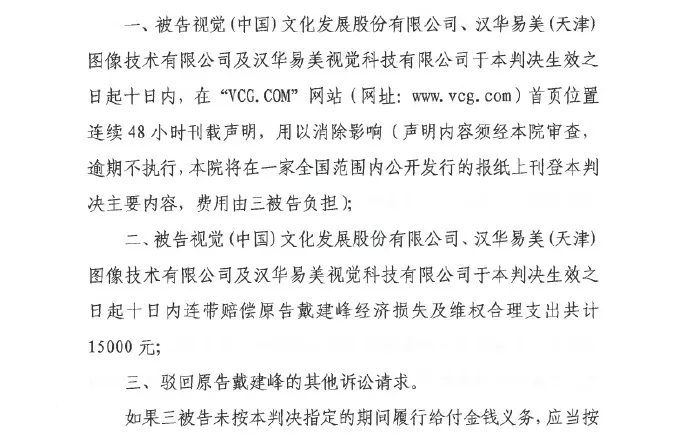
The court ruled that Visual China, Hanhua Yimei (Tianjin) Image Technology Co., Ltd. and Hanhua Yi Vision Technology Co., Ltd. shall publish statements on the homepage of the "VCG.COM" website for 48 consecutive hours within ten days from the date of the judgment to eliminate the impact; compensate the plaintiff Dai Jianfeng for economic losses and reasonable rights protection expenses totaling 15,000 yuan; and reject Dai Jianfeng's other claims.
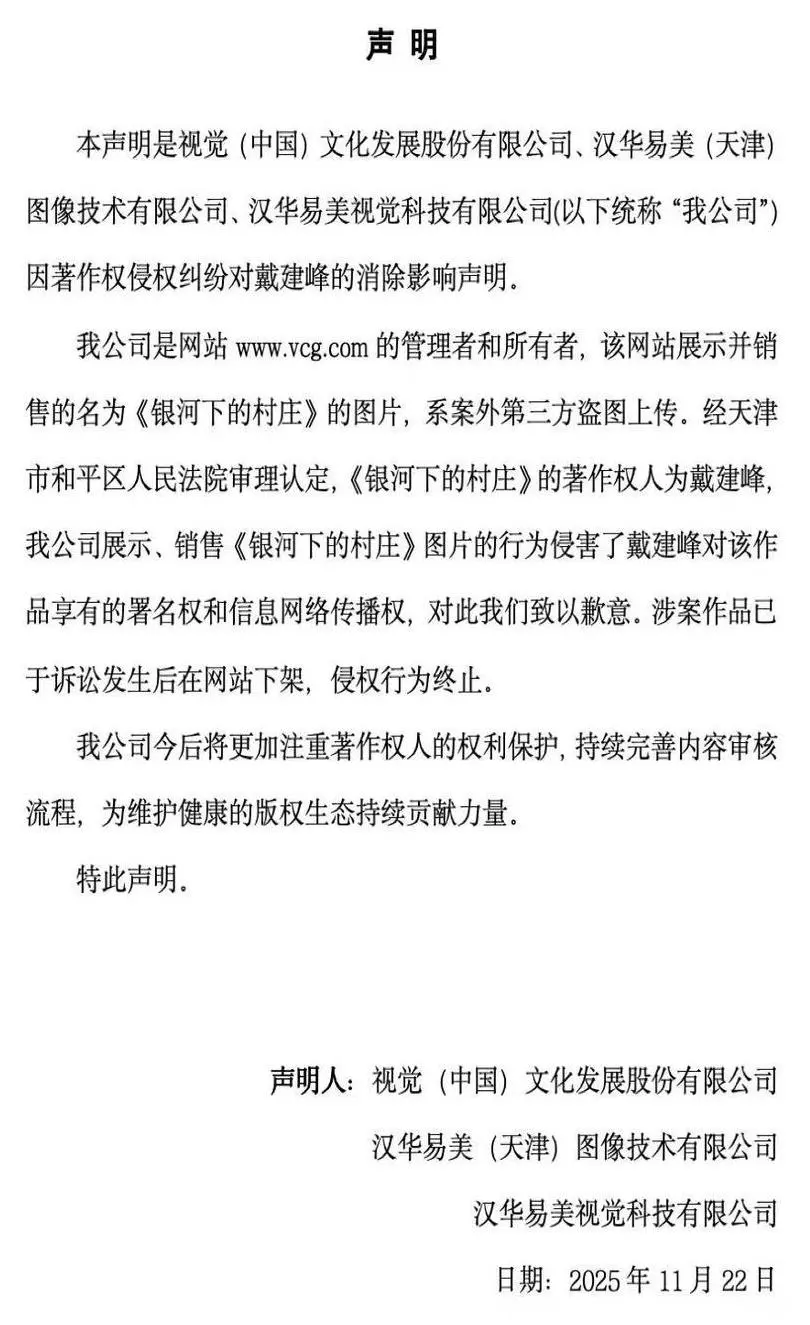
On November 22, Visual China issued a statement on the homepage of its official website, apologizing to Dai Jianfeng and stating that the company will pay more attention to the protection of the rights of copyright owners in the future, continue to improve the content review process, and continue to contribute to maintaining a healthy copyright ecosystem.
It is reported that the case began in August 2023. At that time, the staff of Visual China called Dai Jianfeng and said that his official account had infringed the use of 173 pictures of the Visual China platform and demanded that Dai Jianfeng compensate him more than 80,000 yuan.
However, Dai Jianfeng discovered that these 173 "pictures involved" were all original works taken by him. Later, he disclosed the incident on his personal social platform, which triggered a lot of heated discussions among netizens.
At that time, in the face of pressure from public opinion, Visual China responded that the photo was authorized by photographer Dai Jianfeng to the American photo gallery Stocktrek Images, which in turn authorized it to Getty Images. As Getty's exclusive partner in mainland China, Visual China has the sales rights.

However, after Dai Jianfeng contacted Stocktrek and Getty Images, he pointed out that Visual China’s response was untrue.
On the evening of August 15, 2023, Visual China quietly removed all the pictures involved without making any explanation or public statement.
Three days after the incident, Dai Jianfeng posted a message stating that he had received anonymous death threats. He also said that he had called the police and would protect his legitimate rights and interests through legal means.
On October 9, 2023, Dai Jianfeng posted on his Weibo that he had filed a lawsuit with the People's Court of Heping District, Tianjin City for Visual China's illegal sale of photos without his permission and compensation for it.
This time, Dai Jianfeng revealed on Weibo that he had won the lawsuit against Visual China, which triggered follow-up reports from many media.
Claim-based marketing has been criticized frequently
Public information shows that Visual China is located in Changzhou City, Jiangsu Province. It is an enterprise mainly engaged in the culture and art industry. The actual controllers of the company are Wu Yurui, Chai Jijun, and Liao Daoxun, who constitute persons acting in concert.
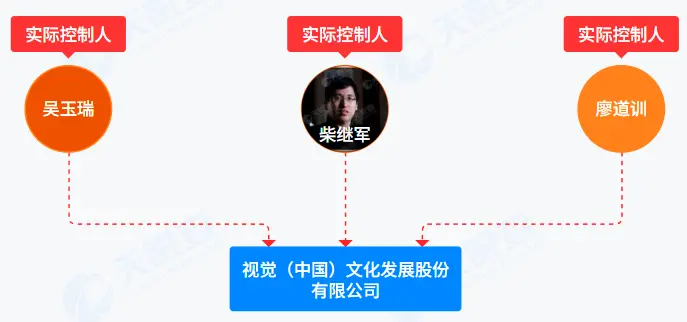
Chai Jijun, the company's president, was born in April 1974. In 1995, after graduating from the Department of Journalism and Communication of Nanjing University, he worked in the photography department of China Youth Daily as a photo editor and photojournalist.
In May 2000, Chai Jijun, who sensed huge business opportunities in the field of Internet pictures, and his colleagues established China's first Internet picture company "Photocome". Users can pay to download pictures uploaded by photographers to the company's platform.
In 2005, Photocome formed a joint venture with Getty Images, the world's largest digital imaging company, to establish Huagai Creative to focus on creative content and enter the commercial market.
The following year, Chai Jijun left China Youth Daily and became the company's director and editor-in-chief. In the same year, Photocome changed its name to "Hanhua Yimei".
In 2014, Visual China backdoored Far East Holdings and successfully landed in the capital market, becoming the only A-share listed company in the cultural and creative industry based on the Internet.
After its listing, Visual China expanded rapidly. In 2016, the company acquired Corbis, a high-end photo gallery founded by Microsoft founder Bill Gates, which covers almost all classic moments in human history since the birth of photography technology; in 2018, it acquired the internationally renowned photographer community 500px.com, which serves more than 31 million registered members in 195 countries and regions around the world; in March 2023, it took control of Vjshi.com, the leading domestic audio and video material trading platform.
However, as the company develops rapidly, its business model has been questioned by "phishing law enforcement" and "blackmail rights protection."
On April 10, 2019, the first black hole photo in human history was released. Later, the image appeared on the Visual China website, and the copyright was marked as owned by Visual China. At the same time, some netizens discovered that pictures such as the national flag and national emblem on the Visual China website were also marked as copyrighted.
On the afternoon of April 11 of the same year, the Central Committee of the Communist Youth League, China Police Network, Shenzhen Traffic Police, and more than 50 companies posted questions on Weibo about the matter. In the evening of the same day, the Tianjin Internet Information Office interviewed the person in charge of the website and ordered the website to immediately stop illegal activities and make comprehensive and thorough rectifications.
On April 12, Visual China issued an apology letter on "VCG Visual China".
It is worth noting that Chen Hangping and Hu Jiahan of Tsinghua University Law School pointed out in the article "A Perspective on China's "Copyright Cockroach" - Based on the Analysis of 3,965 Judgments Involving Two Visual China Companies" published last year that Visual China only selected commercial entities as defendants and focused on filing lawsuits in the courts of Guangdong, Tianjin, and Beijing. Analyzing the "copyright cockroach" from the perspective of law and economics, its filing of lawsuits does not promote the development of the copyright market, but has negative externalities and aggravates the contradiction between too many cases and too few cases in the court.
They suggested that lawsuits filed by "copyright cockroaches" should be regulated in terms of litigation fees, statutory compensation standards, and clarity of factual explanation (sufficiency of evidence).
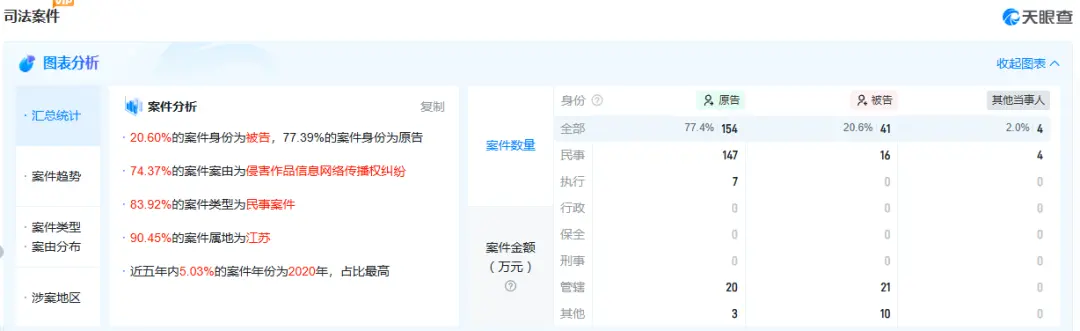
Radar Finance noted that as of now, Vision China has a total of 199 judicial cases on Tianyancha, of which 154 are plaintiffs, and 74.37% of the cases are disputes over infringement of the right to disseminate work information online.
The market value has shrunk by more than 30 billion from its highest point
Vision China, which relies on litigation to obtain customers, has encountered bottlenecks in its development in recent years.
In 2018, Visual China achieved revenue of 988 million yuan and net profit of 321 million yuan, both reaching the highest point since its listing.
In 2019, after the "black hole" copyright incident broke out, the company's revenue and net profit doubled. Among them, revenue fell by 26.9% year-on-year, and net profit fell by 31.81% year-on-year.
Flush iFinD data shows that in 2024, Visual China’s annual revenue will reach 811 million yuan, a year-on-year increase of 3.89%, and its net profit will be 119 million yuan, a year-on-year decrease of 18.17%.
Based on this judgment, the company's revenue and net profit in 2024 are far behind the highs in 2018.
After entering 2025, Visual China’s performance is still far from ideal.
Specifically, in the first quarter of this year, Visual China achieved revenue of 189 million yuan, a year-on-year increase of 8.43%, and net profit increased by 12.26% year-on-year to 18 million yuan; in the second quarter, the company's revenue and net profit both declined, with revenue falling by 6.48% year-on-year. % to 210 million yuan, and net profit fell 25.78% from the same period last year to 26 million yuan; in the third quarter, Visual China achieved operating income of 211 million yuan, a year-on-year increase of 0.78%; net profit was 31 million yuan, a year-on-year decrease of 1%.
Throughout the first three quarters, Visual China achieved revenue of 610 million yuan, a slight increase of 0.3% year-on-year; net profit was 74 million yuan, a decrease of 9.03% compared with the same period last year.
Regarding the decline in the company's net profit in the first three quarters, Visual China pointed out in its investor research announcement on November 3 that it was mainly due to the short-term pressure on related income caused by the overall adjustment of the advertising and marketing industry under the influence of the macro environment.
In the first three quarters of this year, Vision China's gross profit margin was 42.75%, a decrease of 3.48 percentage points from the same period last year; the company's net profit margin decreased from 14.91% in the same period last year to 13.44%, and the company's profitability has weakened.
In terms of cost control, in the first three quarters of this year, Visual China’s sales expenses were 59.1515 million yuan, a year-on-year increase of 6.23%; while during the same period, administrative expenses and research and development expenses fell by 1.07% and 15.37% to 81.5626 million yuan and 51.1467 million yuan respectively.
In terms of assets, as of the end of the first three quarters, Visual China’s total assets were 4.425 billion yuan, a year-on-year increase of 4.89%. Among them, monetary funds decreased by 9.74% from the beginning of the period to 482 million yuan; accounts receivable increased by 61.8686 million yuan from the beginning of the period to 226 million yuan due to the increase in the proportion of project-based business during the reporting period.
In terms of liabilities, in the first three quarters of this year, the company's total liabilities were 766 million yuan, an increase of 12.26% compared with the same period last year.
Against the background of performance pressure, Visual China is trying to broaden its development space by listing on the Hong Kong Stock Exchange.
On November 4, Visual China announced that in order to carry out global strategic layout, assist the company's overseas business development, enhance overseas financing capabilities, and further enhance its international brand image, the company is planning to issue shares (H shares) overseas and list them on the Hong Kong Stock Exchange. However, the company also emphasized that there are still significant uncertainties regarding whether to implement the aforementioned matters, as well as the specific plans and implementation time.
As of November 25, Visual China's stock price closed at 25.32 yuan/share, and on June 3, 2015, Visual China hit an intraday high of 72.79 yuan/share. Based on this calculation, Visual China’s market value has evaporated by 31.874 billion yuan from its highest point.