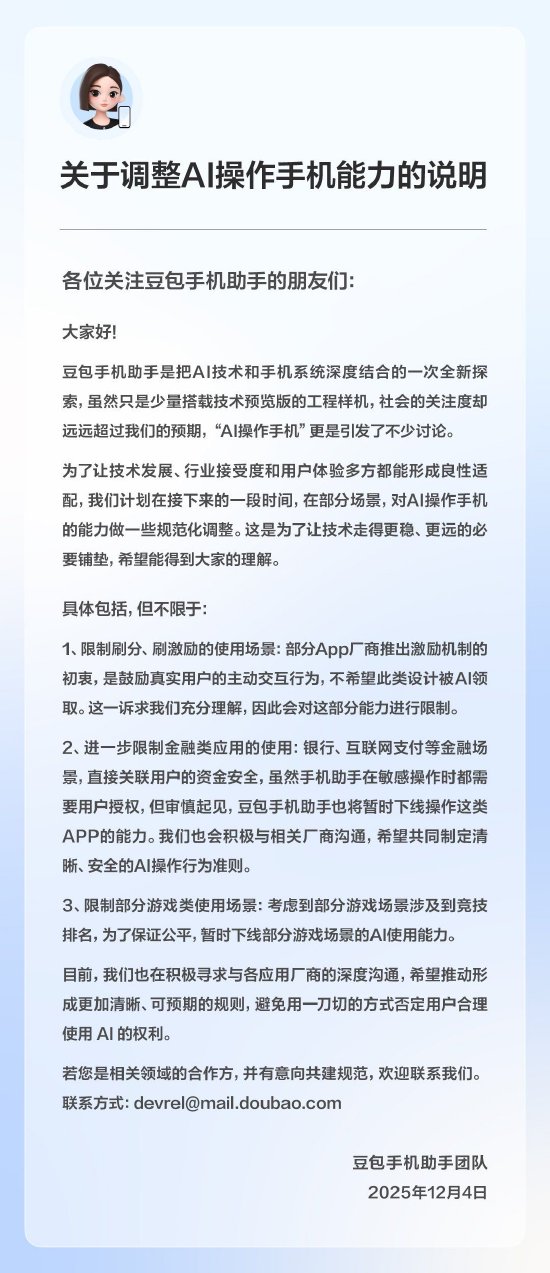
Today, Doubao Mobile Assistant released "Instructions on Adjusting AI's Ability to Operate Mobile Phones", stating that it plans to make some standardized adjustments to AI's ability to operate mobile phones in some scenarios in the coming period. It also emphasized that it will actively communicate with all parties in the hope of promoting the formation of clearer and predictable rules to avoid using a one-size-fits-all approach to deny users the right to reasonably use AI.
Previously, in the official video, the preview version of Doubao Mobile Assistant showed its ability to help users order takeout, book air tickets, compare shopping, and even reply to WeChat messages and operate mini-program games.
However, after the official launch, many users reported that they would be restricted from logging in when using some third-party products, such as WeChat, using the "operate mobile phone function". Later there were rumors that Doubao Mobile Assistant invoked system capabilities without authorization.
In this regard, Doubao Mobile Assistant clearly stated that AI operation of mobile phone functions requires explicit authorization from the user, and the user can interrupt at any time during the execution of the task. If sensitive authorization is encountered when operating a third-party app, the user needs to manually confirm it a second time. However, there are still some disputes that user authorization of data cannot replace the authorization of third-party platforms.
In the announcement, Doubao Mobile Assistant stated that in order to achieve a healthy adaptation between technology development, industry acceptance and user experience, Doubao Mobile Assistant will make some standardized adjustments to some capabilities.
According to the official statement, the adjustment of Doubao Mobile Assistant mainly involves three types of scenarios: first, restricting the automatic operation capabilities for brushing points and incentives in various apps to respect the original intention of manufacturers to encourage "active interaction by real users"; second, further restricting the ability to operate on behalf of financial applications such as banking and Internet payments; third, suspending the use of AI in some game scenarios involving competitive rankings to maintain fairness.