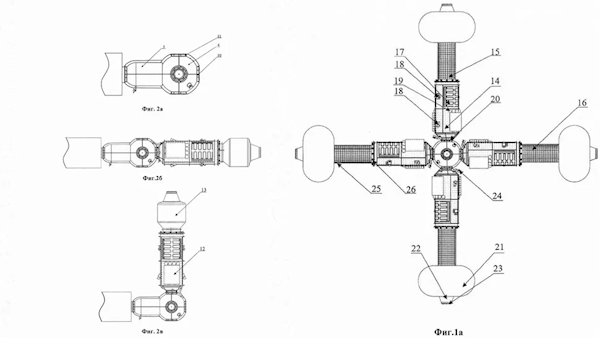
Recently, the Russian state-owned rocket company Energia officially obtained a patent for a giant artificial gravity rotating space station.The core is to generate 0.5g centrifugal gravity through a 40-meter radius rotating cabin section to alleviate the health hazards of microgravity for long-term manned missions..
It is understood that after millions of years of evolution, the human body has become inseparable from the earth's gravity. Once gravity is lost, the muscles of our body will lose their function and the bones will lose their strength.
Astronauts living in the space station need to exercise for several hours every day to ensure that their bodies can maintain normal functions after returning to Earth, and the artificial gravity space station has opened up new ideas.
According to the patent,The new space station is a modular rotating structure, like a huge high-speed fan, rotating around a central spine at a speed of about 5 revolutions per minute with a rotation radius of 40 meters to achieve 0.5 times the acceleration of gravity.
However, it needs to be noted that building such a space station is not easy.
It is huge and requires multiple rocket launches.The transport spacecraft needs to be synchronized with the precise rotation speed of the rotating cabin section. The operation complexity is high and the safety redundancy is reduced. Special docking control algorithms and mechanical mechanisms need to be developed..
The material strength, dynamic balance and fatigue life of flexible joints of a 40-meter-radius rotating body have strict requirements. Structural vibration caused by rotation may interfere with precision loads.
Maintaining a stable rotational speed requires continuous energy input, and attitude control needs to offset the rotational coupling torque, which places higher requirements on the propulsion and control system.
Therefore, it is currently in the design and patent stage, there is no clear construction timetable, and the implementation is far away..