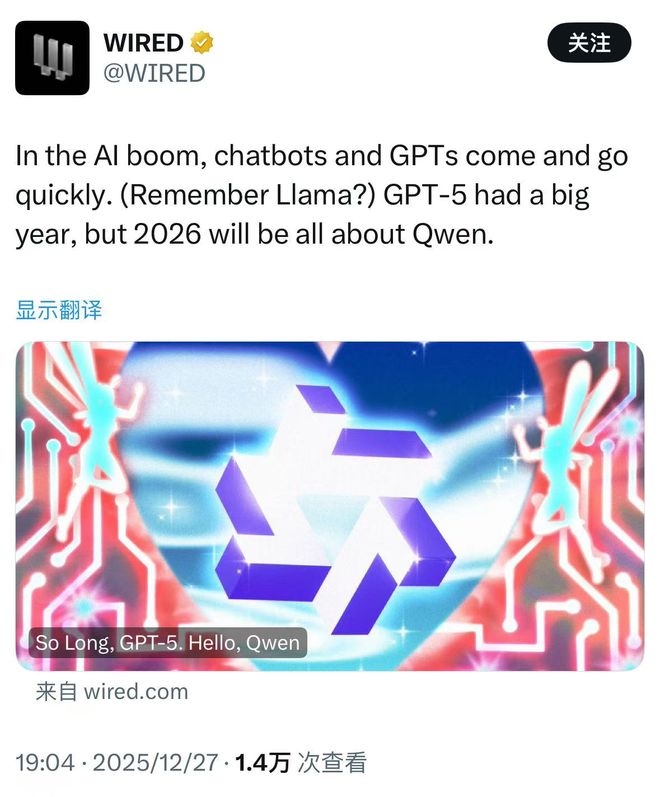
On December 27, WIRED, a well-known American technology media, published a headline article stating that 2026 will be the year of Alibaba’s Qwen. "Wired" stated in the article that although the US OpenAI's GPT-5, Google's Gemini 3 and Anthropic's Claude generally score higher,However, the performance of Chinese models such as Alibaba Qianwen, DeepSeek, and MiniMax are also firmly in the first echelon, and they are becoming more and more popular., "The reason is that they have excellent performance and are easy for developers to flexibly adjust and use."
According to data from HuggingFace, the world’s largest AI open source community,The number of downloads of open source models in China has surpassed that of the United States in July 2025, with Alibaba Qianwen ranking first; Overseas model API call third-party platform OpenRouter data also shows that Qianwen has suddenly emerged this year and has become the second most popular open source model in the world.
"Wired" pointed out that in contrast, OpenAI's latest model GPT-5 released in August this year failed to arouse market enthusiasm. "The key criterion for measuring the value of any AI model should not be limited to its 'smartness', but also the breadth of its use in building other applications. If this is used as a yardstick, China's large open source models such as Qianwen are undoubtedly on the rise."
Andy Konwinsk, founder of Laude, said that the open attitude of Chinese artificial intelligence companies, which often publish papers detailing new engineering technologies and training techniques, is in sharp contrast to the increasingly closed-minded philosophy of large American companies, which seem to be afraid of leaking their intellectual property. A paper by the Qwen team detailing a method to enhance model intelligence during training was named one of the best papers at NeurIPS this year.