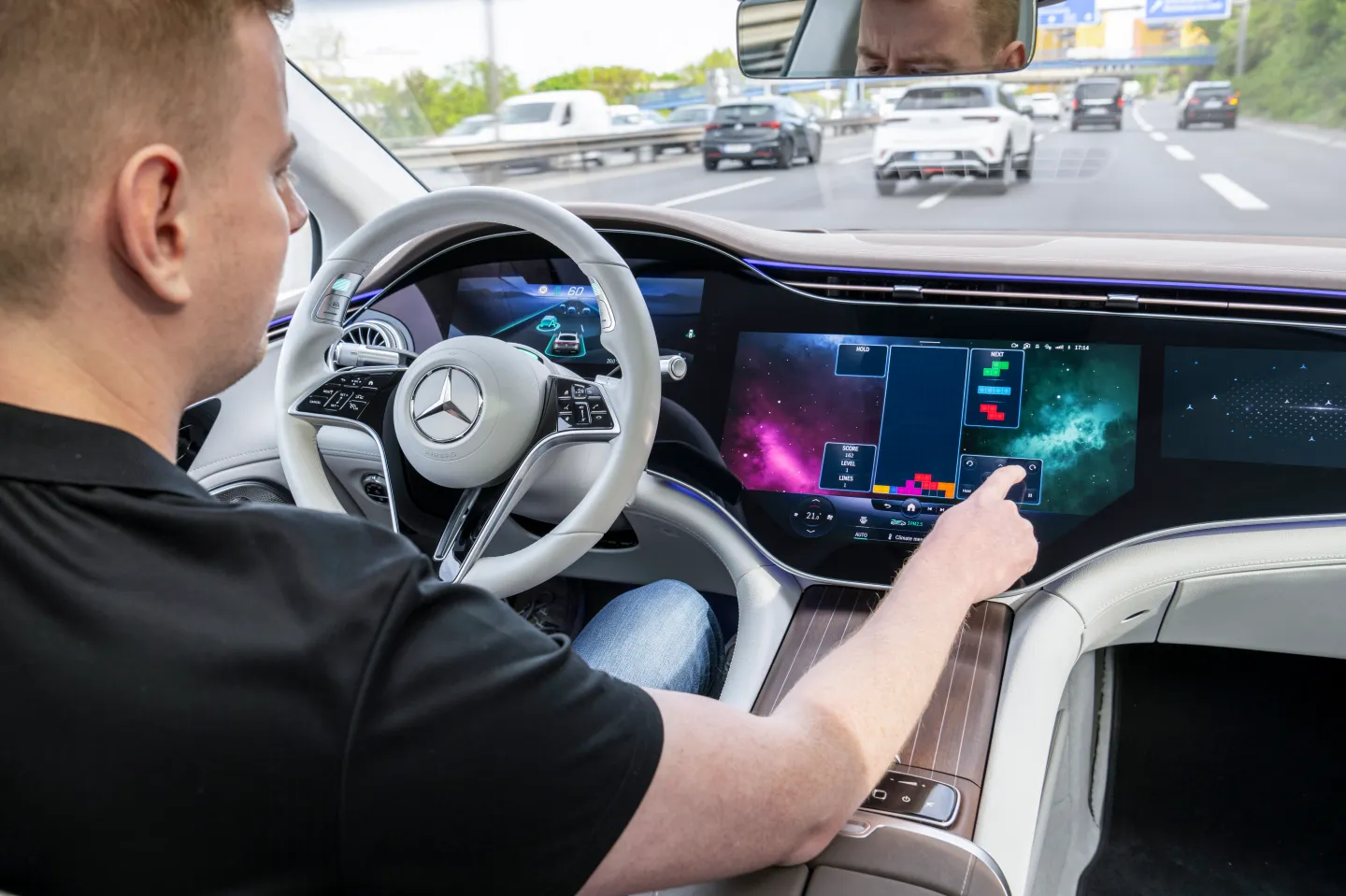
Mercedes-Benz has announced that it is suspending further deployment of its Drive Pilot level three autonomous driving feature launched in Europe and the United States. The new generation facelifted S-Class will no longer be equipped with this "hands-free and eyesight-free" conditional autonomous driving system when it goes on sale at the end of this month. This Drive Pilot, launched in 2023 with the EQS pure electric sedan and the fuel version of the S-Class, was one of the first L3-level systems in the world open to ordinary consumers. In highway congestion scenarios, it can allow drivers to take their eyes away from the road at a maximum speed of about 40 miles per hour and instead play games or watch videos on the central control screen. It is regarded as a major leap compared to traditional L2-level "assisted driving".
According to a previous report by the German media Handelsblatt, the reason for Mercedes-Benz's adjustment is mediocre user demand and the high cost of development and mass production of the technology. At the same time, the company is preparing to launch a new system "Drive Pilot Assist" internally called L2++ this year. The new system can be used in urban traffic conditions, and its function positioning is close to Tesla Full Self-Driving, but it still requires the driver to maintain attention throughout the process and take over vehicle control at any time. Tobias Miller, a spokesman for Mercedes-Benz, said the company did not want to continue to offer a solution with "limited significance to customers" knowing that a new system with higher customer benefits would be launched in a few years.
In terms of technical and regulatory restrictions, Drive Pilot's "operational scope" (ODD) is very narrow: in Europe it is limited to road sections in Germany, and in the United States it is only allowed to be used on some highways in California and Nevada. The system must meet conditions such as piloting the vehicle in front, clear road markings, good weather and lighting, etc. It cannot be activated at night or on rainy days, and requires the lights and wipers to be in automatic gear. The driving road must also be carefully mapped by Mercedes-Benz in advance. This series of prerequisites has significantly weakened the daily usability of users, and has also led Mercedes-Benz to consider integrating Drive Pilot and Drive Pilot Assist in the future, and then promote higher levels of autonomous driving when the regulatory environment is more favorable.
In the process of developing Drive Pilot, Mercedes-Benz has hyped it as "the world's first mass-produced L3": During media testing in 2023, experiencers can play "Tetris" or watch YouTube videos on the central control entertainment screen while the vehicle is driving; in 2024, the maximum speed allowed for the system to operate in Germany has been increased from 64 km/h to 95 km/h. However, high technology costs and supply chain problems soon emerged. One of the key ones was that lidar supplier Luminar failed to meet Mercedes-Benz's requirements. The two parties terminated their cooperation in 2024, and Luminar subsequently went bankrupt. Miller emphasized that lidar redundancy is very important to compensate for the limitations of cameras in backlight, low-light and other scenarios. At the same time, the system also relies on high-precision maps, but he also pointed out that with the advancement of artificial intelligence perception capabilities, the reliance on extremely high-precision maps may be reduced in the future.
The safety and practicality of L3 autonomous driving itself have long been controversial in the industry. Studies have shown that when a vehicle is under automatic control for a long time and the driving rights are returned to humans in an emergency, it can easily lead to problems such as oversteering, overbraking or slow response, thus creating chain safety risks. Many autonomous driving companies, including Waymo and Cruise, have publicly stated that they have reservations or even a negative attitude towards the L3 model, preferring to directly invest in L4 level fully autonomous driving systems that eliminate human driving. Against this background, Mercedes-Benz has temporarily suspended Drive Pilot and instead invested resources in a new generation L2+ system that covers urban commuting but still retains the driver's primary responsibility. This is seen as an important adjustment to the autonomous driving product strategy, and also reflects the entire industry's continued trade-offs in safety responsibilities, regulatory environment and commercial implementation paths.