When engineers at the Ecole Polytechnique Fédérale de Lausanne (EPFL) in Switzerland rethought the concept of "hand", they deliberately abandoned one of the most fundamental settings: the hand must be fixed on the arm. They developed a robot hand that can detach from the robotic arm, crawl on the surface like a small creature, and approach and grab objects from almost any direction, providing a new operating tool for future industrial inspection and maintenance tasks.
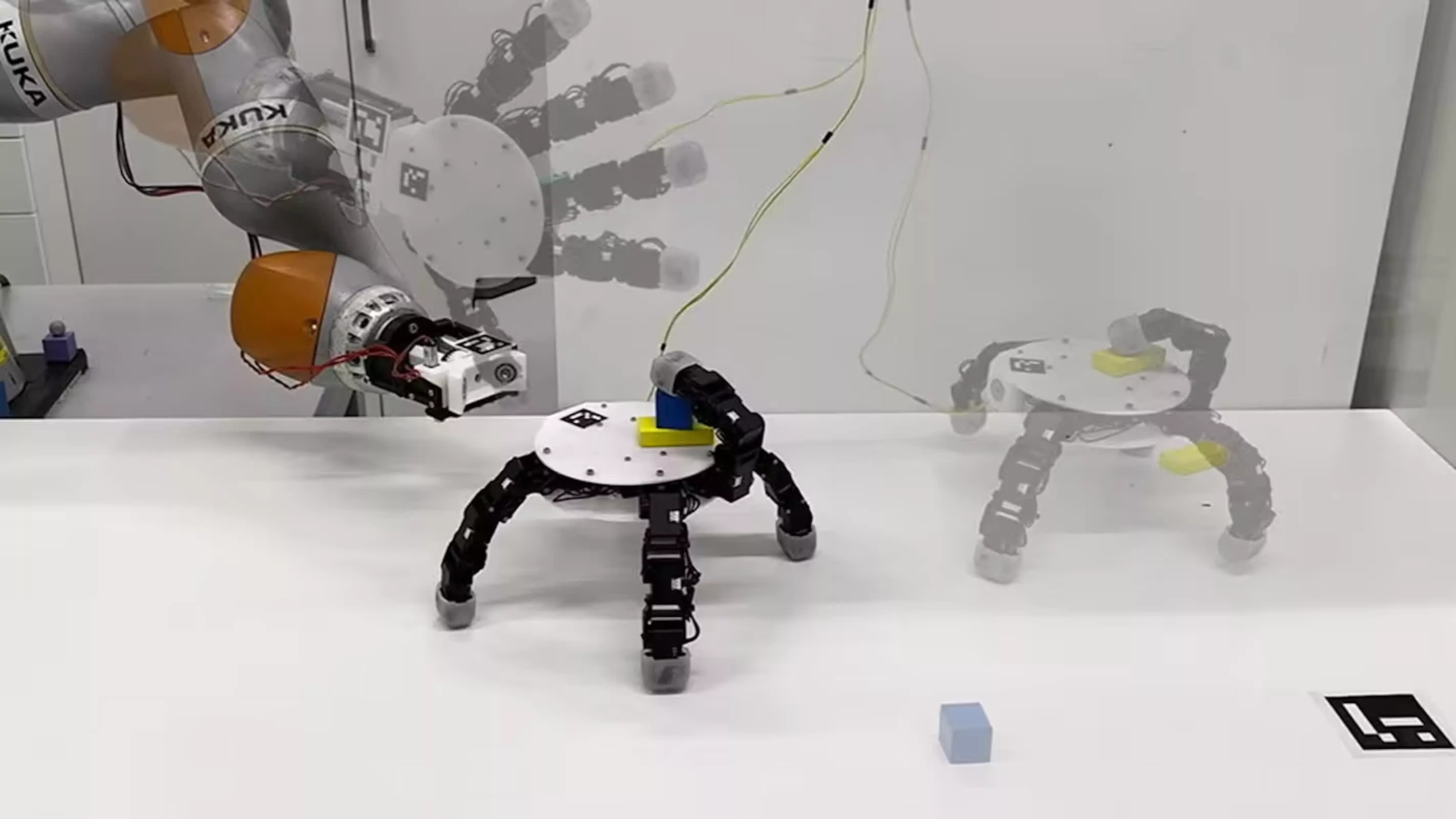
Unlike traditional manipulators, which are fixed to the end of the robotic arm, this new device is a "dual-mode" manipulator: it can be used as a regular end effector or it can move independently after being unlocked from the robotic arm. Once detached, it relies on coordinated movements between its fingers to crawl, turn and reposition in different directions to actively approach the target object. This design blurs the boundaries between "limbs" and "mobile machines" to a certain extent, and is regarded by the research team as a pragmatic evolution of robot form rather than a science fiction concept.
The project is led by Gao Xiao, who conducted research at EPFL and is now at Wuhan University. He told the Financial Times that the team's goal is to expand the boundaries of what "hands" - whether biological or mechanical - can do in operational tasks. Unlike human hands, which rely on a single thumb to oppose the remaining fingers, each finger of this robot hand can form an opposition relationship with any other finger. This counter-finger structure gives the system far greater flexibility than the human hand, allowing it to switch between different finger combinations to precisely manipulate targets in a variety of ways, such as pinching, clamping or lifting.
In terms of structural innovation, this hand also has the ability to "grasp in both directions, front and back" that human hands do not have. Human fingers are physiologically unable to effectively grasp objects from the dorsal direction of the palm, but this system can stably hold objects in both front and rear directions. Not only does this allow it to grasp multiple objects at the same time, it also opens up room for "same-hand multitasking" when manipulating tools and targets.
In the experimental demonstration, this robot hand completed a number of operating tasks that usually require the cooperation of two human hands, such as unscrewing the bottle cap while fixing the bottle body, or applying torque with another tool while stabilizing the workpiece. By flexibly scheduling the opposing combinations of different fingers, it can simulate or even surpass some operating modes in traditional two-hand collaboration scenarios.
Gao Xiao emphasized that the team’s design starting point was “functional control” rather than stealth or surveillance purposes. Researchers believe that its most potential application scenarios are on the front line of industry: status inspection inside pipelines or equipment, disassembly and assembly of maintenance parts, or retrieving dropped workpieces in narrow spaces. In these applications, traditional full robotic arms or human operators often cannot penetrate the site, while small, independently mobile "crawling hands" can access and operate hard-to-reach locations.
The research team envisions that future robotic systems could combine mobile platforms with such detachable robotic hands. The mobile platform is responsible for inspecting and accessing equipment in complex sites, while the robot hand detaches from the platform or robotic arm when necessary and goes deep into narrow spaces to complete tasks such as cleaning debris, operating valves, or grabbing equipment. This structure of division of labor and collaboration is expected to improve the adaptability and task completion rate of industrial automation systems in complex environments.
This work has also attracted the attention of the robotics community. Digby Chappell, associate professor at the Institute of Robotics at the University of Oxford, commented that this robot hand is "interesting and provocative" and has enlightening significance in fields such as industrial automation and prosthetic research. He pointed out that although the crawling speed of the prototype is not very fast at present, its ability to achieve synergy between "movement and grasping" is already redefining the possible form of "robotic hands".
Currently, this "crawling hand" is still in the laboratory prototype stage. However, it has clearly shown a completely different path from imitating human anatomy: the next step of robotics may no longer be limited to "like humans", but will evolve in a more adaptable, multi-purpose and modular direction around industrial and practical needs.