OpenAI today officially released Prism, an “AI-native” online workspace specifically designed for scientific researchers. It is powered by the latest GPT‑5.2 model and aims to simplify scientific writing and collaboration processes. OpenAI said that currently about 1.3 million users discuss difficult scientific topics on ChatGPT every week, and the message volume of advanced science and mathematics users is about 3.5 times that of ordinary users. Prism was launched to serve this rapidly growing research community in a more targeted manner.
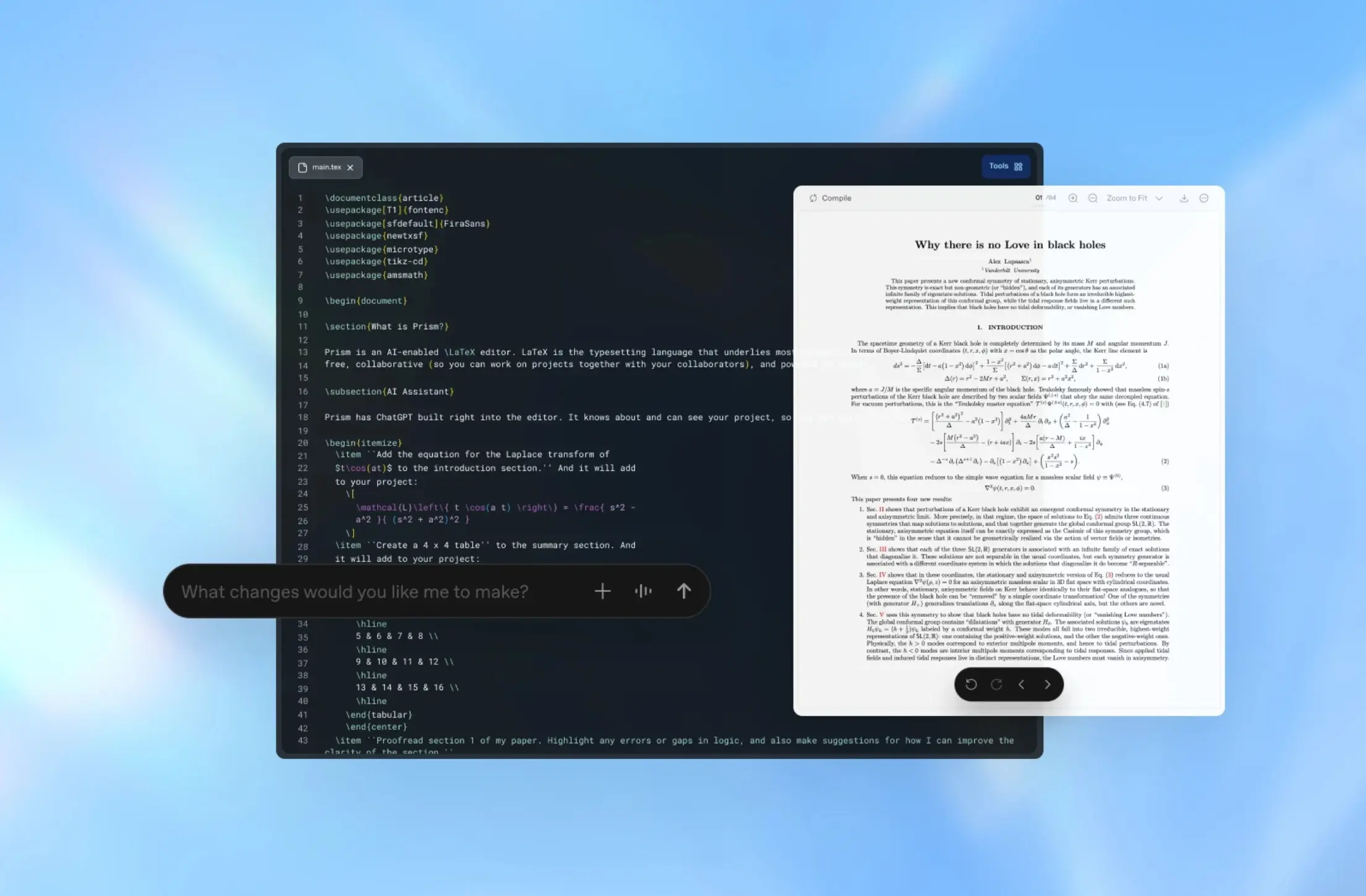
Prism is built on Crixet, the cloud LaTeX platform previously acquired by OpenAI, integrating multiple tools that need to be switched back and forth in traditional scientific research writing - text editors, PDFs, LaTeX compilers, reference management tools and chat interfaces - into a unified cloud workspace. Researchers can complete LaTeX editing, formula writing and reconstruction, reference management, illustration and diagram processing under the same interface, and support real-time collaboration among multiple people. OpenAI said Prism is currently available to users with free ChatGPT personal accounts, and will be available in paid plans such as ChatGPT Business, Team, Enterprise and Education in the coming weeks.
In terms of specific capabilities, Prism integrates GPT‑5.2’s “Thinking” model, which researchers can use to explore research ideas, test hypotheses, and reason and discuss complex scientific issues. Users can not only use AI to assist in writing and reconstructing formulas and polishing paragraphs, but also let the system assist in organizing and inserting literature references, and processing charts and illustrations in papers. Prism also supports automatic conversion of hand-drawn whiteboard sketches into LaTeX representations, and also provides voice editing functions for simple operations such as small modifications and text replacement.
As a tool for research teams, Prism also enhances collaboration capabilities, supporting the addition of an unlimited number of collaborators. All content is stored in the cloud, and researchers can share workspaces and edit with colleagues simply through links. OpenAI stated in its official statement that AI has profoundly reshaped the software development process in 2025. They expect that the scientific research field will also usher in similar changes from 2026: AI will accelerate the pace of scientific discovery by reducing the "friction costs" in daily research work. Prism is seen as an early step towards this vision and an important attempt by OpenAI to deeply embed cutting-edge large models into the scientific research and production process.