Researchers at Kyoto University recently proposed a new theoretical model that attempts to explain how "space weather" such as solar activity can weakly but possibly critically affect the rupture process deep in the earth's crust under certain conditions, thereby "promoting" the occurrence of large earthquakes in rare cases.
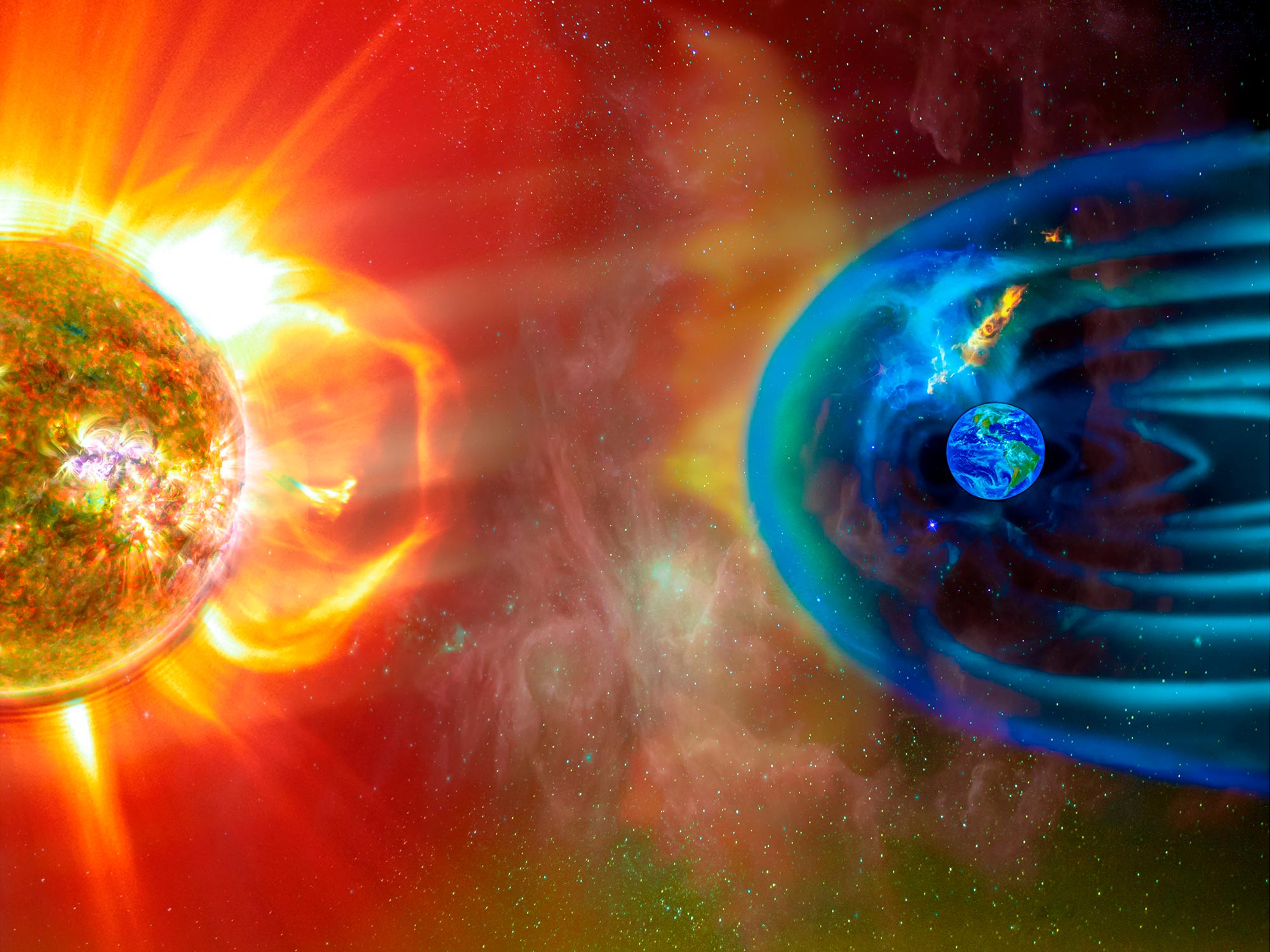
The research team emphasizes that this is not an earthquake prediction method, but proposes a physical path that starts with strong solar activity such as solar flares and eventually reaches the fragile zone of the earth's crust: Solar activity will rapidly change the distribution of charged particles in the ionosphere of the upper atmosphere, and this redistribution of ionospheric charge will change the propagation of Global Navigation Satellite System (GNSS) signals in the upper atmosphere. It is one of the important reasons why the scientific community continues to monitor the total electron content of the ionosphere.
Within the Earth's crust, the model focuses specifically on zones of highly fractured rock that can trap water at high temperatures and pressures and potentially create supercritical fluids. Researchers regard such damaged crustal areas as electrically active "capacitors" that are connected to the surface and the lower ionosphere through capacitive coupling to form an overall electrostatic system, rather than as separate layered structures.
During severe space weather events such as severe solar storms, the electron density in the ionosphere can increase significantly, creating a more electronegative layer structure at lower altitudes. The model proposes that this change in atmospheric charge will not just stay at high altitudes. Since the system is connected to each other through capacitance, changes in the ionospheric charge distribution can induce stronger electric fields in tiny gaps in the broken rocks of the earth's crust, and the scale can be refined to nanometer-scale pores.
Why is this process relevant to earthquakes? Studies have pointed out that pressure changes inside tiny cavities will affect the expansion and connection of cracks, especially when the fault zone is close to the critical state of instability. In the Kyoto team's calculations, this electrostatic pressure induced by an electric field can reach a magnitude comparable to other factors known to be weak but can affect fault stability, such as tidal forces and small gravitational stress changes.
Quantitative estimates show that this effect corresponds to a large perturbation in the total electron content of the ionosphere, especially when the total electron content increases by dozens of TEC units. The model shows that electrostatic pressure on the order of several megapascals may be generated in tiny gaps in the earth's crust. In a suitable geological environment, this range is sufficient to have mechanical significance and become a potential triggering factor for rupture instability.
Before the occurrence of several major earthquakes, the scientific community has repeatedly observed abnormal ionospheric phenomena, such as increased electron density, reduced ionospheric height, and abnormal propagation of mesoscale traveling ionospheric disturbances. In the past, these anomalies were often interpreted as a "result" of accumulation of crustal stresses coupling upward to affect the ionosphere, rather than as a "cause" that would backfire on the crustal rupture process.
The new model proposed this time provides an interactive framework: on the one hand, crustal processes may affect the ionosphere; on the other hand, perturbations in the ionosphere itself may feedback downward through electrostatic coupling, exerting additional tiny forces on the crust that is close to a critical state. This idea provides a physical explanation path that does not require "direct causality" for the existence of a certain relationship between space weather phenomena and seismic activity.
Some major earthquake cases in Japan in recent years, including the 2024 Noto Peninsula earthquake, are also discussed in the study as examples of temporal consistency with this mechanism: In these events, strong solar flare activity occurred shortly before the earthquake. The authors point out that the timing match does not prove direct causation, but is consistent with a scenario in which ionospheric perturbations act as additional triggers when the crust is already in a critical state.
By integrating concepts from plasma physics, atmospheric science, and geophysics, this model extends the traditional understanding of earthquakes as being dominated entirely by Earth's internal processes. The research results suggest that monitoring the ionospheric conditions and underground structures and stress states at the same time may help to gain a deeper understanding of the earthquake initiation mechanism and provide a new physical dimension for mid- to long-term earthquake risk assessment.
Future work will focus on using high-resolution GNSS ionospheric tomography data, combined with detailed space weather observations, to further clarify under what specific conditions ionospheric disturbances can produce significant electrostatic effects in the earth's crust, and to evaluate the applicability and importance of this mechanism in different tectonic environments around the world. The relevant research was titled "Possible mechanism of earthquakes triggered by ionospheric anomalies - the electrostatic coupling between the ionosphere and the earth's crust and the electric power generated inside the earth's crust" and was published in the "International Journal of Plasma Environmental Science and Technology" in February 2026.