J. Scott Davis, Assistant Vice President of Research at the Federal Reserve Bank of Dallas, published an article on February 24, 2026, stating that the impact of artificial intelligence on the labor market depends on whether it automates or enhances worker tasks. Early employment and wage data suggest AI may be doing both at the same time.
The distinction between codifiable knowledge (such as established information in a textbook) and tacit knowledge (understanding gained through experience) is crucial. If AI can replicate codifiable knowledge but not tacit knowledge, it will automate jobs that require codifiable knowledge but supplement jobs that require experiential tacit knowledge. This distinction further suggests that AI may replace entry-level workers but enhance the efforts of senior workers. In occupations where the impact of AI is significant, rising wages show a strong emphasis on workers’ tacit knowledge and experience.
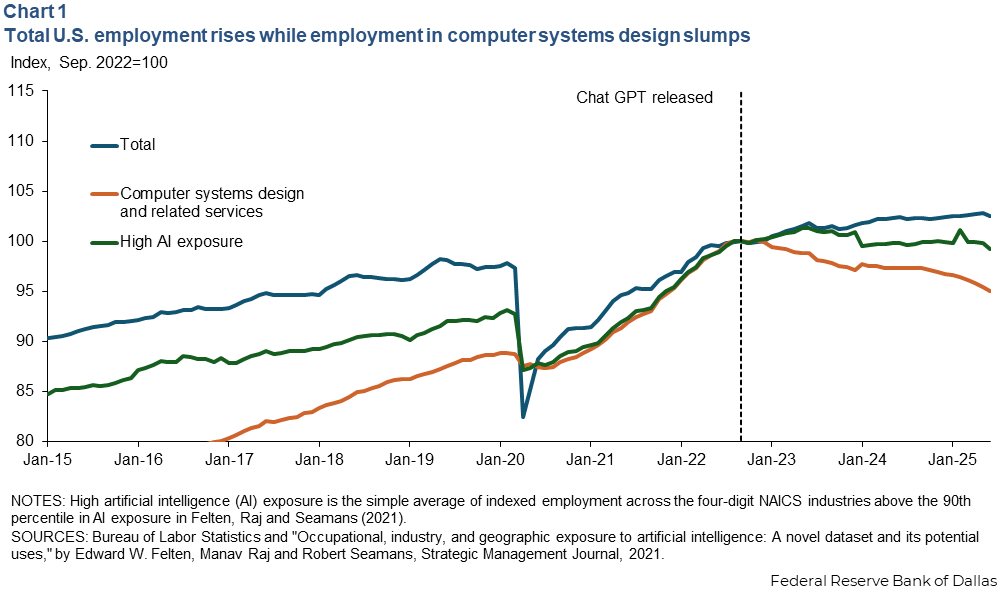
Since the release of ChatGPT in the fall of 2022, total employment in the United States has grown by approximately 2.5%, but employment in AI-exposed industries has lagged significantly behind. Employment in the computer systems design and related services industry fell by 5%, and employment in the 10% of industries most affected by AI fell by 1% overall, according to an index developed by Edward W. Felten, Manav Raj and Robert Seamans. This employment decline mainly affected younger workers under the age of 25, while employment of older workers did not decline. Stanford University researcher Erik Brynjolfsson and others pointed out that the decline in employment in AI-exposed industries is particularly targeted at young people. Previous analysis by Dallas Fed economist Tyler Atkinson showed that this is not due to layoffs, but due to the low employment rate of young job seekers, and new graduates facing a harsh workplace in AI-related fields.
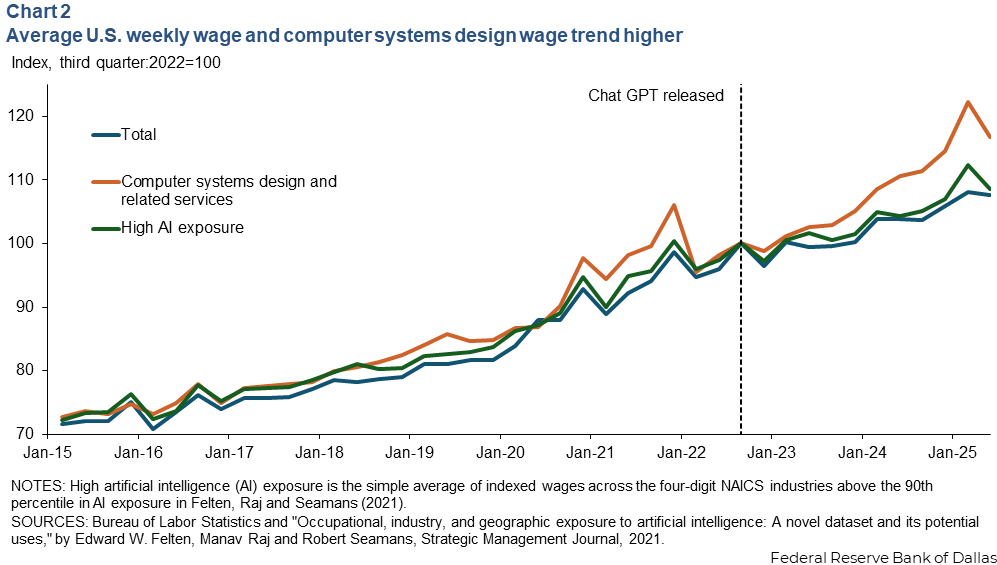
Although employment in AI-exposed industries lags behind, wage growth exceeds the national average. Since the fall of 2022, the national nominal weekly average wage has increased by 7.5%, with the computer system design industry increasing by 16.7%, and wages in the top 10% of industries exposed to AI increasing by 8.5%. An analysis of 205 occupations shows that AI exposure is not directly related to wage growth after 2022.
How to explain the phenomenon of declining employment but stable wages? If AI only automates jobs, both wages and employment should fall. Research by economist David Autor and others shows that enhanced patents increase labor demand, while automation patents reduce demand. AI can automate expert tasks for some jobs, rendering skills obsolete, or it can automate routine tasks for another job, allowing workers to focus on high-value activities. Brynjolfsson and others speculate that AI automation can encode knowledge (book learning), but cannot replicate experiential tacit knowledge. For junior employees, the codable tasks are the expert part; for senior employees, they are the low-end part, thereby replacing the newcomer but supplementing the veteran.
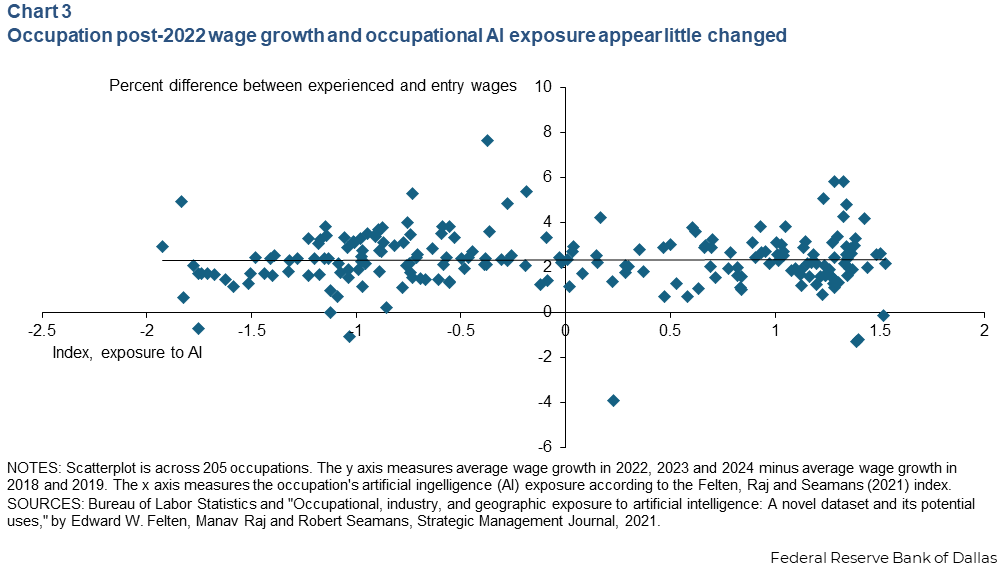
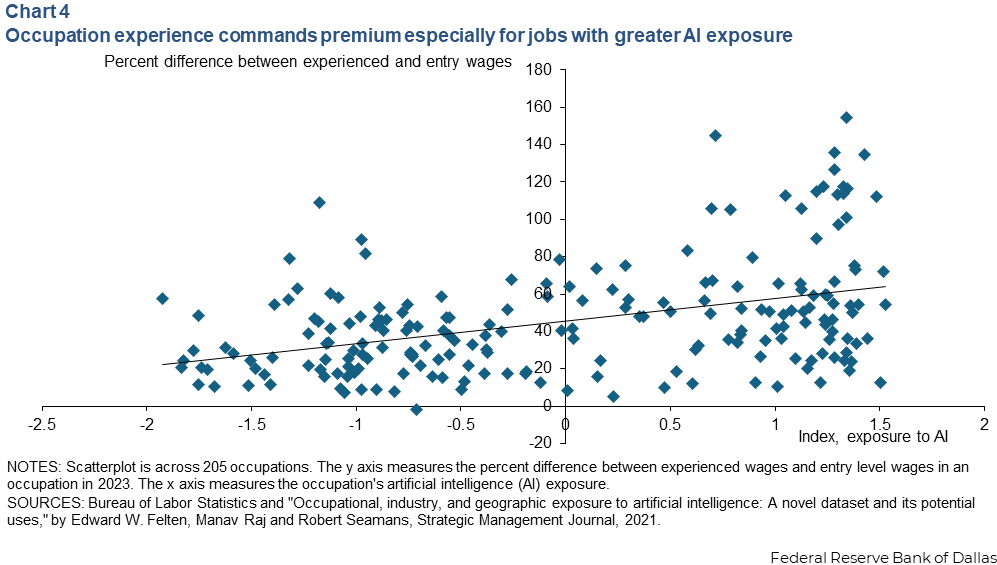
To assess an occupation's need for codifiable or tacit knowledge, Davis calculated the experience premium (the difference between senior and junior wages) using data from the U.S. Bureau of Labor Statistics. An analysis of 205 occupations shows that the experience premium is positively related to AI exposure. Highly exposed occupations usually have higher experience premiums, with a median of 40%, and lawyers, etc., have a higher experience premium of more than 100%. Regression analysis shows that for occupations with median experience premiums, AI exposure has a negligible impact on wage growth (-0.05 percentage points). Exposure to AI in low-experience-premium occupations (such as short-order chefs) caused wage growth to fall by 0.28 percentage points; in high-experience-premium occupations it rose by 0.2 percentage points, with AI replacing entry-level workers but supplementing senior workers.
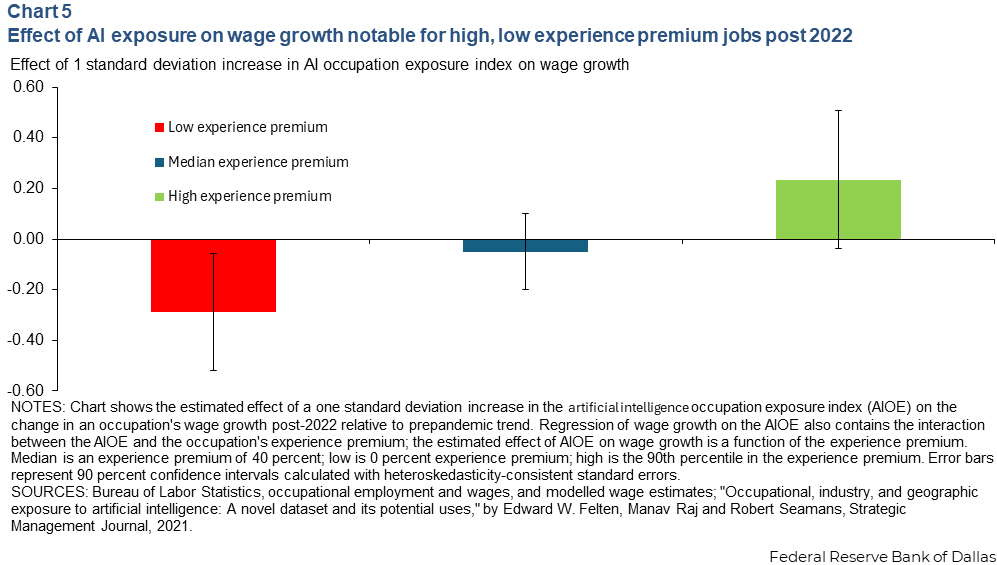
Young job seekers may face tough times as experience returns rise in AI-exposed careers. Senior workers, especially those in occupations with high experience premiums, do not seem to need to worry about mass unemployment because AI is more likely to supplement their tacit knowledge. This has profound consequences for society and the organization of work. The current white-collar career path is to go directly from school to entry-level positions to learn tacit knowledge, but AI makes training such employees expensive in the short term. In the long term, we need to rethink the way newcomers accumulate experience.