South Korean stocks plunged more than 12% on Wednesday, closing below 5,100 points, as investors grew increasingly worried about the economic impact of conflicts in the Middle East. The South Korean won also fell sharply against the U.S. dollar. The Korea Composite Stock Price Index (KOSPI) fell 698.37 points that day, or 12.06%, to close at 5093.54 points. The index fell 7.2% in the previous trading day.
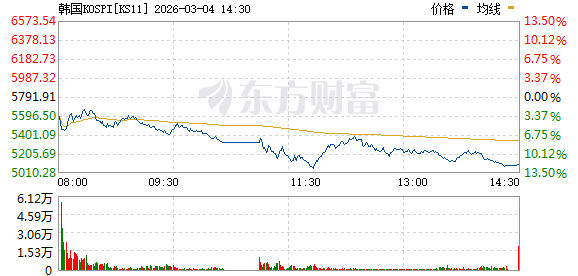
This was the largest one-day drop in the index's history, surpassing the previous record of 12.02% set on September 12, 2001 (after the "9/11" incident).
The Korea Exchange (KRX) activated a circuit breaker after KOSPI fell more than 8% in mid-day trading on Wednesday due to heightened geopolitical tensions.
Institutional investors sold a net 579.4 billion won (approximately US$393 million) worth of stocks that day, while foreign investors and retail investors bought a net 228.78 billion won and 72.9 billion won of stocks respectively.
The trading volume on the day was huge, reaching 1.6 billion shares, with a turnover of 62.6 trillion won (approximately US$42.5 billion). 908 stocks fell and only 12 stocks rose.
Most large-cap stocks closed sharply lower.
Market benchmark Samsung Electronics' stock price plummeted 11.74% to 172,200 won; its chip manufacturing competitor SK Hynix's stock price fell 9.58% to 849,000 won.
Hyundai Motor's share price fell 15.8% to 501,000 won; its smaller subsidiary Kia Motors' share price fell 14.04% to 156,700 won.
The share price of defense giant Hanwha Aerospace fell 7.61% to 1,323,000 won; the share price of leading oil refiner SK Innovation fell 16.73% to 109,000 won.
Korean Air's share price fell 7.94% to 23,200 won; leading shipping company HMM's share price plummeted 16.33% to 20,500 won.
"Market volatility is so extreme that prediction is almost impossible - and analysis doesn't help," said An Hyungjin, CEO of Billionfold Asset Management in Seoul. "Retail investors also seem to be hesitant, and buying has been fading since yesterday. Although we pick high-quality stocks and hedge, this is not an obvious investment opportunity."
The booming development of artificial intelligence (AI) has driven the Korean stock market to rise sharply, with the KOSPI index rising nearly 50% at its peak this year. However, as oil prices soar due to the Iran conflict, the prospect of easing monetary policy from the Federal Reserve is threatened, importers (South Korea is the world's eighth-largest crude consumer) are under pressure, and investors are reassessing overheated stock investments.
As of 3:30 pm local time (2:30 pm Beijing time), the Korean won exchange rate against the US dollar was at 1476.20, down 10.1 won from the previous trading day's closing price.