Qualcomm's latest Snapdragon X2 Elite Extreme processor has upgraded its specifications to an 18-core CPU, and its single-core and multi-core performance has been significantly improved.However, in a head-to-head confrontation with Apple's latest M5 series, this Windows notebook chip still failed to reverse its disadvantage. According to the latest running scores of Geekbench 6, the Snapdragon X2 Elite Extreme installed in the ASUS Zenbook 16 A16 model has a single-core score of 4033 and a multi-core score of 23198.
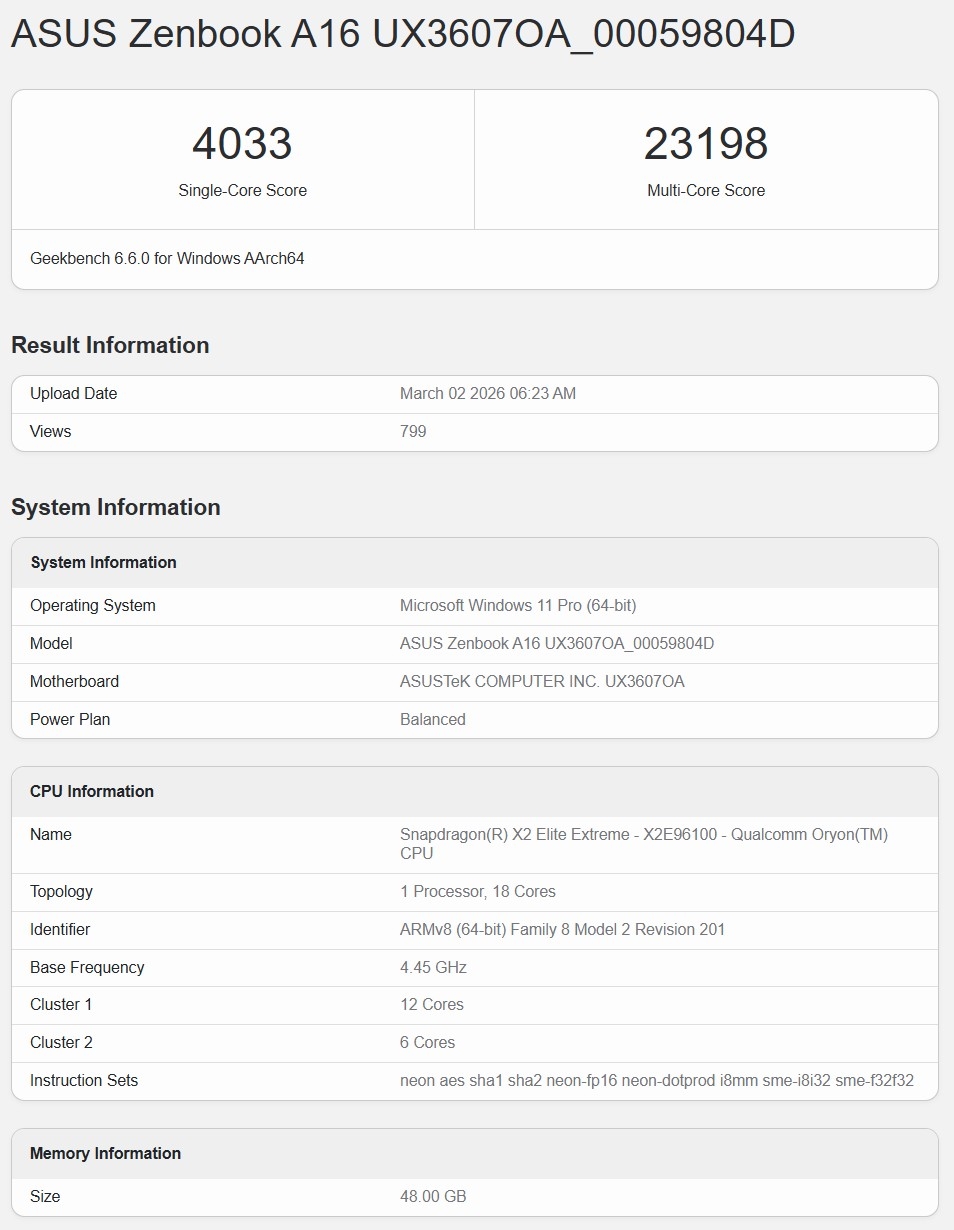
Although this result is a significant improvement compared to the previous generation, it still seems inadequate in the face of Apple's M5 Pro and M5 Max, and even failed to surpass the opponent's previous generation M4 Max chip.
The specific running scores of each chip are as follows:
Snapdragon X2 Elite Extreme (18-core CPU)
Single core score -4033
Multi-core score -23198
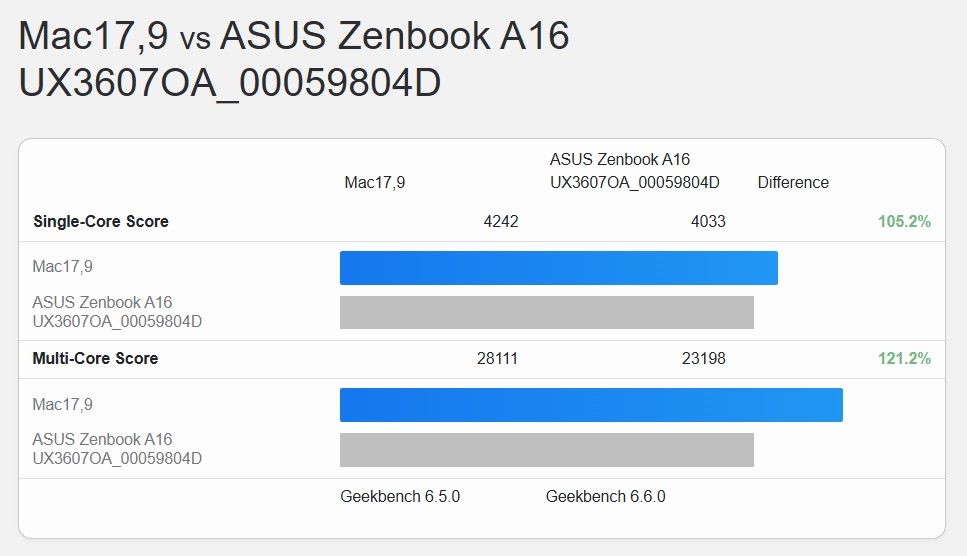
M5 Pro (18-core CPU)
Single-core score -4242 (M5 Pro is 5.2% faster than Snapdragon X2 Elite Extreme)
Multi-core score - 28111 (M5 Pro is 21.2% faster than Snapdragon X2 Elite Extreme)
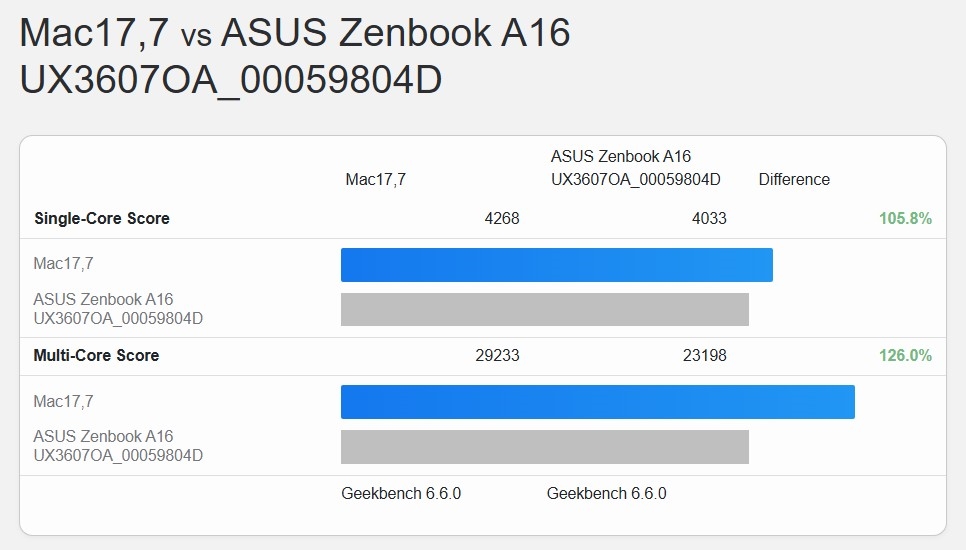
M5 Max (18-core CPU)
Single-core score -4268 (M5 Max is 5.8% faster than Snapdragon X2 Elite Extreme)
Multi-core score -29,233 (M5 Max is 26% faster than Snapdragon X2 Elite Extreme)
M4 Max (16-core CPU)
Single-core score -4049 (M4 Max is 0.40% faster than Snapdragon X2 Elite Extreme)
Multi-core score -26509 (M4 Max is 14.27% faster than Snapdragon X2 Elite Extreme)
Objectively speaking, Qualcomm is only in the second-generation product cycle in the field of customized notebook CPUs, while Apple's years of experience in the field of self-developed chips still create extremely high technical barriers. Qualcomm may still need to go through several generations of iterative accumulation of products.