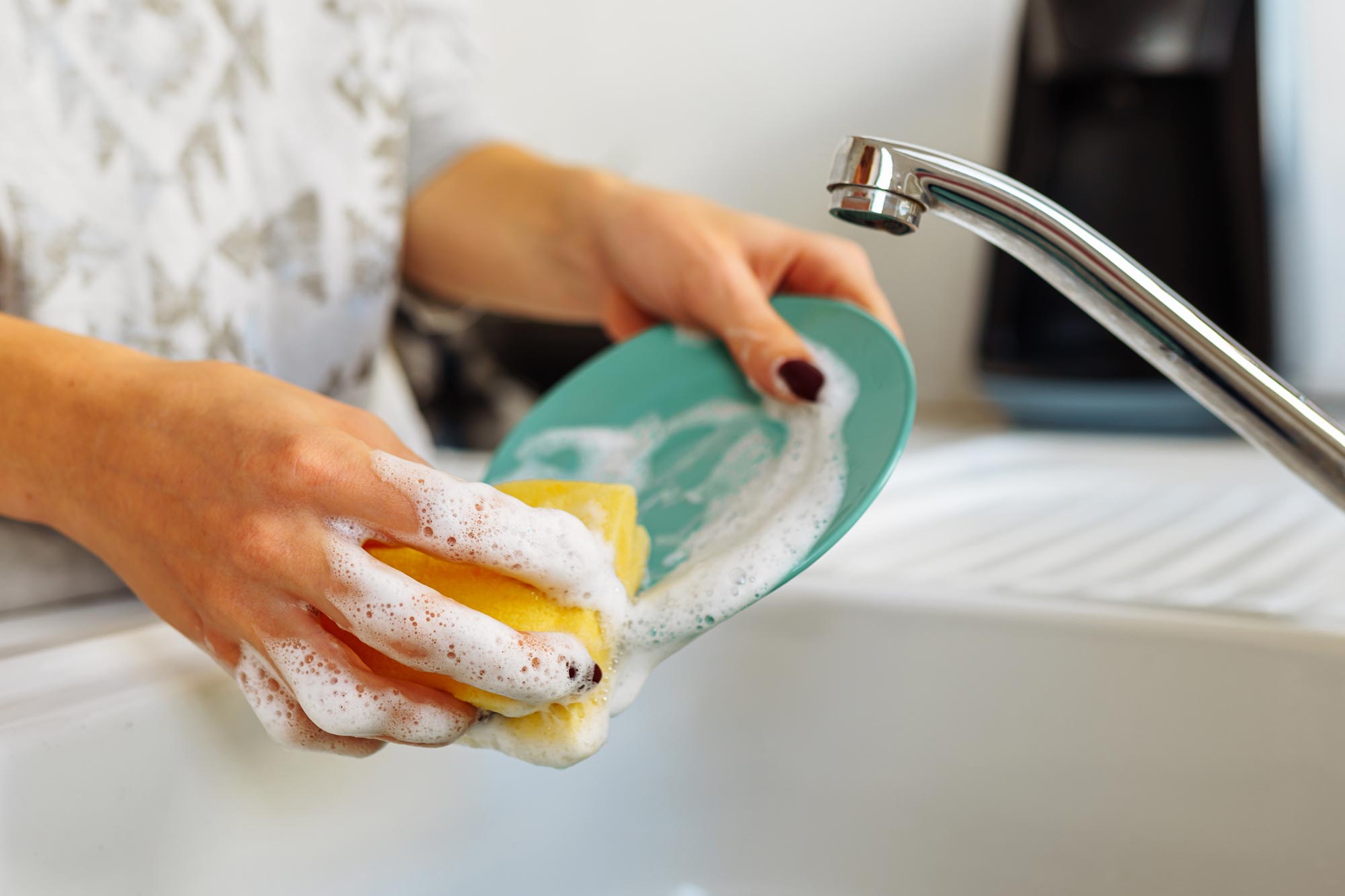
That seemingly inconspicuous dishwashing sponge next to the sink in every household is quietly releasing plastic particles into the environment. A new study led by the University of Bonn in Germany shows that kitchen sponges wear out and shed microplastics during daily scrubbing, but it is not this bit of plastic that dominates the overall environmental impact of dishwashing, but the large amount of water itself.
The research team pointed out that microplastics are now almost everywhere, and traces of them have been found in oceans, soil, air, and human drinking water and food. Studies have shown that microplastics can be ingested by wildlife and humans and may carry harmful chemicals or trigger inflammatory reactions in body tissues. However, there has been a lack of quantitative data on the specific contribution of many daily items to microplastic pollution, prompting researchers to focus on highly used kitchen sponges.
To assess the true scale of microplastic release from sponges, the researchers invited households in Germany and North America to participate in an experiment, asking them to use three different types of sponges during normal dishwashing habits. By comparing the weight change of each sponge before and after use, the team calculated the amount of wear and tear and estimated the mass of microplastics entering the sewer. At the same time, the lab also uses a custom-made device called a "SpongeBot" to simulate the physical pressure of daily scrubbing under controlled conditions to calibrate real-world scenarios with experimental data.
The results showed that all sponges, regardless of their material, gradually lost mass during use and released microplastics into the wastewater. According to calculations, the per capita annual emissions of different types of sponges range from approximately 0.68 grams to 4.21 grams, and sponges with lower plastic content also release relatively fewer particles. However, when the research team put this data into a more complete environmental impact assessment model, they found that the microplastic emissions from the sponge itself were not the "culprit."
Using real water behavior data from participating households, the researchers conducted a life cycle assessment of the entire dishwashing process. They found that from water use and heating to cleaning and discharge, water consumption accounts for the vast majority of the overall environmental load of dishwashing, with its contribution proportion being as high as 85% to 97%. In comparison, microplastics from sponge wear are only a small part of the overall ecological burden.
Nonetheless, microplastic release cannot be ignored on a national scale. The study estimates that if a particular type of sponge was used in households across Germany, the resulting microplastic emissions could reach up to 355 tons per year. Although sewage treatment plants can intercept a large number of particles, there are still tons of microplastics that end up in rivers, lakes or are deposited in sludge and soil. Researchers remind that this means that seemingly small individual emissions will still be transformed into environmental problems under the cumulative effect of population base and time.
An important feature of this study is the combination of “real-life scenarios” of citizen participation with standardized testing in the laboratory. The research team emphasizes that it is difficult to accurately capture the frequency, intensity and water consumption habits of people using sponges at home if they rely solely on laboratory equipment. By observing the dishwashing behavior of real households, the researchers were able to build a model that was closer to daily life, thus giving a more reliable estimate of the release of microplastics from kitchen sponges.
While giving quantitative results, the study also put forward a number of actionable emission reduction suggestions. First of all, the measure considered to be the most "immediate" is to reduce water consumption as much as possible when washing dishes, including turning off long-running water, concentrated rinsing and using more water-saving sprinklers or equipment. Second, consumers can choose sponges with lower plastic content or more durable materials to reduce wear and particle release. In addition, appropriately extending the service life of sponges and reducing the frequency of replacement while ensuring cleanliness and hygiene will also help reduce resource consumption and the environmental burden of the production process.
The related paper was published in the journal "Environmental Advances" on February 24, 2026, titled "From sink to sea: Microplastic release from kitchen sponges and potential environmental effects". The authors of the paper include Leandra Hamann, Christina Galafton, Peter T. Rühr, Alexander Blanke and Nils Thonemann. They hope that this quantitative chain of "sink to sea" can help the public and policymakers more comprehensively understand the sources of microplastics in life, and provide a more targeted basis for promoting water conservation and reducing plastic use.