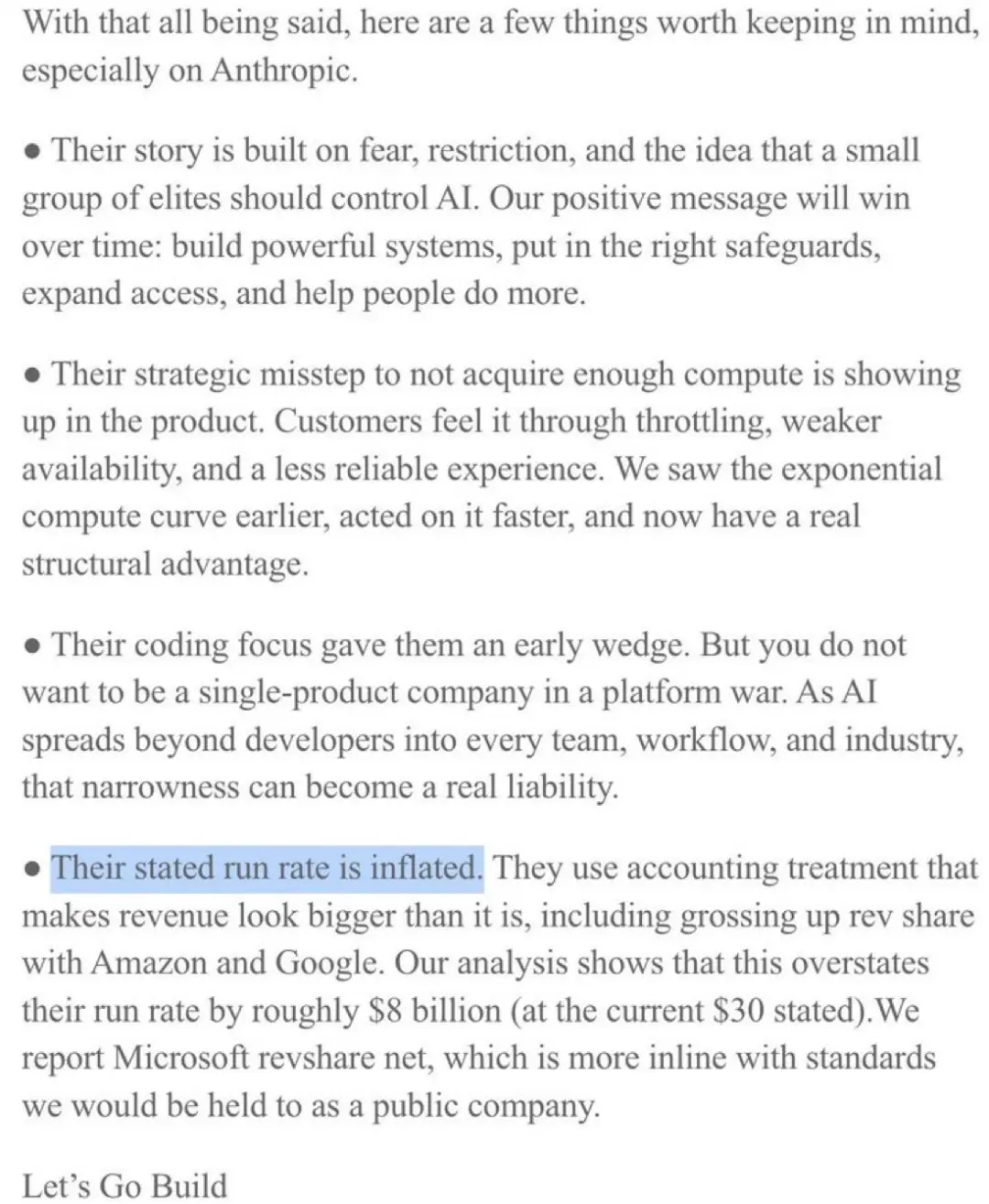
According to foreign media reports, OpenAI chief revenue officer Denise Dresser sent a four-page memo to employees, which mentioned Anthropic competition, insufficient computing power, and product strategy. The memo also mentions that Anthropic will include the commissions it distributes to Amazon and Google into its total revenue, thus increasing its book revenue figures.
The cause of the matter is that a week ago on April 7, Anthropic had just announced with a high profile that its annual revenue reached 30 billion U.S. dollars, successfully surpassing OpenAI’s 25 billion U.S. dollars.
And in terms of growth rate, it has surged 233% compared to US$9 billion at the end of 2025.
However, the memo stated that $8 billion of Anthropic’s annualized revenue was “inflated” through accounting processing, which means their annualized revenue should be $22 billion. No more than OpenAI’s $25 billion.
OpenAI’s accusations are not groundless, but point to a technical but crucial accounting issue.
According to the memo, Anthropic uses a "gross basis" when reporting revenue to handle revenue sharing with cloud service providers.
Specifically, when customers purchase Anthropic's services through cloud platforms such as AWS, Google Cloud or Azure, Anthropic counts the entire amount paid by the customer as its own revenue, including the portion that needs to be distributed to the cloud service provider.
In contrast, OpenAI uses the "net basis" to report its revenue share with Microsoft, and only counts the net income after deducting Microsoft's share into its own revenue.
The memo emphasized that this net method is "more consistent with the standards that listed companies should follow."
According to OpenAI's analysis, if the same accounting standards are used, Anthropic's true annual revenue should be around US$22 billion, not the US$30 billion it claims. This is how the "inflated revenue of US$8 billion" mentioned above comes from.
This difference of US$8 billion happens to be the share that cloud service providers take from it.
In the cloud service distribution model, platforms such as AWS and Google Cloud will draw a certain percentage of commission from the fees paid by customers.
For a company like Anthropic that relies heavily on cloud platform distribution, this amount is indeed considerable.
The memorandum also has a broader background, that is, Anthropic's private market valuation has reached approximately US$600 billion, a premium of more than 50% over the previous round of financing. OpenAI’s secondary market transaction valuation is approximately US$765 billion, which is a discount of approximately 10% from the previous round of financing.
Against this background, OpenAI chose to issue this strongly worded internal memo at this point in time, apparently hoping to stabilize internal morale and influence external market perception by questioning the credibility of competitors' data.
Don't worry, it's not over yet. There are many interesting things about this memo.
The memo stated that Anthropic's "not acquiring enough computing power was a strategic mistake," which resulted in customers encountering problems with current throttling, weak availability, and an unreliable experience when using Claude.
In contrast, OpenAI claims that it "saw the exponential growth curve of computing power demand earlier, acted faster, and now has a real structural advantage."
OpenAI claims it expects to have 30 gigawatts of computing power by 2030, while Anthropic expects only 7 to 8 gigawatts by the end of 2027.
In terms of product strategy, the memo mentioned that Anthropic is too focused on programming scenarios.
Although it helped it obtain the early market, this product could not help Anthropic win the platform war.
The memo mentioned that OpenAI is building a complete enterprise AI system, including ChatGPT for Work, Codex, API, Frontier agent platform, and Amazon chip environment, which can meet the needs of enterprises to enter from different entrances and expand to the full stack.
Enough about finance and strategy, it’s time for ideology.
"Their story is based on fear, limitations, and the idea that a small elite should control AI," the memo reads.
In February this year, Altman once commented on Anthropic, saying that the company was providing expensive products to the rich. OpenAI itself is an advocate of "democratized AI", making AI available to everyone.
On the same day that this war of words started, OpenAI did another very interesting thing.
On the same day, OpenAI acquired Hiro Finance, an AI financial application company.
According to Hiro Finance itself, the company’s original vision was to be an “AI personal CFO.”
Simply put, it is not an ordinary accounting software, but hopes to integrate users’ financial information scattered in bank accounts, investment accounts, budget tools and forms, and then use AI to help users with financial planning, net worth forecasts, cash flow analysis and major decision-making simulations.
For example, buying a house, changing jobs, taking a year off, whether to keep more cash, in the past, you might need a financial advisor, and then use Excel tables and repeated calculations to give an answer that is not necessarily reliable.
Hiro Finance hopes to turn this complicated and cumbersome process into a service that can provide answers in just one conversation. It mentioned on its official website that it has helped clients plan and manage more than $1 billion in assets.
After joining OpenAI this time, Hiro will no longer accept new user registrations, and the product will stop running on April 20. Existing users can export their data before May 13, after which personal data on Hiro's servers will be permanently deleted. Hiro also emphasized that users’ personal data will not be shared with OpenAI.
The amount of the deal was not disclosed, and OpenAI has not yet stated which specific product line the Hiro team will enter next.
OpenAI is actually making up for its own "life scenes". ChatGPT already has chat, search, programming, office and enterprise portals, but if it wants to become a true personal assistant, it cannot only answer questions, but also understand people's long-term goals, asset status, risk preferences and realistic constraints.
Finance just has the ability to check. It requires natural language interaction, verifiable calculations, strong privacy protection and a high enough trust threshold.
More importantly, there is a clear willingness to pay behind personal finance. Users can pay for chatting or programming, but if AI can really help people judge how to spend money and how to manage assets, then it will not just be a "smarter search box", but closer to a personal advisor.
OpenAI's acquisition of Hiro Finance is not necessarily to insert this product into ChatGPT intact.
They may be looking to get someone who understands financial products, user trust, and verifiable computing. While Anthropic is stuck in enterprise and programming, OpenAI wants to provide a universal entrance covering work, life and wealth management.
However, the financial scene is most afraid of miscalculations and overstepping boundaries. Accuracy, compliance and trust are the real issues with this small acquisition.