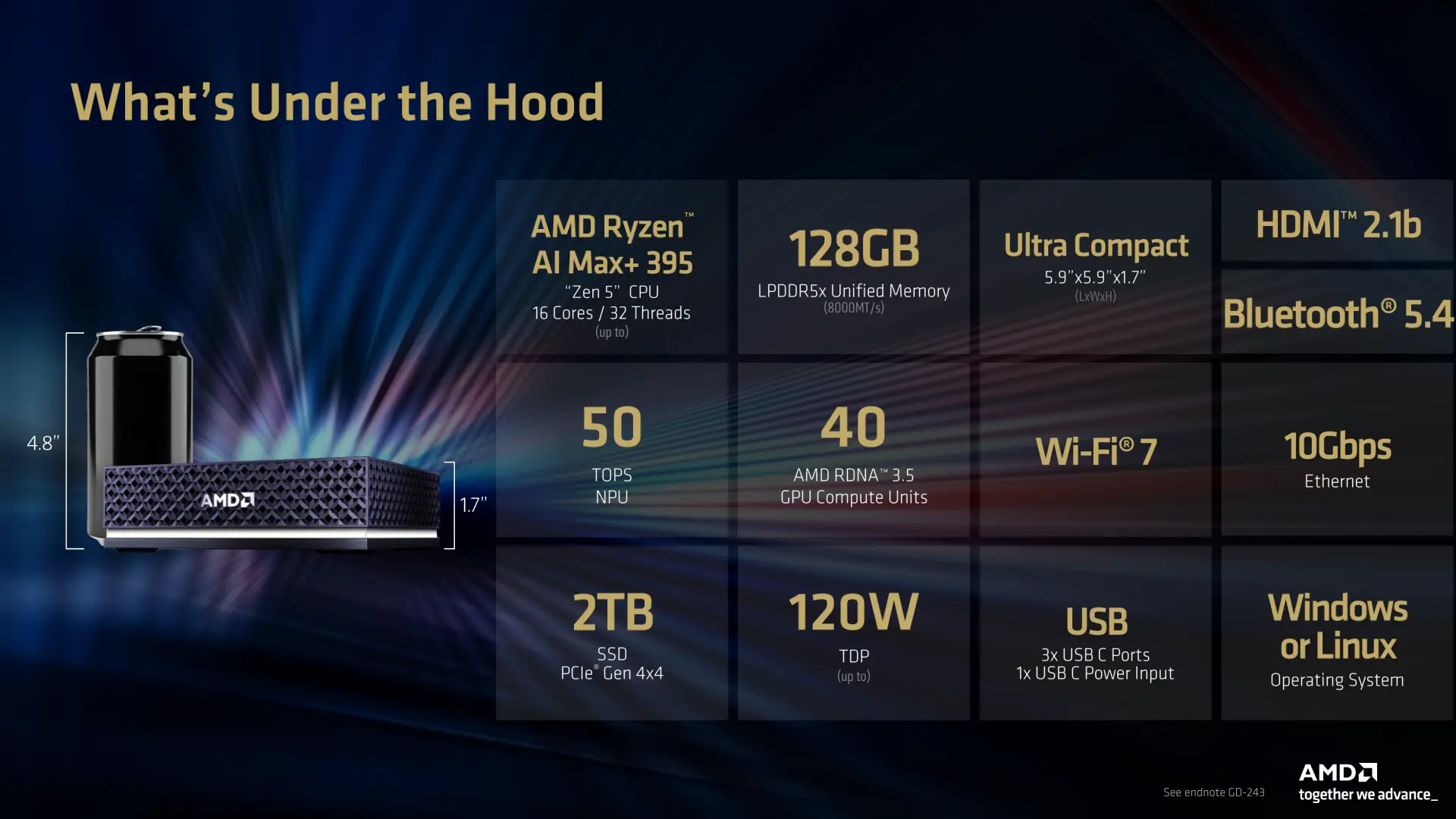
AMD recently officially released the new local AI computing platform Ryzen AI Halo, which is aimed at developers and creators who want to run large models locally. The whole machine is priced at approximately US$3,999, equipped with up to 128GB of memory, and comes pre-installed with a complete AI development and operating environment. It focuses on ready-to-use local AI solutions.
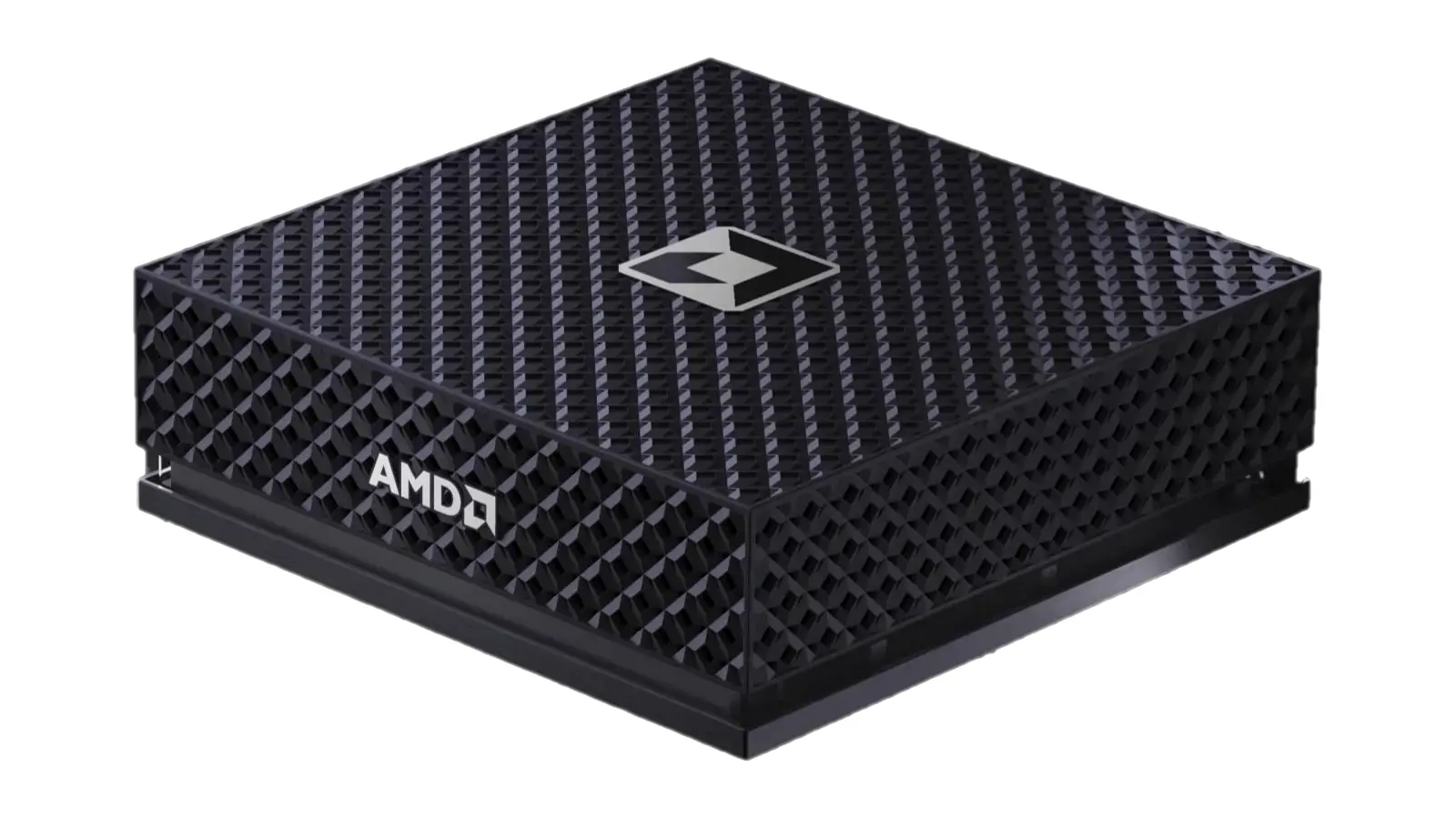
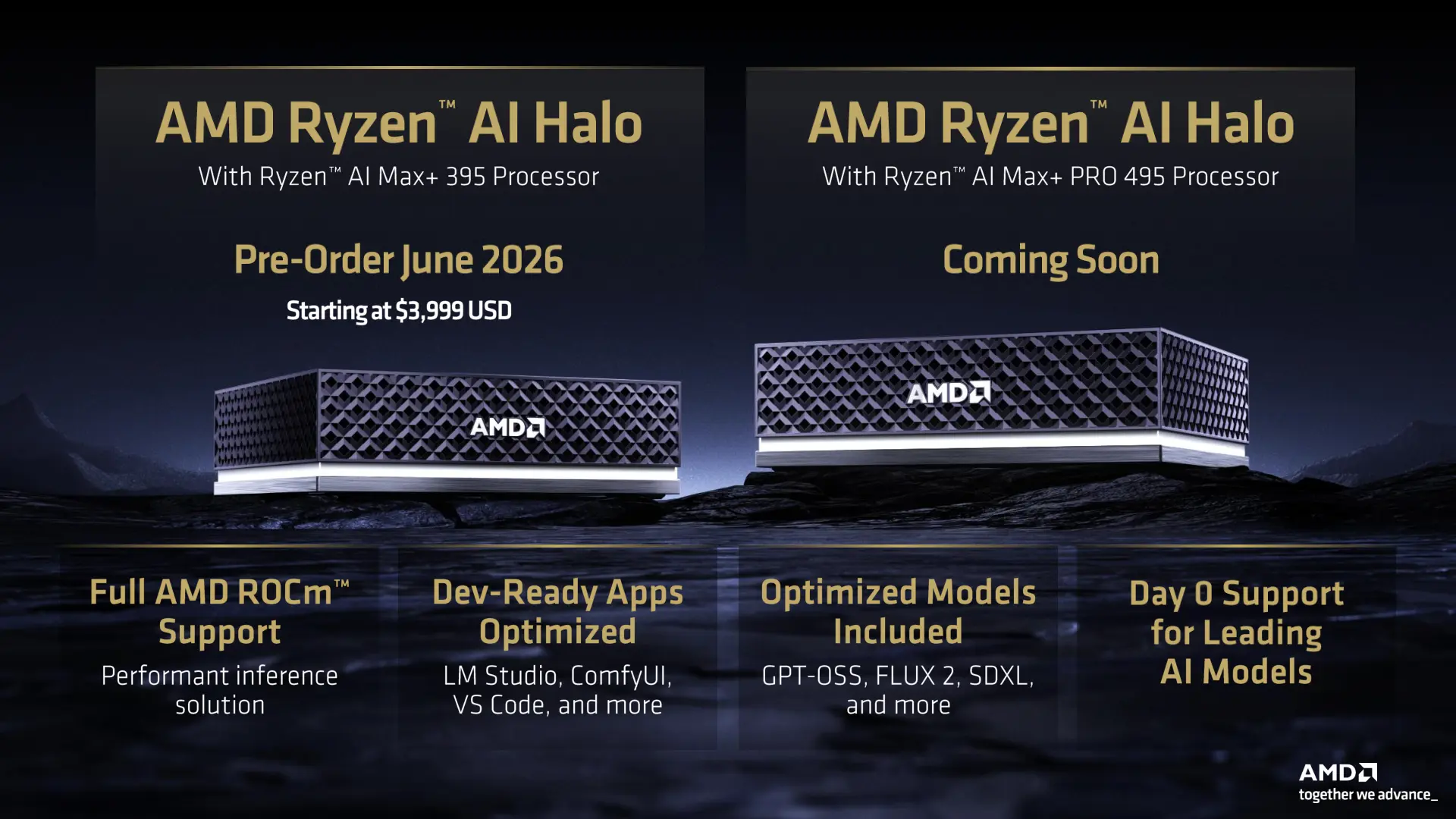
AMD pointed out that many developers and advanced users currently face problems such as complex hardware selection, fragmented software stacks, and confusing tool chains when building a local AI environment. It is difficult to obtain a simple, plug-and-play local AI working platform. To this end, the Ryzen AI Halo platform is packaged and integrated at both the hardware and software ends: On the software side, AMD relies on its own open computing platform ROCm to provide out-of-the-box high-performance optimization and support for mainstream cutting-edge models (SOTA models). At the same time, the new Ryzen AI Development Center is launched to provide centralized feature entry, tools and update management. Officials stated that 5 Playbooks are preset in the platform, and 10 additional Playbooks are available online to guide the construction and optimization of AI applications in different scenarios.
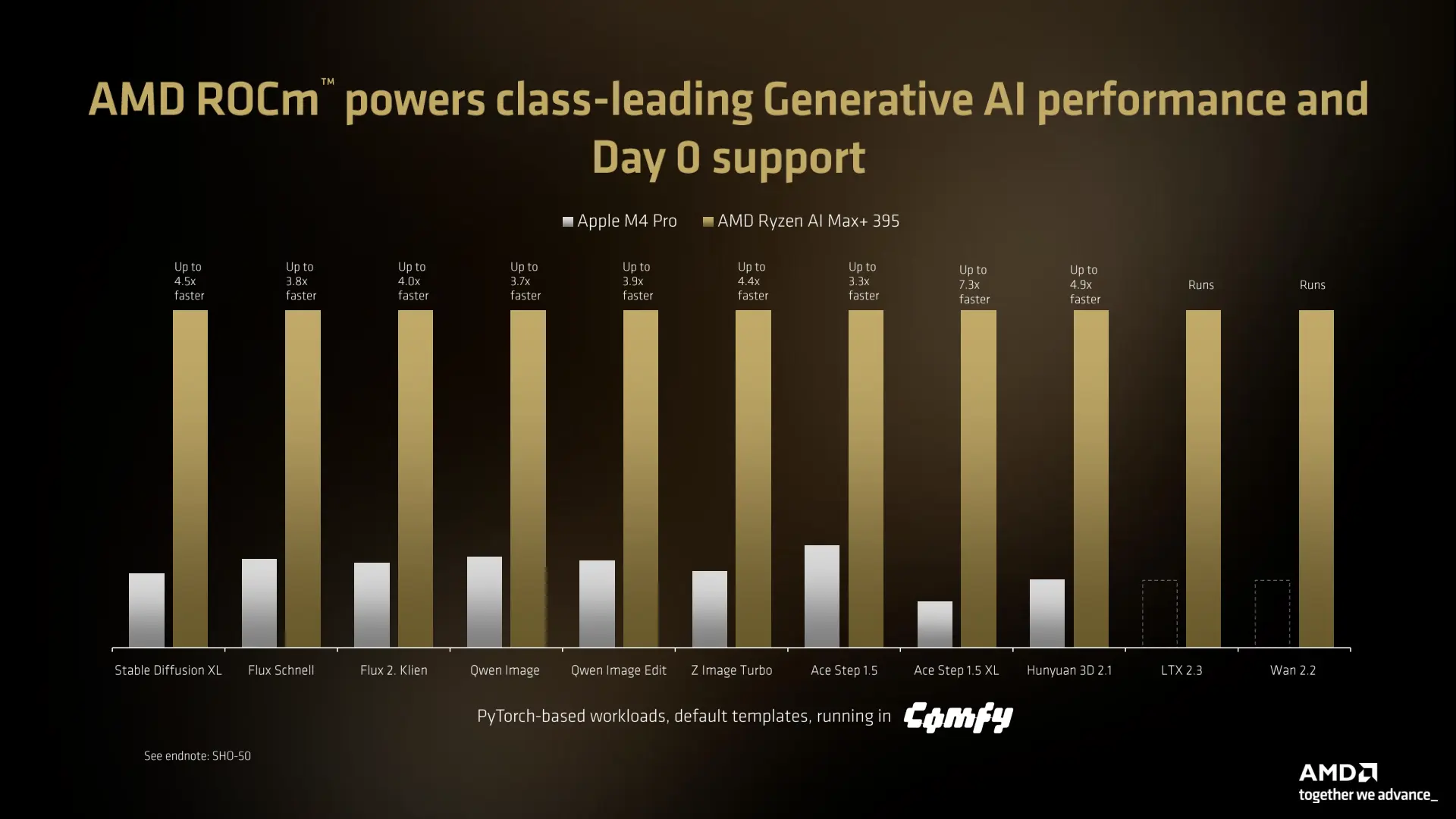
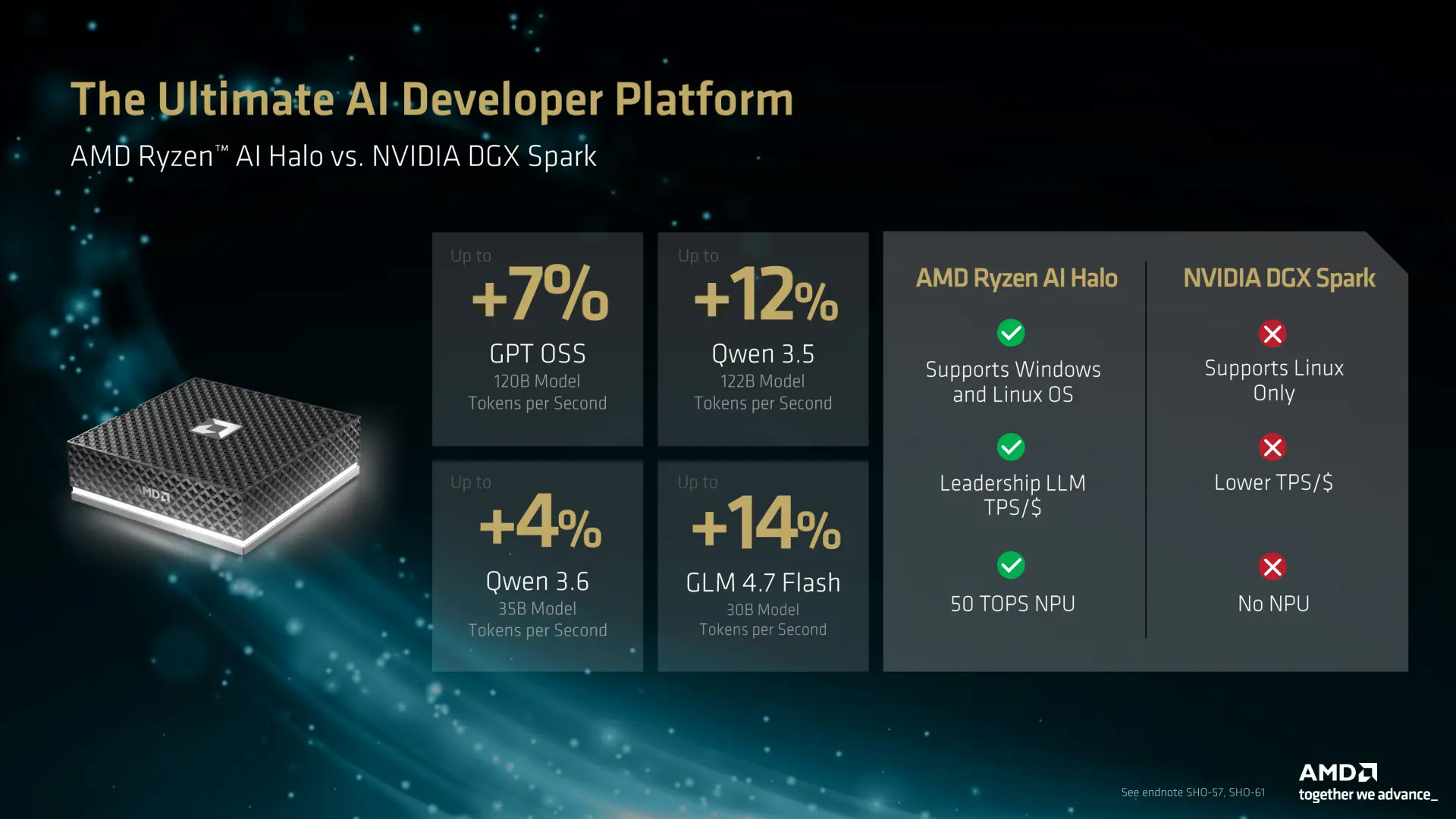
ROCm was updated to version 7.2 earlier this year, bringing significant performance and feature improvements to Linux and Windows systems, which also laid the software foundation for Ryzen AI Halo. In terms of system support, AMD emphasized that Ryzen AI Halo is currently the only such native AI device specifically built for Microsoft desktop operating systems, and compared it with Nvidia DGX Spark, which only supports Linux. In a comparison based on tokens processed per dollar (TPS/USD), AMD claims that Ryzen AI Halo can achieve up to a 14% performance/cost advantage under ideal conditions, and can maintain a lead of approximately 4% even in the most adverse scenarios.
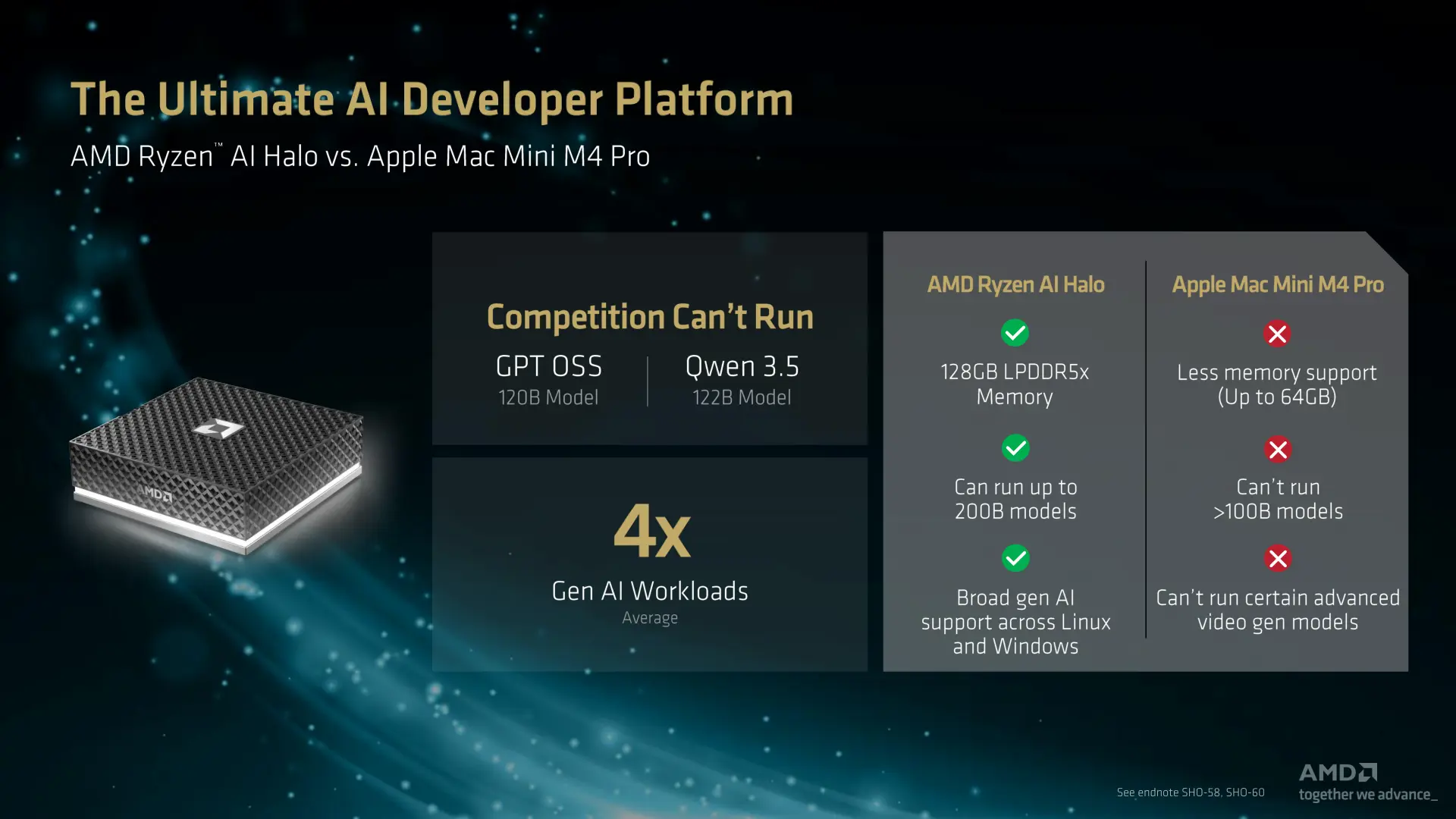
In terms of comparison with the Apple ecosystem, benchmark data provided by AMD shows that in generative AI tasks (such as text, image, etc. generation), Ryzen AI Halo can improve the average performance by about 4 times compared to Apple Mac Mini M4 Pro. In addition, in terms of the scale of supported models, Ryzen AI Halo can run large models with up to 200 billion parameters, while the Mac Mini M4 Pro is considered difficult to handle models with more than 100 billion parameters. AMD particularly emphasized that for content creators, the platform can more easily generate multimedia content such as AI music and videos locally without relying heavily on cloud computing power.
AMD also gave detailed data in terms of energy efficiency and long-term costs. Compared with Radeon AI Pro 9700, the Ryzen AI Max+ 395 APU equipped in Ryzen AI Halo consumes significantly less energy per unit of token processing: taking the Qwen 3.6 35B model as an example, the token throughput of Ryzen AI Max+ 395 is about 68 TPS, while the Radeon AI Pro 9700 is about 160 TPS. TPS, under corresponding configurations and scenarios, the former has more obvious comprehensive advantages in terms of overall platform cost and long-term operating expenses. AMD demonstrated by measuring the average daily Token usage of 18 million that in high-intensity, long-term use scenarios, Ryzen AI Halo has the potential to save users "extremely considerable" total cost of ownership.
According to reports, the first version is the Ryzen AI Halo model equipped with Ryzen AI Max+ 395. It is planned to start pre-orders in June 2026, priced at US$3,999, and is aimed at professional users who need to perform local large model inference and multi-modal creation on Windows 11. At the same time, AMD also previewed the next generation platform: a new version of Ryzen AI Halo based on Ryzen AI Max+ PRO 495, which is expected to be launched in the third quarter of 2026. It is expected to be further upgraded in terms of computing power, energy efficiency and model compatibility, bringing a new round of competition to the local AI computing market.